• Research
  • Emissary
  • About
  • Experts
Carnegie Global logoCarnegie lettermark logo
DemocracyIran
  • Donate
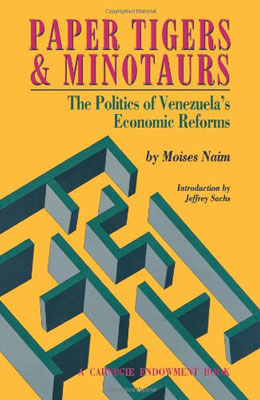
Paper Tigers and Minotaurs: The Politics of Venezuela's Economic Reforms
Book

Paper Tigers and Minotaurs: The Politics of Venezuela's Economic Reforms

Weakened public institutions, military reform, and public opinion in the face of rapid change have opened the door for corruption, inequitable distribution of burdens, and political instability in South America. Countries in the region are facing painful and sometimes dangerous reform.

Link Copied
By Moisés Naím
Published on Jan 1, 1993

Additional Links

Paperback - $5.95

Source: Washington

Based on Moisés Naím's experiences as Minister of Industry in rapidly changing Venezuela and as Executive Director at the World Bank, this book raises questions and explores problems crucial to political and economic reform. Dr. Naím grapples with entrenched interests bent on derailing reform, the corrosive effects of corruption, the inequitable distribution of burdens, political instability brought on by weakened public institutions, military reform, and public opinion in the face of rapid change. After the revolutionary political and economic changes of the 1980s and early 1990s, the countries of South America—and many other countries all over the world—are facing painful and sometimes dangerous reform. Dr. Naím's book tackles the subject of managing that reform.

Advance Praise

“This book is a timely and relevant contribution for rethinking both the content and the process of future reform attempts.”
—Miriam Kornblith, Universidad Central de Venezuela

“The story is well-told and the lessons valuable for those interested in under-standing, as well as making, economic policy."
—Robert Grosse, University of Miami

About the Author

Moisés Naím

Distinguished Fellow

Moisés Naím is a distinguished fellow at the Carnegie Endowment for International Peace, a best-selling author, and an internationally syndicated columnist.

    Recent Work

  • Research
    The World Reacts to Biden’s First 100 Days
      • +10

      Rosa Balfour, Frances Z. Brown, Yasmine Farouk, …
  • Commentary
    View From Latin America

      Moisés Naím

Moisés Naím
Distinguished Fellow
Moisés Naím
North AmericaSouth AmericaTrade

Carnegie does not take institutional positions on public policy issues; the views represented herein are those of the author(s) and do not necessarily reflect the views of Carnegie, its staff, or its trustees.
More Work from Carnegie Endowment for International Peace

  • Article
    Continental Asia and the Rise of Portfolio Politics

    Continental Asia—the overland space from Türkiye to China—has emerged as a critical geopolitical arena, yet receives less attention than its maritime counterpart, the Indo-Pacific. While Continental Asian states are cast as objects of great power competition, they are exhibiting growing agency through “portfolio politics”: strategically diversifying partnerships across sectors to pursue national goals.

      Jennifer B. Murtazashvili

  • Trump and others walking down a red carpet, with Air Force One in the background
    Commentary
    Emissary
    “China Doesn’t Do Anything for Free”

    Why the outcomes of the U.S.-China meetings may be limited.


      Aaron David Miller, David Rennie

  • Construction site
    Commentary
    Emissary
    The Iran War Isn’t the Only Challenge Facing Saudi Arabia’s Vision 2030

    As the monarchy appears to question its grandest projects, the state could do with more critical debate than rote cheerleading.

      • Andrew Leber

      Andrew Leber

  • Commentary
    Carnegie Politika
    Could the Iran War Push Japan to Restore Russian Oil Imports?

    Tokyo would have to surmount a lot of obstacles—not least Western sanctions—if it wanted to return Russian oil imports to even modest pre-2022 volumes.

      Vladislav Pashchenko

  • Article
    Governing AI in the Shadow of Giants: Korea’s Strategic Response to Great Power AI Competition

    In its version of an AI middle power strategy, Seoul is pursuing alignment with the United States not as an endpoint but as a strategy to build industrial and geopolitical leverage. Whether this balance holds remains an open question.

      Darcie Draudt-Véjares, Seungjoo Lee

Get more news and analysis from
Carnegie Endowment for International Peace
Carnegie global logo, stacked
1779 Massachusetts Avenue NWWashington, DC, 20036-2103Phone: 202 483 7600
  • Research
  • Emissary
  • About
  • Experts
  • Donate
  • Programs
  • Events
  • Blogs
  • Podcasts
  • Contact
  • Annual Reports
  • Careers
  • Privacy
  • For Media
  • Government Resources
Get more news and analysis from
Carnegie Endowment for International Peace
© 2026 Carnegie Endowment for International Peace. All rights reserved.