• Research
  • Emissary
  • About
  • Experts
Carnegie Global logoCarnegie lettermark logo
DemocracyIran
  • Donate
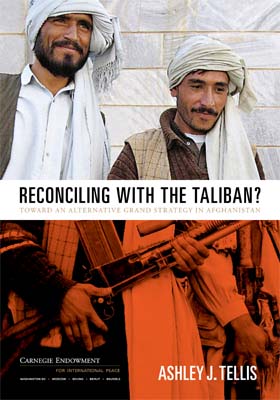
Reconciling With the Taliban?: Toward an Alternative Grand Strategy in Afghanistan
Report

Reconciling With the Taliban?: Toward an Alternative Grand Strategy in Afghanistan

Negotiating with the Taliban is the worst possible approach the U.S. could adopt in its effort to stabilize Afghanistan. Instead, the U.S. must signal long-term commitment to rebuilding the nation.

Link Copied
By Ashley J. Tellis
Published on Apr 13, 2009

Additional Links

Full Text
Program mobile hero image

Program

South Asia

The South Asia Program informs policy debates relating to the region’s security, economy, and political development. From strategic competition in the Indo-Pacific to India’s internal dynamics and U.S. engagement with the region, the program offers in-depth, rigorous research and analysis on South Asia’s most critical challenges.

Learn More

Negotiating with the Taliban—who are convinced military victory is within sight—is the worst possible approach to stabilizing Afghanistan, and one that would fail. Ashley J. Tellis warns that U.S. signals of impatience and a desire for an early exit could motivate insurgents to maintain a hard line and outlast the international coalition. Though costly, a long-term commitment to building an effective Afghan state is the only way to achieve victory and defend U.S. national security objectives.

Key Conclusions:

  • Negotiation with the Taliban is premature and unnecessary. Afghan stability can be achieved through a concerted modification of current military and political strategy—sustaining commitment from Washington, returning to successful counterinsurgency operations, and improving Afghan governance.
     
  • A lasting peace in Afghanistan and defeat of the Taliban can only come from a political-military victory that diminishes the rewards for continued resistance. The Taliban’s leadership does not want conciliation. Initiating unwanted negotiations could exacerbate ethnic fissures in Afghanistan, signal weakness or defeat in Washington and Kabul, and ultimately renew civil war.
     
  • The United States must reaffirm the goal of building a democratic and stable Afghan state. Counterterrorism and state-building are not mutually exclusive. Washington cannot fight al-Qaeda and its allies in Afghanistan and Pakistan without supporting the creation of an effective and responsive regime in Kabul.
     
  • Although counterterrorism cooperation by Pakistan is desirable for U.S. success in Afghanistan, American goals in Afghanistan can be—and if necessary must be—attained without Islamabad’s assistance.
     
  • Portending coalition defeat in the “graveyard of empires” is an inadequate analogy. Neither the British nor Soviet experience mimics the current situation. Military superiority aside, the U.S. presence in Kabul is seen less as occupation than support for the Afghan people, much to its advantage. The Afghan public, by a margin of 82 percent to 4 percent, oppose the Taliban and desperately seek success from Western military forces.
     
  • President Obama’s recently announced “Af-Pak” strategy is courageous and responsible, but still incomplete. The administration needs to commit to building a democratic Afghan state, persevering in Afghanistan over the long term, deploying additional U.S. resources and troops, correct command and control deficiencies, and enlarging the size of Afghanistan’s national security forces, among other things.  


Tellis explains:


“Mullah Omar and the Taliban leadership have decisively rejected any reconciliation with the government of Afghanistan. And the tribal chiefs, village elders, and street fighters, who either
support the insurgency or are sitting on the sidelines currently but are susceptible to being reconciled in principle, certainly will not take any steps in that direction so long as the Karzai regime, and its Western supporters, are not seen to be winning in their long-running battle against the Taliban. The coalition, therefore, is confronted by an inescapable paradox: any meaningful accommodation with those reconcilable segments of the rebellion will only come at the tail end of political-military success in Afghanistan and not as a precursor to it; yet, if such success is attained, reconciliation will become possible but, ironically, when it is least necessary.”

About the Author

Ashley J. Tellis

Former Senior Fellow

Ashley J. Tellis was a senior fellow at the Carnegie Endowment for International Peace.

    Recent Work

  • Paper
    Multipolar Dreams, Bipolar Realities: India’s Great Power Future

      Ashley J. Tellis

  • Commentary
    India Sees Opportunity in Trump’s Global Turbulence. That Could Backfire.

      Ashley J. Tellis

Ashley J. Tellis
Former Senior Fellow
South AsiaAfghanistanForeign Policy

Carnegie does not take institutional positions on public policy issues; the views represented herein are those of the author(s) and do not necessarily reflect the views of Carnegie, its staff, or its trustees.

More Work from Carnegie Endowment for International Peace

  • Commentary
    Strategic Europe
    How to Join the EU in Three Easy Steps

    Montenegro and Albania are frontrunners for EU enlargement in the Western Balkans, but they can’t just sit back and wait. To meet their 2030 accession ambitions, they must make a strong positive case.

      Dimitar Bechev, Iliriana Gjoni

  • Article
    Leveraging Internal Security Cooperation with Vietnam Offers a Glimpse of Future Chinese Diplomacy with Southeast Asia

    Despite long-standing differences, China and Vietnam are reinforcing common ground for collaboration, especially in public security. This internal security–centered diplomacy offers a strengthened road map for how China moves forward with Southeast Asia.

      Sophie Zhuang

  • Aerial shot of island community
    Commentary
    One Year After the Great Aid Recession, Investments in Climate Mobility Offer Cost-Effective Returns

    Climate mobility interventions can vary, but they all present opportunities to unlock transformative results that mitigate costs associated with inaction.

      • Alejandro Rodriguez

      Alejandro Martin Rodriguez

  • Man standing next to a pile of burned cars
    Commentary
    Emissary
    The Myriad Problems With the Iran Ceasefire

    Four Middle East experts analyze the region’s reactions and next steps.

      • Andrew Leber
      • Eric Lob
      • +1

      Amr Hamzawy, Andrew Leber, Eric Lob, …

  •  A machine gun of a Houthi soldier mounted on a police vehicle next to a billboard depicting the U.S. president Donald Trump and Mohammed Bin Salman, the Crown Prince and Prime Minister of Saudi Arabia, during a protest staged to show support to Iran against the U.S.-Israel war on March 27, 2026 in Sana'a, Yemen.
    Collection
    The Iran War’s Global Reach

    As the war between the United States, Israel, and Iran continues, Carnegie scholars contribute cutting-edge analysis on the events of the war and their wide-reaching implications. From the impact on Iran and its immediate neighbors to the responses from Gulf states to fuel and fertilizer shortages caused by the effective shutdown of the Strait of Hormuz, the war is reshaping Middle East alliances and creating shockwaves around the world. Carnegie experts analyze it all.

Get more news and analysis from
Carnegie Endowment for International Peace
Carnegie global logo, stacked
1779 Massachusetts Avenue NWWashington, DC, 20036-2103Phone: 202 483 7600Fax: 202 483 1840
  • Research
  • Emissary
  • About
  • Experts
  • Donate
  • Programs
  • Events
  • Blogs
  • Podcasts
  • Contact
  • Annual Reports
  • Careers
  • Privacy
  • For Media
  • Government Resources
Get more news and analysis from
Carnegie Endowment for International Peace
© 2026 Carnegie Endowment for International Peace. All rights reserved.