

Q&A
- +1
Amr Hamzawy, Andrew Leber, Eric Lob, …
{
  "authors": [
    "Marwan Muasher"
  ],
  "type": "legacyinthemedia",
  "centerAffiliationAll": "dc",
  "centers": [
    "Carnegie Endowment for International Peace",
    "Malcolm H. Kerr Carnegie Middle East Center"
  ],
  "collections": [],
  "englishNewsletterAll": "menaTransitions",
  "nonEnglishNewsletterAll": "",
  "primaryCenter": "Carnegie Endowment for International Peace",
  "programAffiliation": "MEP",
  "programs": [
    "Middle East"
  ],
  "projects": [],
  "regions": [
    "Middle East",
    "Israel",
    "Palestine",
    "Levant"
  ],
  "topics": [
    "Security",
    "Foreign Policy"
  ]
}
Source: Getty
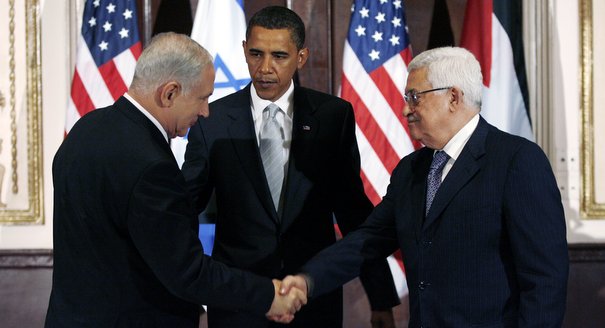
Washington needs to work privately with all the parties—Palestinians, Israelis, and Arabs—to allow for a speedy negotiation process. Only the full backing of the U.S. president and a bold new plan can push the peace process forward.
Source: Foreign Policy
Two recent developments have made many wonder whether the moribund Arab-Israeli peace process is being revived -- and, if so, to what end. The first is that U.S. Secretary of State John Kerry said on April 17 what most pundits have been saying for quite some time: that there may only be two years left to reach a two-state solution. The second is that a few days later, a group of Arab foreign ministers publically announced that the Arab Peace Initiative, a comprehensive regional peace plan first proposed by Saudi Arabia in 2002, did not foreclose minor adjustments to the 1967 borders between Palestine and Israel.
This flexibility was hailed as a major development by Kerry and some now believe that a major U.S. initiative may be in the offing to try to solve the conflict before the chance for a two-state solution is, in Kerry's words, "over."
As an original co-author of the Arab Peace Initiative and someone who has been involved in several earlier efforts to solve the conflict, I'm skeptical. Ten years have passed since the Arab League adopted the initiative, but American unwillingness to go beyond lip service and outright opposition by the Israeli government have prevented any real progress. Now, we have almost run out of time for the Arab Peace Initiative to succeed.Another move to start a peace process based on incrementalism won't produce an acceptable outcome. As Israeli settlement activity continues to eat away at the possibility of a viable Palestinian state, Arabs today liken any incremental process to two people arguing over a slice of pizza, while one of them is eating it.
Instead, it has been clear for some time that progress will require the United States to sidestep the never-ending process and offer parameters of its own -- parameters that can be used as terms of reference by both parties and then turned into an agreement within a reasonable period of time.
There is little reason to doubt Kerry's sincerity or commitment to moving the peace process forward.
But important preconditions for constructive negotiations are simply not in place. Until they are, a resolution might not just remain elusive, but also soon become impossible.
First, it's unclear whether the parties themselves are looking for an opening. Israeli Prime Minister Benjamin Netanyahu has only declared interest in negotiations without prior conditions. In the past, he has repeatedly used this tactic to prolong the peace process while new facts develop on the ground -- facts that damage the prospects for any future Palestinian state.
The Palestinians, meanwhile, are weak and divided -- and just got rid of their main asset with the international community, former Prime Minister Salam Fayyad. At the same time, the Arab world is preoccupied with its own historical transformation, which has left many of the key states for a regional agreement looking inward. Saudi Arabia, for example, is in a state of transition, and both Egypt and Syria are engrossed in their own domestic affairs.
Surely this is not a promising environment for fresh negotiations. Rather, it could be an argument for doing nothing now -- and instead waiting for a better time. Alternatively, it could be an argument for finding a catalyst that can provide the necessary environment for real negotiations.
This brings us to the crux of the matter: How committed is President Barack Obama to ending the conflict and does he feel any pressure to tackle it now? It's easy to understand why Obama would choose an easier route and not attempt anything dramatic. Faced with a vexing array of domestic and international issues -- ranging from budget deficits to concerns about Iran, Syria, China, and Afghanistan -- the Arab-Israeli conflict may not be high up on the president's agenda. Add to this Obama's personal position -- said publicly and privately -- that he cannot want peace more than the parties themselves, and it is difficult to see the same sense of urgency implied in Kerry's statements.
And so, before anyone gets overexcited about statements, speeches, and trips to the region, it must be said what a U.S.-led effort needs to contain in order to be taken seriously.
Washington needs to work privately with all the parties -- Palestinians, Israelis, and Arabs -- to allow for a speedy negotiation process. It also needs to put on the table parameters that are specific enough to break the present deadlock but which don't effectively impose a pre-written agreement on the parties themselves. And most importantly, Obama must elevate the issue to the top of his priority list and signal that he is willing pay the domestic political cost for moving ahead boldly toward a resolution.
Nothing short of this type of commitment will have any chance of success.
Kerry's enthusiasm and sincerity will not be enough. Only the full backing of the U.S. president and a bold new plan can push this process forward. Is Obama in this frame of mind? I highly doubt it. But I hope he will prove people like me wrong.

Vice President for Studies
Marwan Muasher is vice president for studies at Carnegie, where he oversees research in Washington and Beirut on the Middle East. Muasher served as foreign minister (2002–2004) and deputy prime minister (2004–2005) of Jordan, and his career has spanned the areas of diplomacy, development, civil society, and communications.
Recent Work



Amr Hamzawy, Andrew Leber, Eric Lob, …
Marwan Muasher
Carnegie does not take institutional positions on public policy issues; the views represented herein are those of the author(s) and do not necessarily reflect the views of Carnegie, its staff, or its trustees.

How Ukraine is driving doctrinal change in modern warfare.

Andriy Zagorodnyuk

Although Ukrainian strikes have led to a noticeable decline in the physical volume of Russian oil exports, the rise in prices has more than made up for it.

Sergey Vakulenko

Five problems—and solutions—to make it actually work as a tool of great power competition.
Afreen Akhter
The Russian leadership wants to avoid a dangerous precedent in which it is squeezed out of Iran by the United States and Israel—and left powerless to respond in any meaningful way.

Nikita Smagin
One is hopeful. One is realistic. One is cautionary.
Andrew Leber, Sam Worby