• Research
  • Emissary
  • About
  • Experts
Carnegie Global logoCarnegie lettermark logo
DemocracyIran
  • Donate
{
  "authors": [
    "Nathan J. Brown"
  ],
  "type": "legacyinthemedia",
  "centerAffiliationAll": "dc",
  "centers": [
    "Carnegie Endowment for International Peace",
    "Malcolm H. Kerr Carnegie Middle East Center"
  ],
  "collections": [
    "Arab Awakening"
  ],
  "englishNewsletterAll": "menaTransitions",
  "nonEnglishNewsletterAll": "",
  "primaryCenter": "Carnegie Endowment for International Peace",
  "programAffiliation": "MEP",
  "programs": [
    "Middle East"
  ],
  "projects": [],
  "regions": [
    "North Africa",
    "Egypt"
  ],
  "topics": [
    "Political Reform",
    "Foreign Policy"
  ]
}
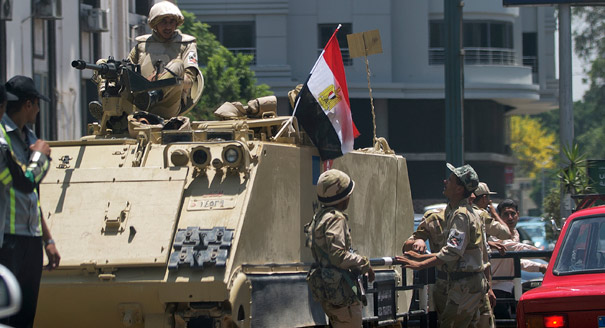
Source: Getty

In The Media

Members of Congress Urged to Cut Aid to Egypt

Members of Congress have begun to call for cuts in the $1.5 billion in military aid given to Egypt each year, as political violence increases in the country.

Link Copied
By Nathan J. Brown
Published on Aug 19, 2013
Program mobile hero image

Program

Middle East

The Middle East Program in Washington combines in-depth regional knowledge with incisive comparative analysis to provide deeply informed recommendations. With expertise in the Gulf, North Africa, Iran, and Israel/Palestine, we examine crosscutting themes of political, economic, and social change in both English and Arabic.

Learn More

Source: NPR

The Egyptian political scene is currently domestically focused and the last thing the political actors want to do is listen to outsider’s advice, explained Carnegie’s Nathan Brown on NPR. He stated that Egypt’s political actors are extremely focused on each other and involved in what they see as a struggle over Egypt’s identity and future, which, he added, is why the United States is having such a hard time influencing the military’s generals.

Last week, the Egyptian military brushed off U.S. efforts to negotiate a peaceful compromise with opposition protestors. As the violence increases in Egypt, members of Congress have begun to call for cuts in the $1.5 billion in military aid given to the country each year. 

“Most political actors do not see the United States as on their side and that even extends to the Egyptian military despite all that aid,” Brown explained. He said that the military leaders are convinced that the United States still looks at things in the country through the lens of the Morsi presidency that was just overthrown. The United States is too closely identified with Morsi, he contended.  

Brown argued that if U.S.-Egyptian relations were to fall apart, Egyptian foreign policy would not radically change under the new regime but there would be far less coordination in regional security issues, such as terrorism and Arab-Israeli diplomacy. Cuts in U.S. aid would make diplomacy and American security policy harder to operate in the region, he added, concluding that the aid is a very important part of the Egyptian military’s calculations.

This interview was originally aired on NPR.

About the Author

Nathan J. Brown

Nonresident Senior Fellow, Middle East Program

Nathan J. Brown, a professor of political science and international affairs at George Washington University, is a distinguished scholar and author of nine books on Arab politics and governance, as well as editor of five books.

    Recent Work

  • Commentary
    Trump’s Plan for Gaza Is Not Irrelevant. It’s Worse.

      Nathan J. Brown

  • Commentary
    Israel’s Forever Wars

      Nathan J. Brown

Nathan J. Brown
Nonresident Senior Fellow, Middle East Program
Nathan J. Brown
Political ReformForeign PolicyNorth AfricaEgypt

Carnegie does not take institutional positions on public policy issues; the views represented herein are those of the author(s) and do not necessarily reflect the views of Carnegie, its staff, or its trustees.

More Work from Carnegie Endowment for International Peace

  • Shipping port at dawn from above
    Commentary
    Emissary
    The U.S. Export-Import Bank Was Built for a Different Era. Here's How to Fix It.

    Five problems—and solutions—to make it actually work as a tool of great power competition.

      • Afren Akhter

      Afreen Akhter

  • Commentary
    Carnegie Politika
    Russia Is Meddling for Meddling’s Sake in the Middle East

    The Russian leadership wants to avoid a dangerous precedent in which it is squeezed out of Iran by the United States and Israel—and left powerless to respond in any meaningful way.

      Nikita Smagin
  • Man speaking into two mics
    Commentary
    Emissary
    Three Scenarios for the Gulf States After the Iran War

    One is hopeful. One is realistic. One is cautionary.

      • Andrew Leber

      Andrew Leber, Sam Worby

  • Commentary
    Strategic Europe
    The Fog of AI War

    In Ukraine, Gaza, and Iran, AI warfare has come to dominate, with barely any oversight or accountability. Europe must lead the charge on the responsible use of new military technologies.

      Raluca Csernatoni
  • Commentary
    Diwan
    Egypt’s Discrete Role in the Ceasefire with Iran

    Cairo’s efforts send a message to the United States and the region that it still has a place at the diplomatic table.

      • Angie Omar

      Angie Omar

Get more news and analysis from
Carnegie Endowment for International Peace
Carnegie global logo, stacked
1779 Massachusetts Avenue NWWashington, DC, 20036-2103Phone: 202 483 7600Fax: 202 483 1840
  • Research
  • Emissary
  • About
  • Experts
  • Donate
  • Programs
  • Events
  • Blogs
  • Podcasts
  • Contact
  • Annual Reports
  • Careers
  • Privacy
  • For Media
  • Government Resources
Get more news and analysis from
Carnegie Endowment for International Peace
© 2026 Carnegie Endowment for International Peace. All rights reserved.