

Article
Frederic Grare
{
  "authors": [
    "Frederic Grare"
  ],
  "type": "legacyinthemedia",
  "centerAffiliationAll": "dc",
  "centers": [
    "Carnegie Endowment for International Peace"
  ],
  "collections": [],
  "englishNewsletterAll": "ctw",
  "nonEnglishNewsletterAll": "",
  "primaryCenter": "Carnegie Endowment for International Peace",
  "programAffiliation": "SAP",
  "programs": [
    "South Asia"
  ],
  "projects": [],
  "regions": [
    "South Asia",
    "India"
  ],
  "topics": [
    "Economy",
    "Foreign Policy"
  ]
}
Source: Getty
The Indian Prime Minister spent considerable time and energy trying to convince the Australian private sector to invest in India, as he has done in every country he has visited so far.
Source: Diplomatist
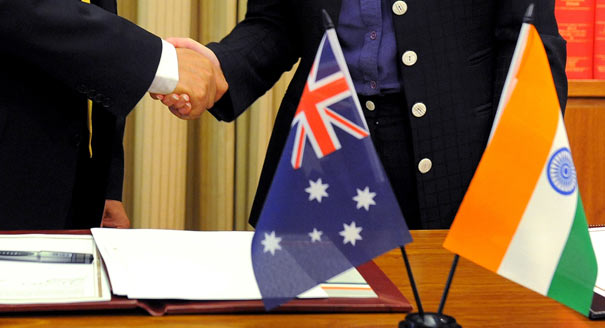
When Narendra Modi landed in Australia on November 16, only two months after the visit of his Australian counterpart Tony Abbott to India, he became the first Indian Prime Minister to visit the country since 1986. This fact alone led commentators to describe the visit as historical. Modi’s visit to Canberra – where he addressed the Australian Parliament – as well as to Brisbane, Sydney, and Melbourne are important landmarks in India’s quest to reengage Australia.
Relations between India and Australia have long been characterised by mutual indifference. For decades, India and Australia have operated in separate strategic spheres. Similarly, divergent commercial goals and strategies have further prevented the development of closer relations between the two countries.
Some 450,000 people of Indian origin live in Australia today. Tourism between the two countries is flourishing, just like many other aspects of the relationship. Similarly, the number of Indian students in Australia, a population of some 40,000, continues to grow, and the country Down Under has become a destination of choice for Indian students seeking an overseas education.
The Indian Prime Minister arrived in Australia accompanied by a strong delegation of CEOs, armed with a primarily economic agenda and a firm intention to provide his interlocutors with the insurance that the India growth story is intact and restore the dynamic which had prevailed for a decade in the economic relations between the two countries. Although two-way trade has tripled in the past 10 years, it has fallen over the past two years. In 2013-2014, bilateral trade stood at $12.2 billion, down 21.5 percent from $15.4 billion in 2012-13. This trend should spur an acceleration of the Comprehensive Economic Cooperation Agreement (CECA), a free trade agreement which should expand trade in goods and services and facilitate investment. Both Narendra Modi and Tony Abbott have expressed their desire to see the agreement signed by 2016.
The Indian Prime Minister spent considerable time and energy trying to convince the Australian private sector to invest in India, as he has done in every country he has visited so far. But energy concerns were also prominent in the discussions between the two countries. Despite sitting on the fifth largest reserves of coal in the world, India is the fourth largest global importer of coal behind China, Japan and South Korea. Its imports rose by 21 percent in 2013 to 152 million tones, coming primarily from South Africa, Indonesia, and Australia.
Considerable attention was also devoted to the finalisation of a civil nuclear deal between India and Australia. Canberra’s decision to sell uranium to New Delhi constitutes perhaps the most spectacular demonstration of Australia’s willingness to develop close economic and strategic ties with India. With about one quarter of the world’s uranium and a large share of low-cost reserves, Australia is one the top three uranium exporters in the world. Purchasing Australian uranium would enable India to diversify its sources of supply and diminish its dependence on any one of them. But differences over the Non-Proliferation Treaty (NPT), which India views as a form of nuclear apartheid and has not signed, have long prevented Australia’s exports of uranium to India.
Since 2008, however, the US-India civil nuclear cooperation agreement and the Nuclear Suppliers Group’s (NSG) new exception to its guidelines allowing for exports to India have conferred to India a status similar to that of a nuclear-weapon state. After years of hesitation and a painful debate within the political establishment, Australia decided in 2011 to remove its long-standing ban on uranium sales to India, an initiative which removed an important irritant from the bilateral relationship.
The deal signed on September 6 during Prime Minister Abbott’s visit to India will secure the supply of uranium for India’s nuclear plants. Australia can expect to sell around 2,500 tones of uranium to India by 2030, generating some $309 million per year at current prices. Interestingly, the sum pales in comparison to the $175 billion expected for the 15 largest Australian commodities in the same period. Furthermore, it remains unclear to some experts whether India will ultimately buy uranium from Australia, as potential suppliers are relatively abundant. Long-term economic expectations may have prevailed in the Australian decision to sell uranium to India in the same way they did when Australia decided to sell uranium to China in 2006 in order to secure a market for more lucrative Australian exports.
Strategic considerations also played a role, particularly the need for Australia to grow closer to India at a time of power shifts in the Indo-Pacific region. Yet, this is the field where, paradoxically, developing a meaningful working relationship may prove the most difficult. The two do share many attributes that may make them natural partners. Both countries share common values; both are multicultural, federal democracies that believe in and respect the rule of law; both share some concerns about the rise of China, which they benefit from while remaining wary of the potential strategic implications of its growing military capability.
Yet, neither country is central to the security concerns of the other, and a deep, mutual ambivalence persists on both sides. Despite Australia’s relative enthusiasm for developing the security relationship – many Australian security analysts support closer engagement with India, but doubt its strategic capabilities – India has so far remained relatively cautious.
The time of mutual suspicion based on Cold War alignments of the two countries is past. Despite the tensions resulting from the Pokhran II nuclear tests, increased political engagement has led to several bilateral security related agreements, including a 2003 agreement on terrorism, a 2006 memorandum of understanding on defence cooperation, a 2007 defence information-sharing agreement on intelligence dialogue and, most importantly, the 2009 Joint Declaration on Security Cooperation, which created a framework for further developments in bilateral security cooperation. Both Tony Abbott and Narendra Modi called for a deepening of this framework during the Australian Prime Minister’s visit to India.
The list of what the two countries can accomplish together on strategic matters, ranging from collaboration in regional institutions to humanitarian and disaster relief efforts to Antarctic research, is a long one, and is getting longer as security dialogues continue and multiply. All proposed activities would insist on cooperation at all levels, which both countries have agreed to in principle.
Such activities, however, are matters of soft security, and it is unclear whether the two countries are truly willing to go any further at this stage. The first ever bilateral naval exercise between the two navies, scheduled during former Indian Defence Minister A K Anthony’s June 2013 visit, will take place only in 2015. So far, India has also remained careful not to look unnecessarily antagonistic to China whenever engaging in a joint military exercise – a posture that might hinder more substantive bilateral security cooperation in the future.
There is no reason to believe that the Indian Prime Minister fundamentally departed from the attitude of his predecessors. Both the Australian and the Indian prime ministers are keen to deepen pre-existing areas of cooperation, especially in the Indian Ocean where the scope for joint operations is large. But it is also clear that, by focussing on the economic dimension of the relationship, Narendra Modi intends to diminish the capability gap with China, which currently limits its margins for diplomatic manoeuvring. Relations with Australia must also be understood in this context; as such, considerations also define the India-Australia bilateral relation. Australian Secretary of the Department of Foreign Affairs and Trade Peter Varghese declared in May 2013, “if we get the economic relation right, the strategic partnership will follow, although there will be a long lag between when India arrives as an economic power and when it arrives at a strategic power”. His statement was prescient, and it would be difficult to better describe the agenda of the two Prime Ministers. The development of substantive bilateral relations between the two will indeed be a long-term project.

Former Nonresident Senior Fellow, South Asia Program
Frédéric Grare was a nonresident senior fellow at the Carnegie Endowment for International Peace, where his research focuses on Indo-Pacific dynamics, the search for a security architecture, and South Asia Security issues.
Recent Work
Frederic Grare
Frederic Grare
Carnegie does not take institutional positions on public policy issues; the views represented herein are those of the author(s) and do not necessarily reflect the views of Carnegie, its staff, or its trustees.

AI could hollow out jobs, reshape them gradually, create entirely new ones—or do all three at once. The case for starting to act now doesn’t depend on knowing which.

Teddy Tawil
Closer EU-UK ties could help address urgent European concerns. But is the EU ready for rapprochement with the United Kingdom?

Rym Momtaz, ed.
In the Philippines, Duterte-era discourse emphasizing sovereignty, anti-Western skepticism, and strongman diplomacy mirrors tenets of populist foreign policy around the world.
Aries A. Arugay

Powerful lobbyists and inertia led to Russia’s coal-mining sector missing an excellent opportunity to solve its structural problems.
Alexey Gusev
Europe has been standing by while its Southern neighborhood is being redrawn by force. To establish a path to peace between Israel and Lebanon, it’s time for Europeans to get involved with hard power.
Rym Momtaz