

Commentary
Marc Lynch
{
  "authors": [
    "Marc Lynch"
  ],
  "type": "other",
  "centerAffiliationAll": "dc",
  "centers": [
    "Carnegie Endowment for International Peace"
  ],
  "collections": [
    "Arab Awakening"
  ],
  "englishNewsletterAll": "menaTransitions",
  "nonEnglishNewsletterAll": "",
  "primaryCenter": "Carnegie Endowment for International Peace",
  "programAffiliation": "MEP",
  "programs": [
    "Middle East"
  ],
  "projects": [],
  "regions": [
    "Middle East",
    "North Africa"
  ],
  "topics": [
    "Political Reform",
    "Democracy",
    "Civil Society"
  ]
}
Source: Getty
Arab politics will be torn for many years to come between the restless, critical power of the public sphere and the determined efforts of regimes, states, and old elites to maintain their domination.
Source: Current History
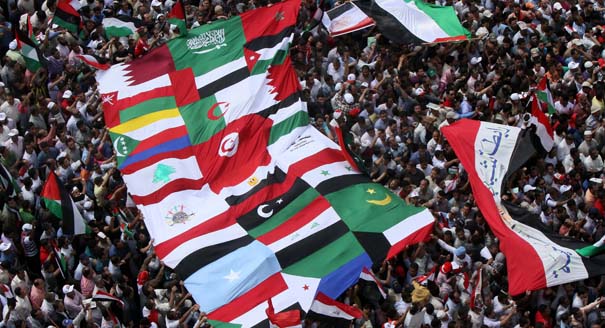
On January 25, 2011, millions of Egyptians poured into the streets to join a protest against the long and autocratic rule of President Hosni Mubarak. Eighteen tense days later, the military removed Mubarak from power and promised to oversee a transition to democracy. On June 30, 2013, millions of Egyptians poured into the streets to join a protest against the Islamist government of President Mohamed Morsi. Four days later, the military removed Morsi from power.
The formal symmetry of these events separated by two and a half years was deeply misleading. The first was an unprecedented mass mobilization rooted in an empowered public sphere, pressing novel demands on an arbitrary and unaccountable state. The second represented the public sphere’s co-optation by a state that was able to manipulate the street into cheering its exercise of arbitrary power.The difference between the two uprisings soon became apparent. On August 14, 2013, Egyptian security forces moved against an Islamist encampment at Rabaa Square in central Cairo, massacring over a thousand people in broad daylight. The vast majority of the Egyptian public applauded the atrocity. In the months and years that followed, the Egyptian media became an enthusiastic cheerleader of military rule and repression, while peddling an astonishingly toxic brew of conspiracy theories, state propaganda, and incitement.
What happened? How did the Egyptian public go from cheering the overthrow of an autocratic regime to celebrating its revival in a span of less than four years? How were the independent, critical, and free-spirited voices of Tahrir Square seduced by the cynical hypocrisies of military rule?...
Former Nonresident Senior Fellow, Middle East Program
Marc Lynch was a nonresident senior fellow in Carnegie’s Middle East Program where his work focuses on the politics of the Arab world.
Recent Work
Marc Lynch
Marc Lynch
Carnegie does not take institutional positions on public policy issues; the views represented herein are those of the author(s) and do not necessarily reflect the views of Carnegie, its staff, or its trustees.

Before the next wave of EU enlargement takes place, the union needs to grapple with thorny questions of how power is distributed among its members.


Emil Sondaj Hansen, Ditte Brasso Sørensen

The Horn of Africa countries are among those facing a new security calculus.


Andrew Leber, Lesley Anne Warner

The European far right might fail to steer EU policy in the direction Russia wants, but they will create enough chaos inside Europe to benefit the Kremlin.

Dimitar Bechev

As the U.S. stumbles in its war with Iran, we are likely to see an acceleration of its disengagement from the region.

Michael Young
In Egypt’s dense cities, the disappearance of foliage has health implications and punishes daily commuters.

Angie Omar