

Article
Thomas Carothers, McKenzie Carrier
{
  "authors": [
    "Thomas Carothers"
  ],
  "type": "other",
  "centerAffiliationAll": "dc",
  "centers": [
    "Carnegie Endowment for International Peace"
  ],
  "collections": [
    "Democracy and Governance"
  ],
  "englishNewsletterAll": "democracy",
  "nonEnglishNewsletterAll": "",
  "primaryCenter": "Carnegie Endowment for International Peace",
  "programAffiliation": "DCG",
  "programs": [
    "Democracy, Conflict, and Governance"
  ],
  "projects": [],
  "regions": [],
  "topics": [
    "Political Reform",
    "Democracy",
    "Civil Society",
    "Foreign Policy"
  ]
}
Source: Getty
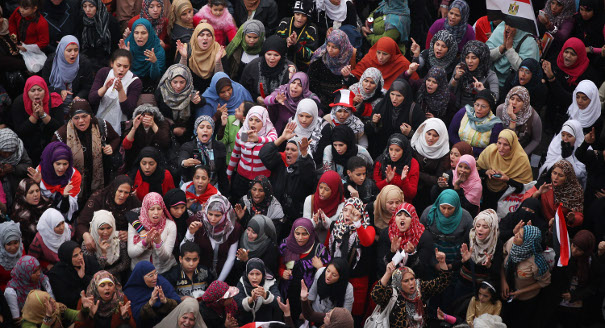
Women’s political empowerment work can and should be part of the core agenda for responding to challenging democratic transitions.
Source: Oxfam
Last year the gender, women, and democracy team at the National Democratic Institute approached me with a question. NDI, like many groups engaged in supporting democracy internationally, was responding to the increasingly fraught landscape of global democracy by attempting to think more strategically and move fully away from any lingering tendency to pursue a standard democracy “menu” across extremely diverse political contexts. NDI’s gender team wanted to insert women’s political empowerment programming into the new strategic discussion. Would I help them think it through? The team deflected my protests that I lack expertise on women’s empowerment, telling me they would help me get up to speed. They also politely pointed out that as someone who presents himself as a general expert on democratic change, perhaps it was time for me to correct my lack of knowledge about the gender domain. I signed on.
After some months of delving into the literature on women’s political empowerment and interviewing numerous aid practitioners and women’s activists working on the front lines, some interesting findings came into focus. I present them in my new paper, “Democracy Support Strategies: Leading with Women’s Political Empowerment.”
At first glance, programs seeking to foster greater women’s political empowerment did seem to follow a standard menu – everywhere I looked I saw training for women candidates in local and national elections, efforts to strengthen the role of women within political parties, advocacy in favor of gender quotas in legislatures, and support for women’s parliamentary caucuses. Yet when I probed how such programming unfolds across different transitional contexts, important variations emerged. I focused on three alternative contexts distinct from the assumed standard democratization path (in which the dictator falls, foundational elections take place, and democracy steadily takes root):
I learned that in stuck transitions, women’s political empowerment work can address two critical issues that lie at the heart of what keeps such transitions from moving forward: polarization and inadequate representation. Multiparty women’s caucuses, for example, can provide a bridge across the partisan divide. The ability of women politicians to connect to grassroots networks of women civic and social activists can serve as a start for building a more representative politics.
I found that, at least in some semi-authoritarian contexts, strengthening the capacity of women parliamentarians or women local council members can help bolster the few sources of independent political authority that exist. Power holders determined to screen out foreign political assistance often let in women’s political programming, lulled by the false belief that it always remains at the political margins. For example, years of patient work on women’s political empowerment in Burkina Faso went on in an environment of growing political thuggishness, but paid off in 2014 when women were at the forefront of protests that helped crack open the system.
In conflict-affected countries, significant opportunities arise for women to play a key role in the negotiation of new constitutions, the brokering of peace, and the reform of security services after peace is restored.
The point is not just that women’s political empowerment work can be usefully tailored to different political contexts. It is that a focus on women’s political empowerment often connects directly to the central levers of political change that democracy aid providers believe could help countries with problematic transitions get back on a democratic track. In other words, women’s political empowerment work should not be seen as an isolated aid sector or a nice extra at the sides of the assistance stage. Properly understood, it can and should be part of the core agenda for responding to challenging democratic transitions.
Interestingly, some of the expert practitioners I consulted were hesitant about formulating focused strategic arguments for women’s political empowerment work in particular contexts. They felt that aid providers shouldn’t need anything more than a basic overarching rationale for pursuing such work—the argument that no democracy is a full democracy when significant gender inequalities exist in politics. In this view, women’s political empowerment work should be pursued wherever gender inequalities exist (which is to say, pretty much everywhere outside of a few very cold countries). While I agree with the basic principle of such a rationale, I believe that in this era of tough competition among multiple aid priorities and the relentless search for value for money, fortifying the case for women’s political empowerment with focused strategic arguments is a worthwhile pursuit.

Harvey V. Fineberg Chair for Democracy Studies; Director, Democracy, Conflict, and Governance Program
Thomas Carothers, director of the Carnegie Endowment for International Peace’s Democracy, Conflict, and Governance Program, is a leading expert on comparative democratization and international support for democracy.
Recent Work

Thomas Carothers, McKenzie Carrier
Thomas Carothers, McKenzie Carrier
Carnegie does not take institutional positions on public policy issues; the views represented herein are those of the author(s) and do not necessarily reflect the views of Carnegie, its staff, or its trustees.
Europe has been standing by while its Southern neighborhood is being redrawn by force. To establish a path to peace between Israel and Lebanon, it’s time for Europeans to get involved with hard power.

Rym Momtaz

After four years of war, there is no one who can stand up to the security establishment, and President Vladimir Putin is increasingly passive.

Tatiana Stanovaya
Although Ukrainian strikes have led to a noticeable decline in the physical volume of Russian oil exports, the rise in prices has more than made up for it.

Sergey Vakulenko
Five problems—and solutions—to make it actually work as a tool of great power competition.
Afreen Akhter

The Russian leadership wants to avoid a dangerous precedent in which it is squeezed out of Iran by the United States and Israel—and left powerless to respond in any meaningful way.

Nikita Smagin