

Report
- +2
George Perkovich, Jessica Tuchman Mathews, Joseph Cirincione, …
{
  "authors": [
    "Jon Wolfsthal"
  ],
  "type": "legacyinthemedia",
  "centerAffiliationAll": "dc",
  "centers": [
    "Carnegie Endowment for International Peace"
  ],
  "collections": [
    "U.S. Nuclear Policy",
    "Korean Peninsula"
  ],
  "englishNewsletterAll": "ctw",
  "nonEnglishNewsletterAll": "",
  "primaryCenter": "Carnegie Endowment for International Peace",
  "programAffiliation": "NPP",
  "programs": [
    "Nuclear Policy"
  ],
  "projects": [],
  "regions": [
    "North America",
    "United States",
    "East Asia",
    "North Korea"
  ],
  "topics": [
    "Nuclear Policy",
    "Global Governance"
  ]
}
Source: Getty
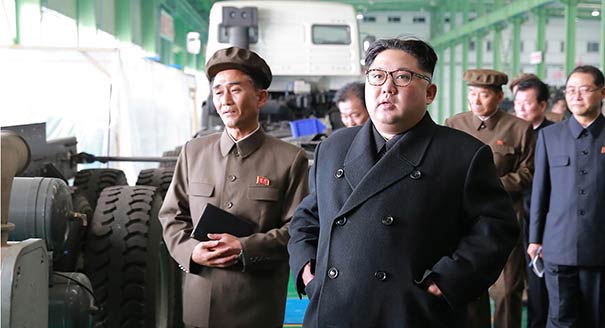
Regardless of how we got here, this week’s summit between President Trump and North Korean leader Kim Jong Un will be a major milestone. Considering a wide range of outcomes, we should all be hoping for progress.
Source: Foreign Policy
I have been to North Korea and spent 30 years working on the dangers posed by its development of nuclear weapons and long-range missiles. No matter how you slice it, next week’s summit in Singapore between U.S. President Donald Trump and North Korean leader Kim Jong Un will be a major milestone. Regardless of how we got here, it presents an opportunity to make progress on one of the most challenging and intractable proliferation challenges of our era.
Over the past few months of on-again, off-again summit preparations, the most frequent question I have gotten is: What is the best thing that could happen, and what is the worst thing that could happen? I’ve expanded that to consider a wider range of outcomes, since Trump and Kim are both untested and unpredictable, to put it mildly.
Best-case scenario: Real talks begin. Despite the ridiculously high expectations that have arisen ahead of the summit, the best outcome Trump and Kim could achieve at the hastily arranged meeting is to agree that the end goal for this new process is the full and verified elimination of nuclear weapons from the Korean Peninsula, along with diplomatic and political normalization between the United States and North Korea. To achieve this ambitious set of goals within a realistic timeframe, the two leaders should adopt a clear and detailed joint statement to guide the work of a team of negotiators to pursue both paths in parallel. The goal should be for the leaders to come back together in a reasonable amount of time (six months or no more than a year) to codify the results. In the interim, the two should agree on how to define and ensure that the current North Korean testing freeze continues (what is allowed, what is not allowed) and on what the United States and its partners can agree to do to ensure the diplomatic process continues, including curtailing certain types of military activities that North Korea sees as preludes to offensive military action.
Worst-case scenario: Kim pulls a fast one. Trump claims he has mastered the art of the deal, but so far my perception is that he has been far too eager for a summit and that Kim has gained considerable ground over the past year at the expense of the United States in East Asia. If the summit makes progress on denuclearization, it will be worth it, but that remains a long shot. Failure to move the disarmament needle will have given Kim a major propaganda victory — equal status with the world’s only superpower — in exchange for little or no real sacrifices on his part.
This skeptical view could play out even worse in Singapore. Eager for the appearance of progress, and a bid for his own Nobel Peace Prize, Trump might just jump at a bad deal. There are many forms this could take. My nightmare is that Kim will try to sell Trump half a loaf, offering to hand over, say, 10 nuclear weapons and destroy 20 long-range missiles, claiming they are all he has. Even though the United States believes with good reason that Pyongyang’s arsenal is much larger than that, Trump might try to sell this as a complete win, despite North Korea holding onto many more capabilities. Just as he took Russian President Vladimir Putin’s word that he did not interfere in the 2016 U.S. presidential election, Trump might take Kim’s word that his arsenal is smaller than the intelligence community — of which Trump is not a fan — says it is.
This is not the only bad scenario. Another might be a North Korean offer to disarm in two or three years — but only after the United States withdraws all troops from the Korean Peninsula. Given Trump’s well-established views that alliances are more of a cost than a benefit for the United States, he might very well take the opportunity to bid the U.S.-South Korea alliance a fond farewell. Once committed to withdrawal, the United States would find it hard to reverse, and North Korea would have gained considerable leverage over the pace of nuclear disarmament, if indeed it ever gets there.
The unicorn deal. Beyond the best and worst cases, there are other possibilities. In one scenario, the United States pursues the idea that North Korea could and should immediately disarm at or just after the summit. Represented in the form of U.S. National Security Advisor John Bolton’s Libya model, the idea that North Korea should ship all of its nuclear weapons to an airport to be shipped abroad, and rapidly destroy all of its ballistic missiles, is neither politically nor technically feasible. The number of nuclear weapons and amount of nuclear material North Korea has produced will take months, if not years, to determine and verify. No one could or should take North Korea’s word. The details and intrusive access needed to confirm North Korean claims will take thousands of hours to achieve, and it will be years before the United States gains confidence in them. This has always been more than just a fantasy; rather, it is a proposal designed to sabotage the prospect of real progress toward disarmament in North Korea.
The train wreck. This possibility, sadly, remains all too possible. Thinking back to Trump’s disastrous phone call with Australian Prime Minister Malcolm Turnbull in January 2017, it is clear that when tired or unprepared, Trump can not only veer off script but become openly hostile. Singapore is almost a full day of flying time away from Washington. Even on Air Force One, that takes a toll. If Kim offends Trump or pulls a bait and switch, or if Trump finds that one of his own advisors or South Korean President Moon Jae-in has misled him, things could turn nasty. He is not far removed from fire and fury and comparing nuclear buttons with North Korea and clearly feels he has the upper hand. If things turn out poorly, the summit could derail quickly, with disastrous effect. While both leaders have an incentive for the summit to go well, Trump has displayed a lack of personal control time and time again, and Kim, having appeared as the more reasonable actor over the last six months, may have an incentive to goad Trump into a hostile display to further bolster his perceived position in South Korea as more reliable and less volatile than the U.S. president.
In the end, no one — neither Trump nor Kim nor anyone reading this — knows what will happen in Singapore. Summits are usually capstone affairs, where agreements negotiated by staff are codified. Sometimes leaders have to get together to make things happen, and this may be one of those times. But there is always a risk when negotiations happen this way, and given the personalities involved, those risks seem very real.
We should all be hoping for real progress, and if they achieve it, Trump, Moon, and Kim will deserve real credit. But you’ll excuse me if I reserve judgment until after the summit.

Former Nonresident Scholar, Nuclear Policy Program
Jon Wolfsthal was a nonresident scholar with the Nuclear Policy Program.
Recent Work



George Perkovich, Jessica Tuchman Mathews, Joseph Cirincione, …
Jon Wolfsthal
Carnegie does not take institutional positions on public policy issues; the views represented herein are those of the author(s) and do not necessarily reflect the views of Carnegie, its staff, or its trustees.

Despite its flop at the box office, the film raises important questions for the climate community to answer.

Leonardo Martinez-Diaz

In an interview, Rozina Ali discusses her new book on the rise and manifestations of Islamophobia in the United States.

Michael Young

While the EU and European governments are embracing the much-lauded middle-power moment, this entails three difficult conundrums.

Richard Youngs

Europe is facing rising populism internally as well as external pressures from Russia, China, Turkey, and the United States.

Dimitar Bechev

Policy proposals on sovereign debt must both match the scale of the challenge and be implementable within existing political constraints.

David McNair