

Other
Stephen Wertheim
{
  "authors": [
    "Stephen Wertheim"
  ],
  "type": "commentary",
  "centerAffiliationAll": "dc",
  "centers": [
    "Carnegie Endowment for International Peace"
  ],
  "collections": [],
  "englishNewsletterAll": "americanStatecraft",
  "nonEnglishNewsletterAll": "",
  "primaryCenter": "Carnegie Endowment for International Peace",
  "programAffiliation": "ASP",
  "programs": [
    "American Statecraft"
  ],
  "projects": [],
  "regions": [
    "North America",
    "United States",
    "East Asia",
    "China",
    "Taiwan"
  ],
  "topics": [
    "Security",
    "Military",
    "Foreign Policy"
  ]
}
Source: Getty
They contribute to a policy drift that risks bringing about conflict, not strengthening deterrence.
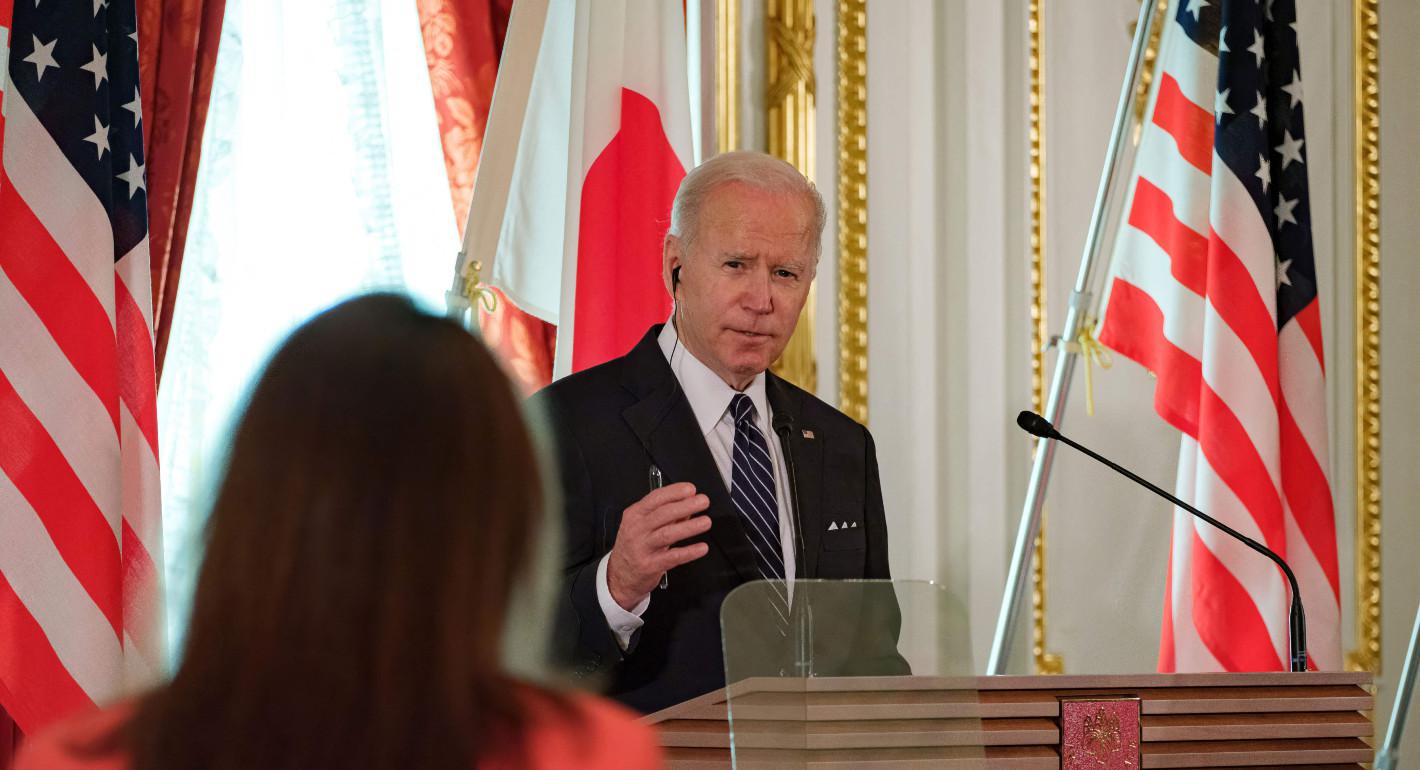
President Joe Biden made a potentially dangerous statement on Monday. In Tokyo, he gave a flat “yes” to a reporter’s question of whether he is willing to “get involved militarily to defend Taiwan.” “That’s the commitment we made,” the president claimed. In fact, the United States scrapped its formal commitment to defend Taiwan in 1979, replacing a treaty of alliance with the Taiwan Relations Act, which obligates the United States to help equip Taiwan to defend itself.
This is the third time in less than a year that Biden has publicly declared that the United States would use force to keep Beijing from seizing the island. Once again, the White House scrambled to clarify that the U.S. position has not actually changed: the United States continues to adhere to a One China policy and maintain “strategic ambiguity” rather than clarity as to whether it would defend Taiwan. This approach is a wise one that, as many administration officials recognize, has served the United States well. But repeated gaffes risk being interpreted as changes in policy. They increase the chance of damaging peace and stability between the world’s two leading powers.
For decades, China has refrained from attempting to conquer Taiwan by force but has retained the threat to do so. Many analysts believe that Beijing would prefer to use gradual pressures toward “reunification” than to mount a costly and risky campaign of sudden conquest. The possibility of full-scale Chinese aggression can never be discounted, especially in light of the country’s growing military capabilities and international ambitions. One reason Beijing’s calculus could change, however, lies in Washington. If the United States appears to regard Taiwan as an irrevocable strategic asset that could never join with the mainland, then China may resort to plan B: launch an invasion out of fear that it must act now or accept that Taiwan is lost forever.
No single presidential utterance is likely to cause Chinese President Xi Jinping to make a policy decision of enormous consequence. Xi and Biden know each other from direct and continuing conversations. The People’s Liberation Army already takes seriously the possibility that the United States would intervene militarily in defense of Taiwan. So Biden’s comment, in and of itself, may have little effect.
More troubling, however, is the larger policy drift in Washington to which the gaffe contributes. Over the past few years, members of Congress have increasingly called for strategic clarity about using force to defend Taiwan and have promoted other steps to restore the appearance of diplomatic relations between Washington and Taipei. Under Donald Trump’s administration, the United States loosened restrictions on high-level contacts with Taiwanese officials, and the Biden administration has issued new guidelines to reflect “our deepening unofficial relationship.” Most important, these measures have accompanied the growing hostility across U.S.-China relations, as the world’s two leading countries engage in intensifying economic, technological, and security competition.
At a minimum, then, Biden’s vow to defend Taiwan risks conveying that the United States is degrading the long-standing policies that have underpinned the bilateral relationship and preserved peace and stability across the Taiwan Strait. Even if Chinese officials were to accept the White House’s clarification that U.S. policy remains unchanged, they may conclude that the United States will grow only more determined to defend Taiwan as time goes on and that China’s existing threats no longer suffice to keep Taipei from drifting toward independence. In that case, China could move up its timeline for “reunification” and become more willing to risk military and economic conflict with the United States.
Indeed, several influential senators sent exactly that destabilizing message to Beijing by cheering on Biden’s ostensible misstatement. Senator Bob Menendez, the Democratic chair of the Senate Foreign Relations Committee, tweeted, “President Biden is right. Credible deterrence requires both courage and clarity—and Taiwan’s vibrant democracy deserves our full support.” Republican Senator Lindsey Graham made the sentiment bipartisan: “President Biden’s statement that if push came to shove the U.S. would defend Taiwan against communist China was the right thing to say and the right thing to do.” Likewise, Republican Senator Tom Cotton seized the moment to urge Biden to “restate our new policy of strategic clarity in clear, deliberate remarks from a prepared text.” Whatever effect the gaffe may have in Beijing, it is opening space to attack the status quo in Washington.
The war in Ukraine demonstrates that it can be difficult to discern just where red lines lie. Russia had long drawn a clear red line over Ukraine joining NATO, but Russian President Vladimir Putin ended up launching a full-scale invasion of Ukraine in February, citing mounting cooperation between Kyiv and NATO, among other grievances, even though the alliance was nowhere near admitting Ukraine as a member. The United States did not know in advance what would cause Russia to go to war—and neither did many Moscow elites who were stunned by Putin’s decision to invade. The circumstances across the Taiwan Strait are very different, but it is worth considering that no one knows how much liberty the United States can take with its One China policy before Beijing will decide its red line has been crossed. Even Xi may not know himself. For all involved, it would be better not to find out. The stakes are too high.

Senior Fellow, American Statecraft Program
Stephen Wertheim is a senior fellow in the American Statecraft Program at the Carnegie Endowment for International Peace.
Recent Work
Stephen Wertheim



Sophia Besch, Alper Coşkun, Nate Reynolds, …
Carnegie does not take institutional positions on public policy issues; the views represented herein are those of the author(s) and do not necessarily reflect the views of Carnegie, its staff, or its trustees.

Despite its flop at the box office, the film raises important questions for the climate community to answer.

Leonardo Martinez-Diaz

Funding Ukraine remains a priority for European leaders. As Russia’s war of aggression heads into another winter, two feasible options to mobilize support for Kyiv should be fast-tracked.


Vladyslav Rashkovan, Gregory P. Wilson

Russian strikes are weakening the economy sustaining Ukraine’s war effort. Closing the growing funding gap will require more European support and politically contentious reforms in Kyiv.

Balázs Jarábik

In an interview, Rozina Ali discusses her new book on the rise and manifestations of Islamophobia in the United States.

Michael Young

While the EU and European governments are embracing the much-lauded middle-power moment, this entails three difficult conundrums.

Richard Youngs