

Article
Marc Pierini
{
  "authors": [
    "Marc Pierini"
  ],
  "type": "commentary",
  "blog": "Emissary",
  "centerAffiliationAll": "dc",
  "centers": [
    "Carnegie Endowment for International Peace",
    "Carnegie Europe"
  ],
  "collections": [
    "Turkey’s Transformation",
    "Europe’s Southern Neighborhood"
  ],
  "englishNewsletterAll": "ctw",
  "nonEnglishNewsletterAll": "",
  "primaryCenter": "Carnegie Europe",
  "programAffiliation": "EP",
  "programs": [
    "Europe"
  ],
  "projects": [],
  "regions": [
    "Europe",
    "Türkiye",
    "Middle East"
  ],
  "topics": [
    "Foreign Policy",
    "Democracy",
    "NATO"
  ]
}
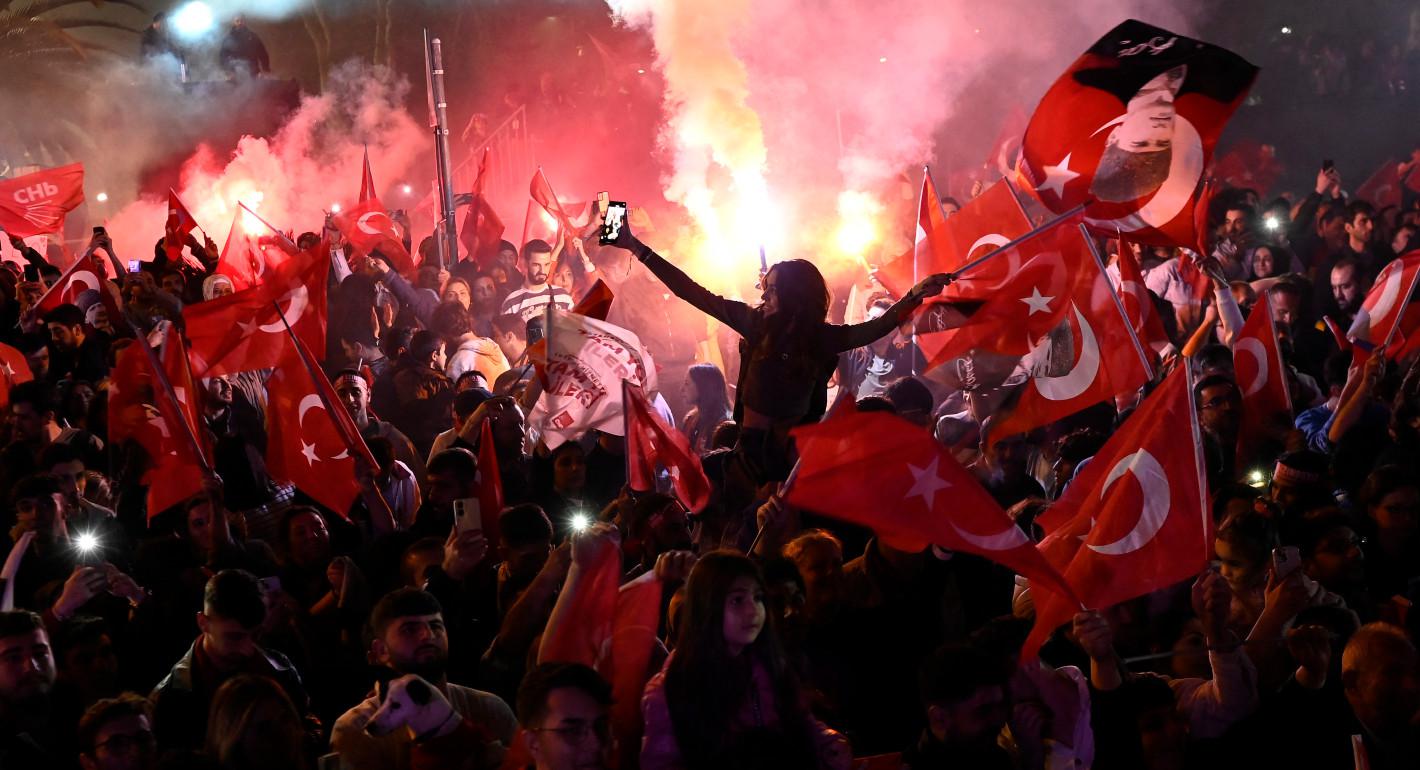
Source: Getty
Erdogan and his aides have wasted no time offering three reminders of the president’s power.
On March 31, Turkey’s local elections resulted in a vexing setback for the governing Justice and Development Party (AKP) and its president, Recep Tayyip Erdoğan. According to provisional results, most larger cities are now under the control of the secular opposition Republican People’s Party (CHP). Erdoğan soberly admitted defeat.
Before the election, the president had campaigned in more than fifty of the country’s eighty-one provinces to support the AKP mayoral candidates, and he may have known things weren’t going well. Last week, he lamented the meager attendance at an Istanbul rally, and on his way out of his ballot station on Sunday, he deplored the poor turnout. Although the elections were local, some also saw them as a personal referendum on Erdoğan, an extra layer of legitimacy needed to pursue his agenda.
Seen from the West, there was a wave of dissatisfaction across Turkey: high inflation, difficulty for the average worker or retiree to make ends meet, fundamental freedoms ever more curtailed, top-down polarization of Turkish society, and risky foreign policy choices. Yet Erdoğan and the AKP had struck victory in the 2023 presidential and legislative elections, seemingly confirming that there was some kind of Erdoğan magic at work: people would forgive him for an interest rate policy nobody understood, or earthquake victims would trust him for a swift and secure reconstruction process. Since the presidential contest, he had made several policy changes, including renewing relations with Egypt and publicly accepting Sweden’s accession to NATO. To illustrate Erdoğan’s standing, pro-government media leaked news of his meeting with U.S. President Joe Biden, scheduled for May 9.
Yet Erdoğan’s popularity contest failed on Sunday—most spectacularly in Istanbul, where his candidate lost by around 1 million votes to Ekrem Imamoğlu, the incumbent who won the mayorship in 2019 to the president’s dismay. As of April 1, the national vote tally puts the opposition CHP ahead of the ruling AKP—an almost unimaginable outcome a few weeks ago.
Despite his party’s loss in the local vote, Erdoğan remains in control at national level, his super-executive regime is unaffected, and his parliamentary coalition is intact. The personal vexation may be significant, but his leadership is not legally or functionally challenged.
Before the vote counting was completed, Erdoğan and his aides wasted no time offering three reminders of his power. First, to illustrate his world standing, Erdoğan spoke with the presidents of Iran, Kazakhstan, and Uzbekistan on Sunday, as well as the prime minister of the Netherlands, who is a candidate to become NATO’s next secretary general. Second, the Turkish defense ministry announced an aerial bombing in Iraq on April 1, signaling that the fight against Kurdish militants in northern Syria and Iraq will continue. Finally, Erdoğan and his aides quickly transformed the “disappointing results” of the election into a narrative about the country’s vibrant democracy, as seen in an X post reading “the message of democracy we gave to the world.”
For the next few years, the European Union and NATO will probably face the same Erdoğan: acutely aware of his country’s geopolitical value, intent on remaining at equal distance from NATO and Russia, confident in his proclaimed ambition for mediating for peace everywhere possible, and often ready to shed a given foreign policy option if he finds a more attractive alternative.
What Erdoğan may now realize is how unpopular his polarizing choices and turbulent economic policies have become at home, though this may change in the months to come.
What remains uncertain is whether Turkey’s policies will shift on two issues of critical importance. The first is the presence of Russian-made S-400 missile systems in Turkey’s inventory—a disturbing choice for a NATO country. The second is the dismal state of rule of law in Turkey, including the treatment of dissenters and free thinkers as terrorists on the basis of spurious arguments. For Western governments and, importantly, for Western business circles, the country remains in a different league. Changes in these domains would vastly improve Turkey’s image on the world stage.

Senior Fellow, Carnegie Europe
Marc Pierini is a senior fellow at Carnegie Europe, where his research focuses on developments in the Middle East and Turkey from a European perspective.
Recent Work
Marc Pierini
Marc Pierini
Carnegie does not take institutional positions on public policy issues; the views represented herein are those of the author(s) and do not necessarily reflect the views of Carnegie, its staff, or its trustees.

The books, podcasts, and films that explain the world it made.

Andrew Leber

U.S. trading partners in Asia are closely watching the dispute for signs of how it may affect their own interests.

Barbara Weisel
Congress should ask tough questions about the agreement’s more unique features and whether they advance U.S. interests or compromise them.

Jane Darby Menton
The ninety-three-year-old Biya’s absence and refusal to name a vice president threaten to upend domestic and regional stability.

Lesley Anne Warner

Amid celebrations of bilateral ties was a deeper focus on stability in the Middle East.

Amr Hamzawy