

Q&A
Dara Massicot, Aaron David Miller, Andrew S. Weiss
{
  "authors": [
    "Aaron David Miller"
  ],
  "type": "questionAnswer",
  "blog": "Emissary",
  "centerAffiliationAll": "",
  "centers": [
    "Carnegie Endowment for International Peace"
  ],
  "englishNewsletterAll": "",
  "nonEnglishNewsletterAll": "",
  "primaryCenter": "Carnegie Endowment for International Peace",
  "programAffiliation": "",
  "programs": [],
  "projects": [],
  "regions": [
    "Israel",
    "Lebanon",
    "United States"
  ],
  "topics": [
    "Foreign Policy",
    "Security",
    "Defense"
  ]
}
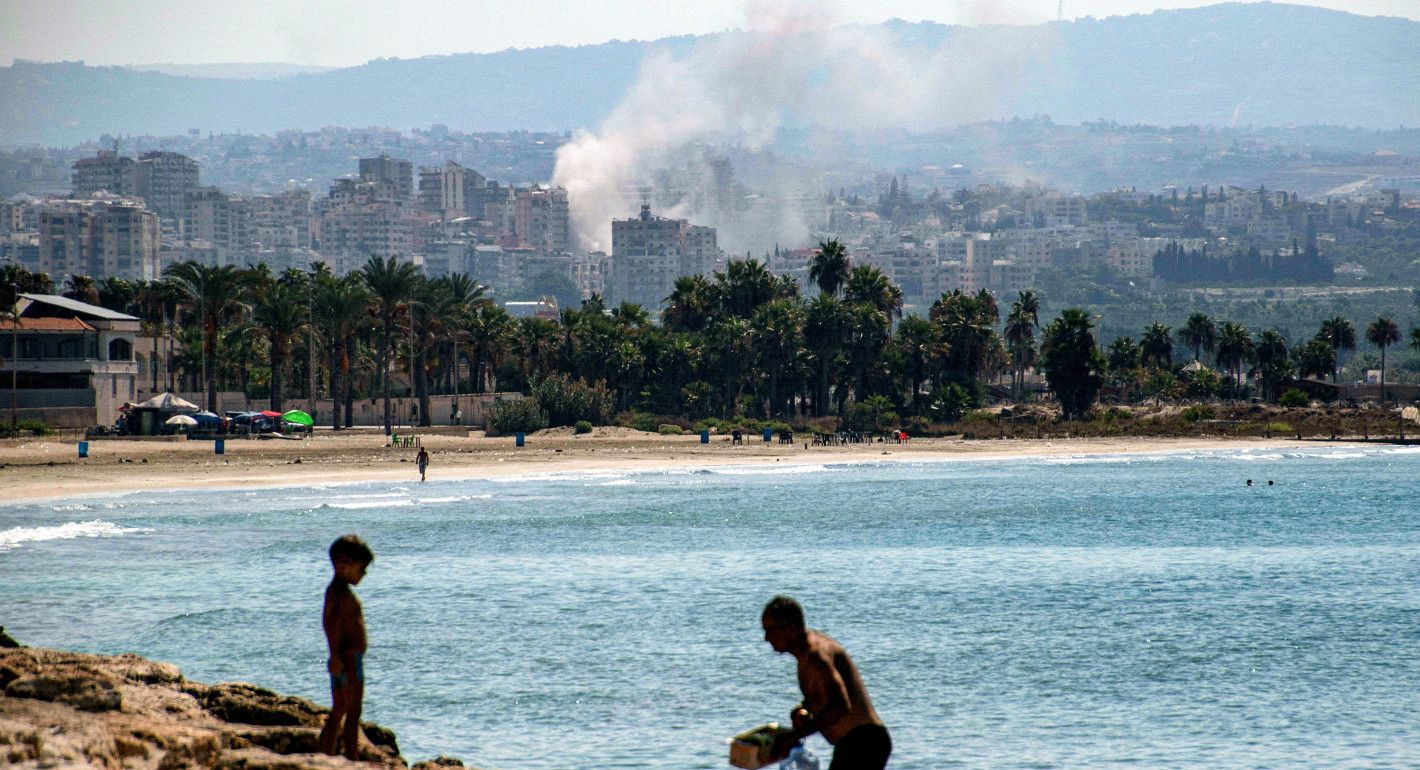
An Israeli air strike on a village near Tyre in southern Lebanon on September 25, 2024. (Photo by Hasan Fneich/AFP via Getty Images)
Lebanon’s foreign minister on the Israel-Hezbollah conflict, the southern border, and what it will take to end the violence.
On this week’s episode of Carnegie Connects, Aaron David Miller spoke with Lebanese Minister of Foreign Affairs and Emigrants Abdallah BouHabib about the unfolding crisis in Lebanon and how the United States and others can respond. Their conversation was recorded on Tuesday evening.
Excerpts from their conversation, which have been lightly edited for clarity, are below. Listen to their full discussion here.
Aaron David Miller: You were at the UN General Assembly listening to President [Joe] Biden’s speech. When the president mentioned Lebanon, the cameras flashed to you, and you were listening intently. What did you think about what he had to say?
His Excellency Abdallah BouHabib: It was not strong. It was not promising, and it would not solve the Lebanese problem. We need to solve [the problem]. We can’t continue like this, neither the situation that we are in today nor [the situation] we were in the other day before [Israel’s] escalation. And there was no promise in this sense. But we still are hoping the United States is the only country that can really make a difference in the Middle East and with regard to Lebanon.
Miller: Can you describe for us what the general mood of the country is?
BouHabib: I’ve been [in the United States] or on the road since last Thursday, which was this second day [after] we saw the explosions of walkie talkies. . . .
But let me tell you, it is depressing. And nobody expected the war to be taken in that direction. We Lebanese—we’ve had enough war. We’ve had fifteen years of war. . . .
We’d like to live without war—happily, as a tourist country, a beautiful country, good food—and we are not able to do it. And so there is a lot of depression, especially with the latest escalation. It’s really depressing people . . . and those who are leaving, the capable people, have something in their hands that they can sell somewhere else.
So it is very difficult for the Lebanese people to accept what’s happening. We want peace. A recent poll in Lebanon showed that 90 percent of Lebanese want peace. And it’s not easy to get it. I think the more we think about it, the United States is the key to our, I would say, salvation, if I can use this word.
Miller: That’s a strong word to use in terms of America saving Lebanon. What are Lebanese people feeling with respect to last week’s incidents?
BouHabib: It was an attack mostly on Hezbollah, but a lot of civilians got hurt in the process, because not everybody is sitting there fighting on the front. These are people who have pagers or have telephones. They are regular people. Some of them are also fighters, but not most of them. A lot of them are administrators working here and there. . . .
This is against our sovereignty, and this is against our independence. It’s an attack on our country. That’s how we see it. And we don’t welcome it. It is difficult to explain because we are in a situation where we don’t like the war, but at the same time, the war is imposed over us. And you’ve got to defend your country.
Miller: If you ask most Lebanese how they looked at Hezbollah, would they say that it’s a resistance organization, a proxy of Iran, a legitimate Lebanese political party, or all of the above?
BouHabib: Yes, there are groups—not the whole community, [but] groups in communities—that are against Hezbollah. Against not Hezbollah as a party, but Hezbollah as a military organization.
Whenever you have occupation, the resistance becomes legitimate. And Israel still occupies a small part of Lebanon. . . . And therefore, there is a resistance, and the country gives [Hezbollah] some kind of legitimacy as resistance. And it is very difficult for us to really be able to control such kind of things—it’s beyond the hand of the Lebanese and the Lebanese government. . . .
We see ourselves in a catch-22 situation. We need to be saved from such a situation. I think we are not able to do it on our own. We need some help. And that’s why I go again to the United States, despite the disappointments of the past. You and I know about them!
Miller: Yes, we do.
When we talk about Hezbollah defending Lebanese sovereignty, is what we’re really talking about the land border between Israel and Lebanon?
BouHabib: . . . From 2006 up until October 7, 2023—seventeen years—there was no major incident on the border between us and Israel. And Hezbollah was there, armed and down there—maybe preparing for such a war as you see it now, but there was no major incident.
And now we are pushing to start a process [for diplomatic resolution with Israel] through which [Lebanon] will get back all of this land . . . .
And, if Hezbollah remains armed, it should become a Lebanese problem. It would be gradually, but I think it would be solved. It’s not going to be solved overnight.
But on the border [with Israel], we are ready to put a strong number, a large number of troops in the south, just so that the government itself would be the absolute power with the help of [the United Nations Interim Force in Lebanon] in the South. We really need to negotiate such kinds of things.
Miller: This is not like the Israeli-Palestinian conflict where we’re talking about Jerusalem, borders, refugees. This is something that is far more direct, far more tractable. It can actually be fixed.
And what you seem to be saying is once it is fixed, Hezbollah would lose its legitimacy as a resistance organization—no more problems with Israel, presumably, and then Hezbollah would become an internal Lebanese problem.
BouHabib: That’s true.
Miller: The Lebanese sovereign institutions, including the Lebanese Armed Forces and the political system, would address [Hezbollah]. Is that fair?
BouHabib: That’s a fair statement.
Miller: That is actually extremely encouraging, even amid all the grimness that we’re facing.
We’ve known each other for a very long time. You’re a very good analyst of the region. . . .
BouHabib: (laughing) It’s very difficult for me to analyze publicly, and before my analysis was in opposition to the government.
Miller: As an analyst, have you drawn any conclusions about what you think the Israelis are doing? What is the strategy here?
BouHabib: What I hear from most countries that we meet with . . . is that this [Israeli] government cannot survive except with wars and therefore doesn’t look favorably on a ceasefire in Gaza. Also now there isn’t much [left] in Gaza to destroy, [so now they] turn to Lebanon. In Lebanon there is Hezbollah. Hezbollah is an enemy to them. They are targeting [Hezbollah], but they are also very much hurting Lebanon and the Lebanese, who are not involved that much in the war. . . .
It’s a very difficult situation, a costly situation in a time that the country is still weak economically. We still did not come back from the port blast [in Beirut], or the [coronavirus pandemic] that hurt us a lot, or the economic disaster that occurred in 2019. . . .
And all of this to do what? It’s all destruction for nothing. And the people are hurt. Most people are hurt. Israelis are hurt. Lebanese are hurt. We can find a solution. . . . We can reach an agreement again on the land border. But Israel has to say “start negotiating” and start accepting the fact that it must finish the occupation of this very small area of Lebanon.
The latest from Carnegie scholars on the world’s most pressing challenges, delivered to your inbox.
Miller: How do you begin to structure a pathway out of this, under these circumstances?
BouHabib: It’s a very difficult situation. One suggestion I heard here at the United Nations is a ceasefire in Gaza and Lebanon at the same time.
Although in Gaza it would not last later than when the hostages are released. In Gaza, [Israelis have] phase one, phase two, phase three. . . .
So we don’t know yet. We haven’t met with the United States yet. My prime minister is coming after [Tuesday] evening, and hopefully we will meet with them in the next two days, and we’ll see what happens, what they have in mind. Because only the United States is equipped to know both sides of the border. They know Lebanon [and] what it wants, and they know Israel and what it wants, and maybe they can find a match. I pray for that. But it is just at the level of prayers still.
Miller: It’s complicated by the fact that Lebanon’s policies are inextricably linked to what happens in Gaza.
BouHabib: That’s right.
Miller: Your view here is that Iran is risk averse. Iran does not want a major expansion of the war because it could involve the United States and could involve Iran. Correct?
BouHabib: That’s right. Iran, well, I think they don’t want a war. They don’t want an overall war. I don’t think they want to be involved in a war. And from the beginning—I heard it from the former foreign minister—they wanted a ceasefire immediately rather than a war. But of course, it was difficult for Israel to have a ceasefire in the first week or so [after October 7].
There were talks between the Iranians and the United States in Oman. And they thought they succeeded. And I understood . . . that there would have been talks on October 10—but October 7 happened—to discuss the nuclear agreement again.
Now [Tuesday] the foreign minister of Iran said that they are ready to talk about—I don't know how or when—the nuclear issue between them and the United States, or between them and the Western world, whichever. . . . But they’re willing, which means that they don’t want war. They really want peace.
Use the player below to listen to the whole conversation, or watch it on YouTube.
Invalid video URL

Senior Fellow, American Statecraft Program
Aaron David Miller is a senior fellow at the Carnegie Endowment for International Peace, focusing on U.S. foreign policy.
Recent Work

Dara Massicot, Aaron David Miller, Andrew S. Weiss

Sophia Besch, Eric Ciaramella, Steve Feldstein, …
Carnegie does not take institutional positions on public policy issues; the views represented herein are those of the author(s) and do not necessarily reflect the views of Carnegie, its staff, or its trustees.
The summit may be remembered as a fatal blunder, when Washington, Beijing, and the AI industry collectively chose ceremony over action.
Jeffrey Prescott

The real test may come after the leaders leave the room.



Sheena Chestnut Greitens, Oriana Skylar Mastro, Yukon Huang, …

The Horn of Africa countries are among those facing a new security calculus.


Andrew Leber, Lesley Anne Warner
Why governance of rapidly evolving technology will be distributed and complex.


Stewart Patrick, Scott Singer

It should address the shortcomings of previous crisis communication efforts and adapt to the demands of frontier AI.

Lucy Luo