

Article
Federica Du Pasquier, Oona A. Hathaway, Stewart Patrick
{
  "authors": [
    "Stewart Patrick"
  ],
  "type": "commentary",
  "blog": "Emissary",
  "centerAffiliationAll": "dc",
  "centers": [
    "Carnegie Endowment for International Peace"
  ],
  "collections": [
    "The Post-American World"
  ],
  "englishNewsletterAll": "ctw",
  "nonEnglishNewsletterAll": "",
  "primaryCenter": "Carnegie Endowment for International Peace",
  "programAffiliation": "GOI",
  "programs": [
    "Global Order and Institutions"
  ],
  "projects": [],
  "regions": [
    "United States"
  ],
  "topics": [
    "Global Governance",
    "Foreign Policy",
    "Domestic Politics"
  ]
}
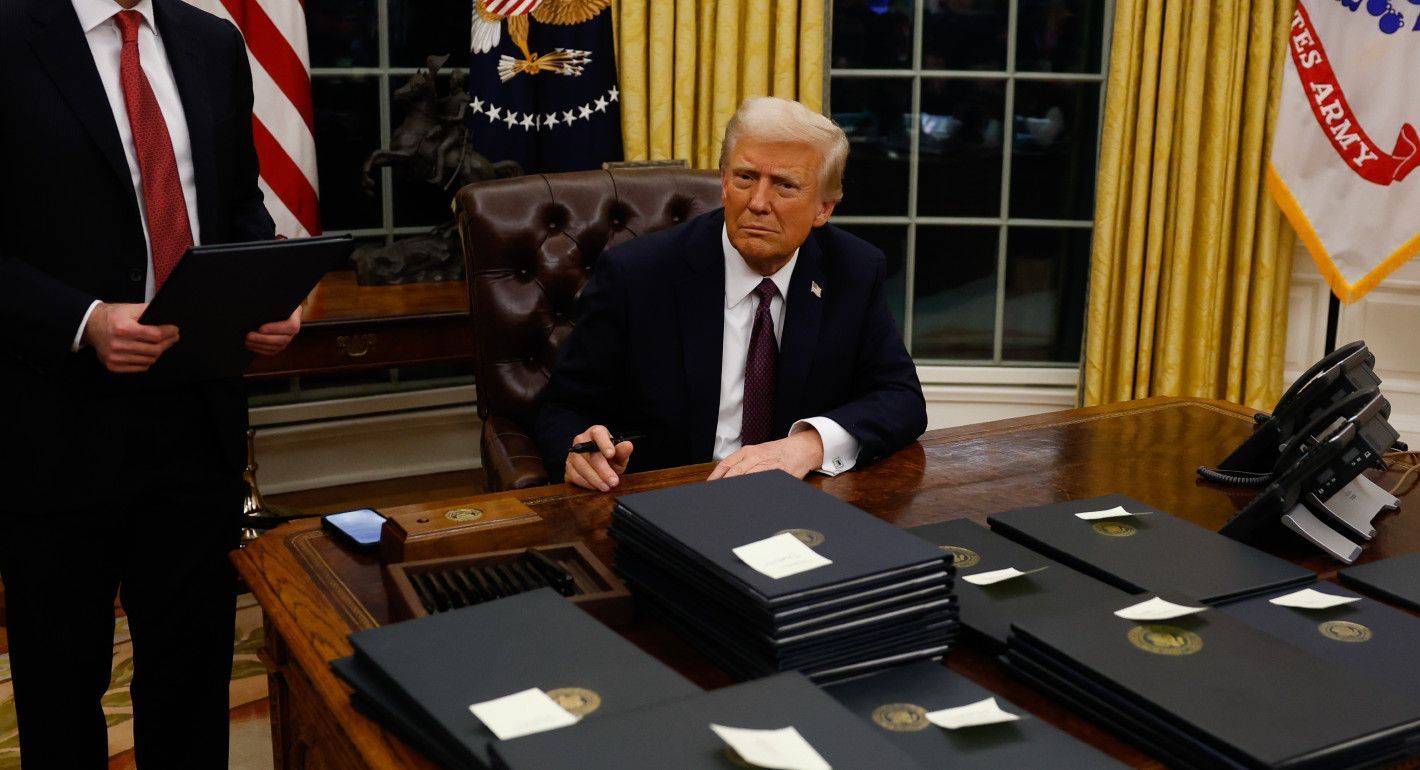
Trump signs executive orders in the Oval Office on January 20, 2025. (Photo by Anna Moneymaker/Getty Images)
The new administration’s retreat from global institutions and agreements is self-defeating.
President Donald Trump’s inaugural address and busy first days in office signal a determination to reassert American sovereignty and opt out of arrangements that he perceives to threaten it. His claims and executive orders, however, reflect a distorted understanding of the true meaning of sovereignty and a crimped view of how best to advance U.S. interests in an age of global interdependence. The president may ground his rejection of international organizations and agreements in the language of American exceptionalism, but the “exemptionalist” policies he advocates will leave the United States defenseless against problems that don’t carry passports and cede the diplomatic field to nations whose preferences may diverge markedly from U.S. interests and values.
In his January 20 address in the Capitol Rotunda, the president promised a new era of national greatness, grounded in the country’s distinctive identity. “Our sovereignty will be reclaimed. Our safety will be restored. . . . America will soon be greater, stronger, and far more exceptional than ever before.” Trump’s invocation of sovereignty—a common theme of his first administration—was predictable if problematic. More intriguing, given recent commentary suggesting that his election signaled the death knell of American exceptionalism, was his invocation of that very concept and his insistence that the United States is no ordinary power.
The president and his Make America Great Again (MAGA) movement articulate a deeply misleading interpretation of sovereignty that treats virtually any involvement in multilateral organizations, treaties, and other arrangements as infringing on the U.S. ability to govern itself. But the U.S. Constitution allows for these commitments, since they are made voluntarily by elected officials, including the president and, in the case of treaties, the Senate. And although they do entail some relinquishing of notional freedom of action, they advance objectives that are otherwise difficult, if not impossible, to attain without collective action.
Viewed in this light, U.S. participation in international organizations and agreements is an exercise of sovereignty. This is based on the recognition that in an age of global interdependence, the United States frequently needs to go along with others to shape its fate. In many cases, the alternative is to try, at inordinate expense and likely in vain, to address transnational problems alone. Or—as Trump seems to prefer—to have the United States take its ball and go home, believing that border walls can somehow protect the nation from contemporary global risks, threats, and dangers.
This does not mean that all international initiatives merit U.S. support, but even decisions to join wrongheaded multilateral schemes are not a violation of sovereignty. As president, Trump is entitled to his own calculus about the costs and benefits of particular international commitments and bodies, from the Paris Climate Agreement to the World Health Organization, both of which he recently declared the United States would leave. But suggesting that American sovereignty is somehow at stake when it joins others to combat climate change or address global health issues is misleading. These bodies and agreements are not like the European Union, with hierarchical arrangements that place U.S. officials below their authorities.
Trump’s invocation of American exceptionalism should have come as no surprise. The notion that the United States is unique and superior and has a special destiny among nations has long been an article of faith in American political culture. “We have it in our power to begin the world over again,” Thomas Paine declared in 1776. American independence was widely interpreted as heralding a new order of the ages, and since then, nearly all U.S. presidents and their political parties have embraced the view that the United States is peerless and blessed with a special providence. At the same time, they have often differed markedly on the implications of this exceptional status for U.S. foreign policy.
Those of an internationalist bent, particularly since Woodrow Wilson, have depicted the United States as having a vocation to spread democracy and even to remake the world in its own image. Others have hewn to a more isolationist course, seeking to protect America’s sacred liberties from an alien and dangerous world, while serving as a beacon and model for others. This orientation often translates into “exemptionalism”—a decision to opt out of international treaties, organizations, and other obligations, even when these have been painstakingly negotiated by diplomats and tailored to the U.S.’s preferences. The result, as the Pulitzer Prize–winning historian Walter MacDougal observes, has been an oscillation between two foreign policy archetypes: the “crusader state” and the “promised land.”
Trump falls into the “promised land” category, advocating for retrenchment from foreign entanglements and forever wars, secure borders, and a heightened focus on the Western Hemisphere where national security is concerned. In historical terms, Trump’s closest spiritual predecessor may be Andrew Jackson, another populist U.S. president focused on national greatness. Like Jackson, Trump is insistent on preserving national sovereignty and quite willing to threaten force, with a don’t-tread-on-me ferocity, if provoked. With Trump, the Jacksonian tradition has come roaring back, with the current president as its avatar.
The ongoing struggle between these alternative forms of American exceptionalism leaves the rest of the world whipsawed between U.S. overreach and solipsism. Over the past decade, the United States has executed three 180-degree turns in its attitude toward multilateralism, as the White House lurched from Barack Obama to Trump to Joe Biden and now back to Trump.
The United States will bear heavy costs—both material and reputational—for Trump’s approach to sovereignty and exceptionalism. The U.S. renunciation of the Paris Agreement will complicate global progress on the most pressing ecological threat humanity has ever encountered and raise the costs to U.S. citizens from climate-related disasters. America’s departure from the WHO will cripple the agency charged with anticipating, preventing, and responding to health threats that have the potential to kill vastly more Americans than the COVID-19 pandemic. The president’s imposition of tariffs will lead to a spiral of tit-for-tat responses that further fragment global trade and raise prices for Americans. Trump’s decision to rescind Biden’s executive order on AI safety, and his opposition to global AI regulation, will intensify threats from destabilizing technologies. America’s failure to comply with U.S. asylum obligations under the 1951 Refugee Convention will further darken its already tarnished reputation as a champion of international law and human rights. And so on.
In his inaugural address, Trump celebrated “our nation’s glorious destiny,” promising, “our golden age has just begun.” He declared that the United States will be “full of compassion, courage, and exceptionalism . . . and bring a new spirit of unity to a world that has been angry, violent, and totally unpredictable.”
These are attractive, even admirable, goals. But nurturing such a spirit of global unity, to say nothing of enduring international cooperation, will require more than a self-regarding, transactional approach to world affairs. It will require exercising leadership to forge collective action on shared global problems and accepting significant responsibilities for defending international order. Neither has been apparent in the president’s early moves.
The latest from Carnegie scholars on the world’s most pressing challenges, delivered to your inbox.

Senior Fellow and Director, Global Order and Institutions Program
Stewart Patrick is a senior fellow and director of the Global Order and Institutions Program at the Carnegie Endowment for International Peace. His primary areas of research focus are the shifting foundations of world order, the future of American internationalism, and the requirements for effective multilateral cooperation on transnational challenges.
Recent Work


Federica Du Pasquier, Oona A. Hathaway, Stewart Patrick

Ian Klaus, Stewart Patrick
Carnegie does not take institutional positions on public policy issues; the views represented herein are those of the author(s) and do not necessarily reflect the views of Carnegie, its staff, or its trustees.

Rubio’s recent visit brought welcome attention, but more capital requires governance changes that may be a hard sell for regional governments.

Jennifer B. Murtazashvili
Why Pakistan, Saudi Arabia, and Turkey are joining forces on regional security.


Alper Coşkun, Amr Hamzawy

Despite public disputes over trade and immigration, the strategic partnership’s foundations remain sturdy.

Sameer Lalwani

It signals a new era of tech diffusion and warfare.

Steve Feldstein
Despite its flop at the box office, the film raises important questions for the climate community to answer.
Leonardo Martinez-Diaz