

Paper
Raluca Csernatoni, Alicia Wanless
{
  "authors": [
    "Alicia Wanless"
  ],
  "type": "commentary",
  "blog": "Emissary",
  "centerAffiliationAll": "dc",
  "centers": [
    "Carnegie Endowment for International Peace"
  ],
  "collections": [
    "Trump’s Disruptive 100 Days"
  ],
  "englishNewsletterAll": "ctw",
  "nonEnglishNewsletterAll": "",
  "primaryCenter": "Carnegie Endowment for International Peace",
  "programAffiliation": "TIA",
  "programs": [
    "Technology and International Affairs"
  ],
  "projects": [],
  "regions": [
    "Canada",
    "United States"
  ],
  "topics": [
    "Democracy",
    "Security",
    "Economy",
    "Foreign Policy"
  ]
}
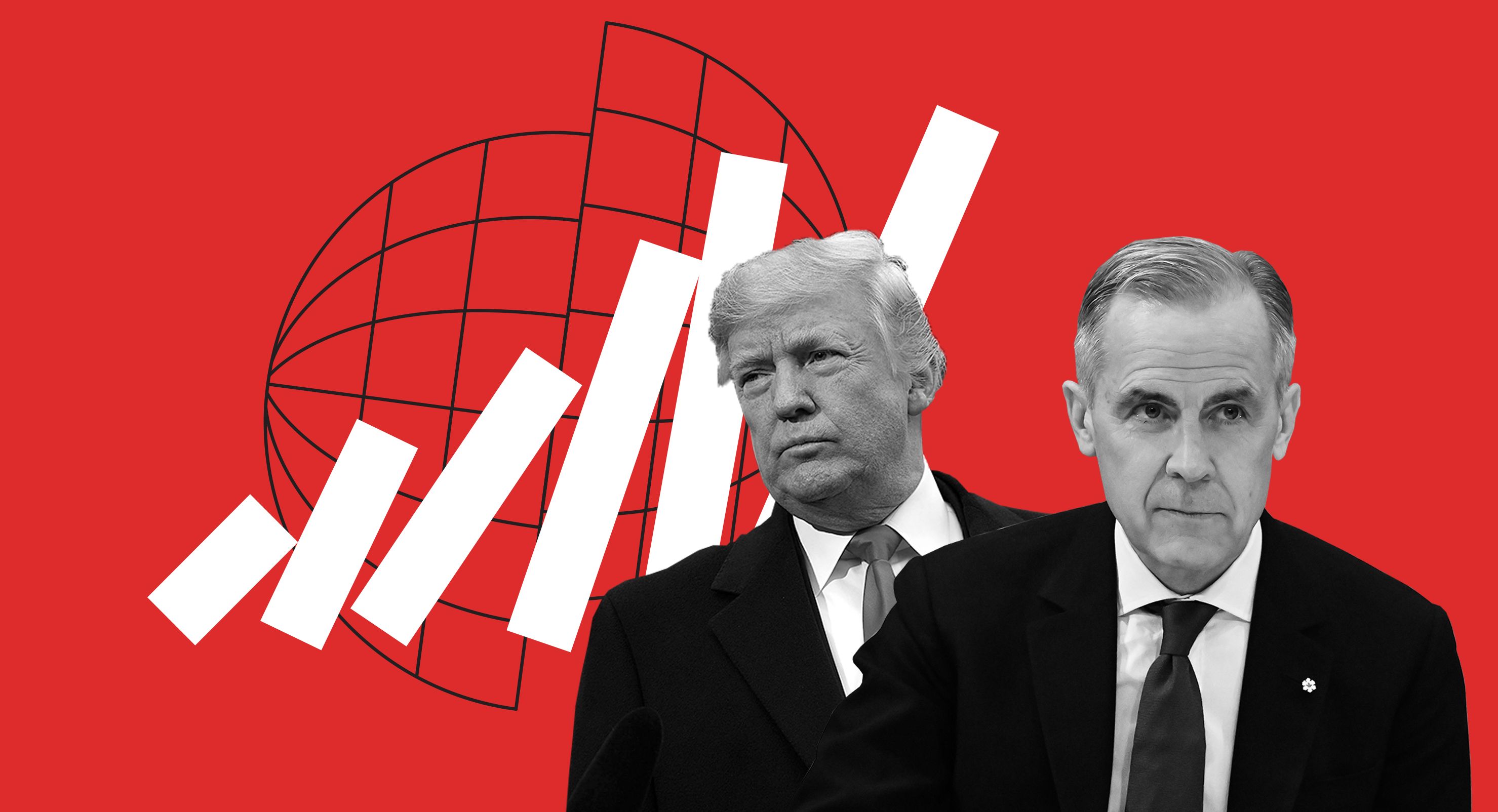
(Photos by Getty Images)
Its path forward depends on overcoming internal divisions and developing a new strategy for its own place in the world.
This piece is part of a Carnegie series examining the impacts of Trump’s first 100 days in office.
How long does it take to ruin a friendship?
Weeks. Through tariffs and annexation threats, President Donald Trump upended the long-standing relationship between Canada and the United States. Within a month of his second term, 27 percent of Canadians saw the United States as an enemy country. Six weeks in, Trump imposed a 25 percent tariff on Canadian goods and 10 percent on energy exports, leaving half the country angry and 37 percent feeling betrayed.
Canada and the United States are deeply integrated economically—they share one of the world’s most comprehensive trading partnerships—as well as in defense, security, and intelligence-sharing. Three-quarters of Canada’s exports go to the United States, most of which are part of the production processes for American businesses. For example, Canadian softwood pulp is prized in American toilet paper manufacturing, but tariffs could now cause shortages. Decoupling from this relationship will challenge both sides, but Canada also faces internal destabilization.
Trump’s actions came amid a political crisis in Canada. Former prime minister Justin Trudeau stepped down on January 6, triggering a Liberal Party leadership race. Widely expected to lose the next election, the party reversed negative approval ratings in selecting Mark Carney, a former central bank governor of both Canada and England who promptly called a vote for April 28. On the other side of the aisle, Alberta Premier Danielle Smith suggested that Trump’s tariffs played a role in the Liberal Party’s new fortunes. She asked the U.S. administration to put its measures “on pause” such that a politician more “in sync” with Republican views could win the election, referencing Conservative Party leader Pierre Poilievre. Smith’s admission to Breitbart News stoked fears of foreign election interference, hot off a public inquiry into the practice during the 2021 federal election. But it also highlighted domestic political tensions that make mounting a collective response to tariffs challenging.
Canadian federalism divides the government’s powers into two jurisdictions, with the federal government responsible for the entire country and the provinces for their regions and populations. Traditionally, this setup requires a delicate balance between the two levels of government. Discontent in the west of Canada has been festering, with nearly half of Albertans believing their province is getting less from federalism in Canada than it is giving to other provinces. A quarter of Albertans want independence, and 22 percent want to join the United States. Some are running Facebook groups supporting the latter idea. So, although the Canadian federal government responds to these tariffs, it must do so in conjunction with the providences, which may have other ideas.
Oil exports are one example of a tariff response that would be politically toxic. Canada is the top exporter of crude oil to the United States, accounting for 60 percent of all imports in 2023. However, most Canadian crude oil comes from Alberta, and Smith is unwilling to jeopardize those exports. Moreover, Smith has issued demands to Carney, including having “full access to unfettered oil and gas corridors to the north, east, and west,” while raising the specter of an independence referendum for the province after the federal election. Others, such as former Reform Party of Canada leader Preston Manning, have gone further. Manning suggested Alberta could secede if Carney wins the upcoming election. Moreover, political rhetoric on the right of Canada’s political spectrum has mirrored that in the United States, deepening divides across party lines.
If oil tariffs are out, what other options remain?
Federally, Canada announced a wave of countertariffs on American products. Officials tried to compromise, too, announcing investments in border security and hiring a so-called fentanyl czar to address Trump’s purported reason for introducing the tariffs. It’s hard to fix a problem that isn’t there, though: In 2024, just 43 pounds of fentanyl crossed from Canada, accounting for 0.2 percent of the total amount seized at American borders.
Provincial and territory leaders have also responded. Most moved quickly to remove American alcohol from stores, and some, including Alberta, deprioritized or banned American companies from bidding on public projects. Ontario Premier Doug Ford threatened to tax electricity exports and end a $70 million contract with Elon Musk’s Starlink.
Canada could overhaul its domestic market. Some policies, such as health and safety regulations, have been left to the provinces, resulting in trade barriers that impede the movement of goods and services between provinces and territories. One way to compensate for the losses caused by tariffs is to foster free trade within Canada by removing these barriers.
Another option is to deepen ties with the European Union and even seek membership. Technicalities aside, it’s not out of the question. Indeed, as Canada seeks to bolster defenses independent from the United States, it is already turning to the European Union to participate in its defense industry. Moreover, Carney has also indicated that Canada is prepared to replace the United States as a world leader in fostering democracy and free trade.
Predicting Canada’s longer-term response is challenging, especially given the upcoming election. Candidates are currently announcing campaign promises, with many focusing on shoring up domestic industries and supporting workers. Although Trump’s actions have shaken Canadians out of a long-held complacency born from a massive market next door, it’s an open question whether Ottawa’s elite has the creativity and wherewithal to diversify the economy. The fact remains that geography ties Canada to the United States, and pragmatism suggests a functional relationship is necessary. Likewise, hope remains that a future administration south of the border will have a better attitude toward Canada.
The more significant issue, though, will be trust. With tariffs, Trump is violating a trade agreement he negotiated, rendering future deals less reliable in the eyes of Canadians. However, the threat of taking over Canada makes restoring the old relationship unlikely, and citizens are using their power to make this known. Canadians are boycotting American products and canceling U.S. travel plans, leading to a 70 percent decrease in flight bookings—and a potential loss of billions for the American tourism sector. Most Canadians see their upcoming vote as more important than ever before. Carney was reading the room when he proclaimed that Canada’s relationship with the United States was over.
Read more from this series, including:

Senior Fellow, Technology and International Affairs, Director, Information Environment Project
Alicia is the director of the Information Environment Project and the author of The Information Animal: Humans, Technology and the Competition for Reality. Alicia was a technical advisor to the Aspen Institute’s Commission on Information Disorder and is a founding member of its Global Cybersecurity Group.
Recent Work

Raluca Csernatoni, Alicia Wanless



Sophia Besch, Steve Feldstein, Stewart Patrick, …
Carnegie does not take institutional positions on public policy issues; the views represented herein are those of the author(s) and do not necessarily reflect the views of Carnegie, its staff, or its trustees.

AI capabilities are moving fast. Most institutions—including governments—can’t keep up.


Anton Leicht, Scott Singer
They face an uphill climb, but they could draw on a strategy that other diplomats have used in the past.


Shana Tabak, Alejandro Martin Rodriguez

The books, podcasts, and films that explain the world it made.

Andrew Leber
U.S. trading partners in Asia are closely watching the dispute for signs of how it may affect their own interests.

Barbara Weisel

Congress should ask tough questions about the agreement’s more unique features and whether they advance U.S. interests or compromise them.

Jane Darby Menton