

Q&A
- +1
Sophia Besch, Alper Coşkun, Nate Reynolds, …
{
  "authors": [
    "Nate Reynolds"
  ],
  "type": "commentary",
  "blog": "Emissary",
  "centerAffiliationAll": "dc",
  "centers": [
    "Carnegie Endowment for International Peace"
  ],
  "collections": [
    "Trump’s Disruptive 100 Days"
  ],
  "englishNewsletterAll": "ctw",
  "nonEnglishNewsletterAll": "",
  "primaryCenter": "Carnegie Endowment for International Peace",
  "programAffiliation": "russia",
  "programs": [
    "Russia and Eurasia"
  ],
  "projects": [],
  "regions": [
    "Russia",
    "Ukraine",
    "United States"
  ],
  "topics": [
    "Security",
    "Domestic Politics",
    "Foreign Policy"
  ]
}
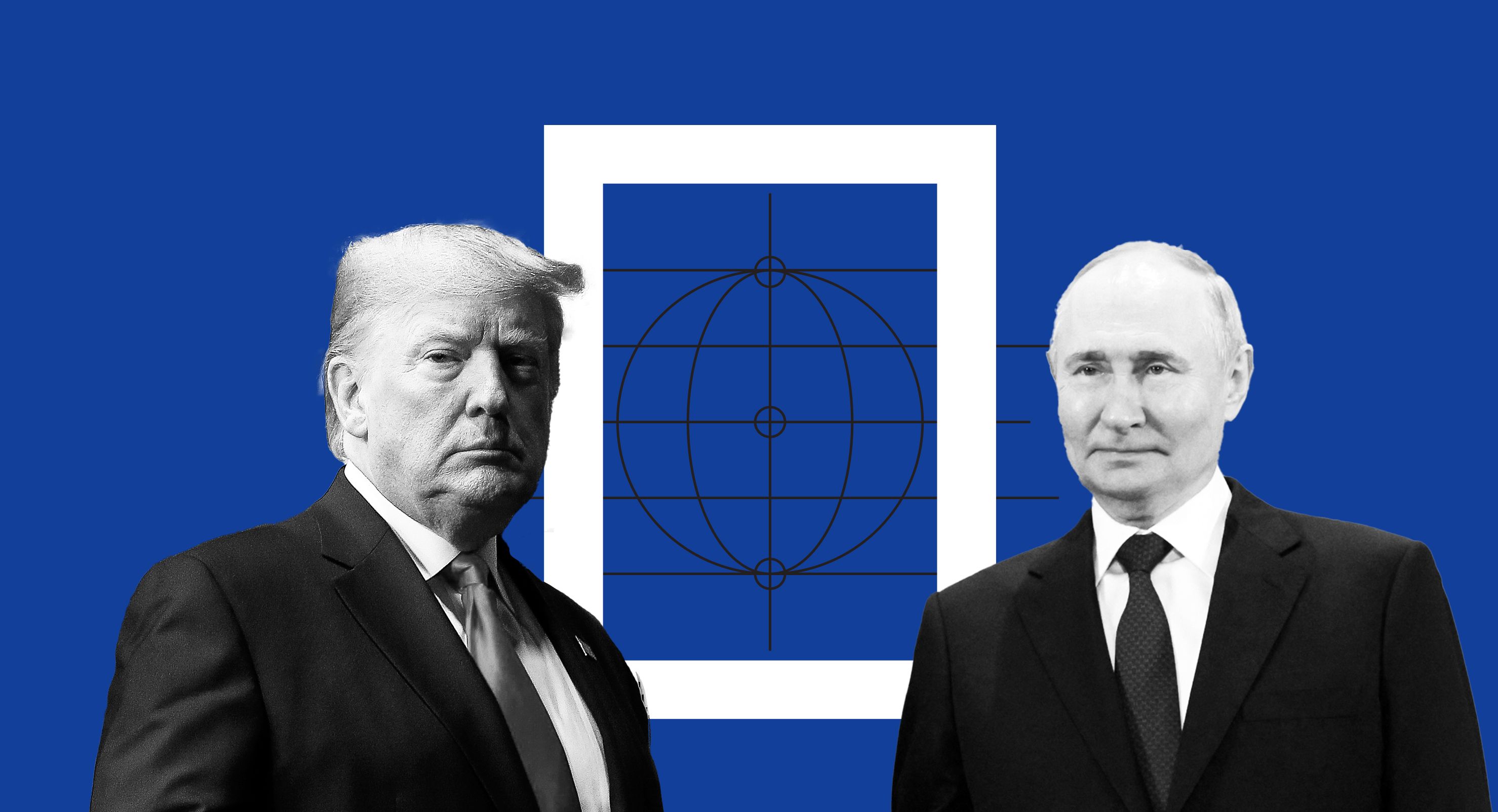
(Photos by Getty Images)
In doing so, Putin hopes to undo the post-Cold War order.
This piece is part of a Carnegie series examining the impacts of Trump’s first 100 days in office.
In its first 100 days, the administration of President Donald Trump has flipped previous policy toward Russia on its head. It’s broken Russia’s previous isolation from the West in hopes of securing a ceasefire in Ukraine and a better U.S. relationship with Moscow. It’s taken a coercive and transactional approach to Kyiv, putting the future of U.S. support to Ukraine’s security in doubt. And it’s hinted at a broader retrenchment from Europe, helping plunge the transatlantic partnership—which has been the bedrock of U.S. strategy toward Russia and its Soviet predecessor for the past eighty years—to new lows. The Trump administration justifies at least some of these moves as a pivot to counter China, but Russia stands to gain.
Moscow is playing along with Washington’s ceasefire diplomacy, hopes for a rapprochement, and deep skepticism of allies and partners. In doing so, it wants to achieve two long-standing, strategic goals—dominion over Ukraine and the weakening of U.S. power, especially in Europe. Both goals are embedded in Russia’s ambition to undo the post–Cold War order. Moscow resents that the United States preserved its dominant role in European security after Soviet power collapsed, even as post-Soviet states gained sovereignty to align with Washington, including through NATO. Overturning this status quo is President Vladimir Putin’s white whale, a driving obsession that has always been beyond the limits of Russian capacity alone. But as the United States creates geopolitical shockwaves in Europe, Russia sees a window of opportunity.
Putin’s first order of business is Ukraine. He has disabused the White House of its early hopes for a quick ceasefire, despite significant U.S. concessions. Now he wants to convince Trump that the only path to peace is through accepting all of Russia’s demands, which will amount to a neutered Ukraine that is vulnerable to Russian influence and power. Whether Putin thinks this will lead to a deal is unclear. But he wants to persuade Trump that Ukraine and Europe should give the necessary concessions, hoping to stoke U.S. hostility toward its partners. For Russia, even a failed negotiation is valuable if it persuades the United States to walk away from the conflict—it would be a de facto U.S. recognition that Ukraine lies in Russia’s sphere and boost the Kremlin’s confidence in eventual victory.
Putin also sees an opportunity to cleave the United States from Europe, in part by playing on Washington’s enthusiasm to improve U.S.-Russia relations. Early discussions of a U.S.-Russia rapprochement have added to tensions in the transatlantic alliance, because a more friendly U.S. relationship with Moscow would be at odds with the near-consensus view in Europe that Russia is the primary security threat. For its part, the Kremlin will happily use dialogue with Washington to gain advantages and create opportunities to widen the divide. For example, Russia seems to be preparing narrow commercial deals for the United States, especially on energy, that could result in sanctions relief, drive wedges with Europe, and weaken solidarity on maintaining sanctions in the broader West. More worrisome, Russia could try to go over Brussels’ metaphorical head and dangle negotiations on the U.S. role in European security, which would quickly roil NATO.
At the same time, the Kremlin will not undertake a major reorientation of its foreign policy for the sake of improved U.S. ties. Russian elites view Trump as mercurial and idiosyncratic. In their eyes, he is holding back a U.S. political establishment that the Kremlin believes is bent on keeping Russia weak and that could quickly and unexpectedly reverse any concessions made by Trump. For many in Moscow, the confrontation with the United States is viewed as part of a centuries-long struggle against a hostile West, which they believe will never accept a strong Russia. The Trump administration may be useful, but it cannot alter a dynamic with roots that deep.
Certainly, the Kremlin will not break with China, or even Iran and North Korea, as some in the new U.S. administration hope. The Kremlin gets tangible economic and security benefits from cooperating with these countries—especially China—that the United States cannot replace. Russia has spent the past three years reorienting its foreign policy away from the West, building new trade patterns, and investing in these partnerships to gain critical support for its military efforts. In the case of China, improvements in the partnership have accumulated for over a decade and reflect Putin’s strategic direction that the United States is the more clear and present danger. The Kremlin will not throw this away for what it expects will be a temporary easing of tensions with Washington.
Even if the possibilities for the Kremlin are obvious, outcomes in times of geopolitical turmoil are always uncertain. Russia may find its window of opportunity closes quickly if it antagonizes Washington on Ukraine or takes a strategic misstep that sours relations. In this scenario, the Kremlin could find itself in circumstances resembling the first Trump administration, when a frustrated Moscow could not advance ties. Or Russia may succeed in weakening U.S. influence in Ukraine and Europe, only to find the outcome is not what it hoped. The war in Ukraine already created the very thing Putin feared—an aggrieved and capable neighbor right on its border. Now expectations of U.S. retrenchment are sparking new discussions in Europe about how to take more responsibility for security, unearthing arguments in Germany and Poland on obtaining access to nuclear weapons. Even if Putin succeeds, more dangerous times for Russian security may await.
Read more from this series, including:

Senior Fellow, Russia and Eurasia Program
Nate Reynolds is a senior fellow in the Russia and Eurasia Program at the Carnegie Endowment for International Peace.
Recent Work


Sophia Besch, Alper Coşkun, Nate Reynolds, …

Frances Z. Brown, Nate Reynolds, Priyal Singh, …
Carnegie does not take institutional positions on public policy issues; the views represented herein are those of the author(s) and do not necessarily reflect the views of Carnegie, its staff, or its trustees.
Fatima El Mansouri is the country’s first female prime minister. She’s also a privileged insider in a largely ceremonial position.

Sarah Yerkes

The acknowledgment has sparked fears of a new arms race with China and Russia.

Chris O’Meara

The summit may be remembered as a fatal blunder, when Washington, Beijing, and the AI industry collectively chose ceremony over action.

Jeffrey Prescott

The real test may come after the leaders leave the room.



Sheena Chestnut Greitens, Oriana Skylar Mastro, Yukon Huang, …

The Horn of Africa countries are among those facing a new security calculus.


Andrew Leber, Lesley Anne Warner