

Commentary
Without addressing the worsening issue’s root causes, any mitigation efforts will likely fall short. States in similar situations should take note.
{
  "authors": [
    "Eric Lob"
  ],
  "type": "commentary",
  "blog": "Emissary",
  "centerAffiliationAll": "dc",
  "centers": [
    "Carnegie Endowment for International Peace"
  ],
  "englishNewsletterAll": "menaTransitions",
  "nonEnglishNewsletterAll": "",
  "primaryCenter": "Carnegie Endowment for International Peace",
  "programAffiliation": "MEP",
  "programs": [
    "Middle East"
  ],
  "projects": [],
  "regions": [
    "Iran",
    "Middle East"
  ],
  "topics": [
    "Domestic Politics",
    "Economy",
    "Foreign Policy"
  ]
}
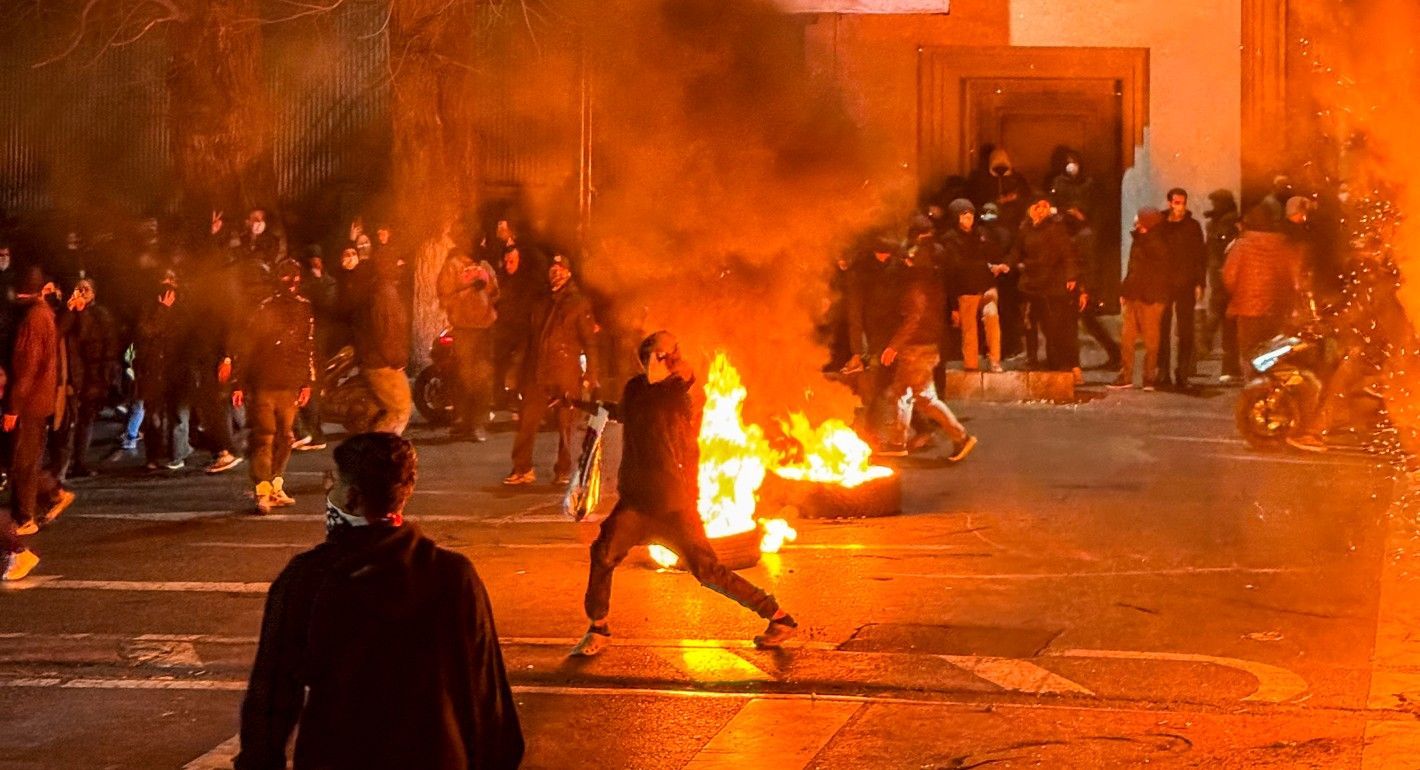
Iranians protest in Tehran on January 9, 2026. (Photo by Mahsa/Middle East Images/AFP via Getty Images)
The pattern may be familiar, but the images of piled bodies and warnings of foreign intervention are stark and sobering.
Once again, large protests have erupted in Iran and spread throughout the country. As the demonstrations enter their third week, the Islamic Republic is again confronting a serious legitimacy crisis and significant international pressure—including threats from U.S. President Donald Trump of military intervention. As in the past, the Iranian government is responding with state repression, including internet blackouts and mass arrests, as images of injured protestors struggling on streets and body bags stacked outside morgues continue to circulate online. Without substantive and systemic change, such cycles of protest and repression will likely continue.
On December 28, merchants and shopkeepers in Tehran—who in the past have tended to be conservative and cozy with the state—went on strike over increased inflation caused by a drastic currency devaluation. In September, EU states imposed UN snapback sanctions against Iran for enriching uranium at levels that exceeded those required for a peaceful nuclear program. Since then, the value of the rial declined sharply and steadily, reaching a record low of 1.45 million per dollar in December. During this period, the steep devaluation of the rial caused inflation to rise by more than 40 percent.
As the prices of food and other essential goods soared, merchants and shopkeepers were unable to sell their products to strained and stressed consumers. They demanded that the government intervene to provide financial assistance, stabilize the exchange rate, and reduce economic pressures precipitated by international sanctions and regional conflicts.
Within days, what started as economic protests concentrated in the capital swiftly spread to other cities and became increasingly politicized. University students and other protesters in Tehran and elsewhere chanted slogans against the government of President Masoud Pezeshkian and the state system of Supreme Leader Ali Khamenei. They also called for more freedom, less interventionism, and regime change. Some allegedly attacked police stations and burned government buildings.
Iranian leaders and officials, including Khamenei himself, rhetorically validated protester grievances and singled out rioters while throttling or shutting down the internet. They did so to prevent demonstrators from mobilizing and coordinating through social media and to limit the amount of information about the protests circulating inside and outside the country. They also resorted to brute force, first using tear gas to disperse demonstrators, then arresting, beating, and firing on protesters. As of January 11, at least 500 people reportedly have been killed and thousands of others have been detained.
The protests have followed a pattern of ones that have occurred since 2017. (The exception was those in 2022–23 over the killing of Mahsa Amini by the so-called morality police for purportedly improperly wearing the hijab, though demonstrations against the compulsory hijab law did happen in 2017–19.) On December 28, 2017, the same date as the start of the current protests, demonstrations broke out in Mashhad over popular discontent concerning alleged government corruption and economic hardship—particularly rising prices—that was exacerbated by international sanctions and Iranian intervention in conflicts in Iraq, Lebanon, Palestine, Syria, and Yemen. The protests soon spread to other cities and became politicized with slogans against the reformist government and supreme leader. They turned violent with alleged attacks against police stations and military installations. The protests prompted an internet shutdown and state repression that resulted in twenty-some deaths and at least 3,700 arrests by the time they largely subsided on January 7, 2018.
Between late 2019 and early 2020, large-scale protests once again spread throughout the country. As in 2017–18, the initial impetus was economic, with citizens expressing outrage over the government’s gasoline rationing and fuel price hike of 50 percent to 200 percent. The protests again started in Mashhad before spreading to more than a hundred other cities. They quickly became politicized against then-president Hassan Rouhani and Khamenei. As with the previous protests, some Iranians called for a cessation of Iran’s involvement in regional conflicts that increased state spending and economic instability. Others set fire to military bases, government banks, and other buildings. As the state had done during the previous protests, it subdued these by imposing a weeklong internet blackout and relying on extensive repression that resulted in approximately 1,500 deaths and more than 7,000 arrests.
Both the previous and current protests placed the Islamic Republic in a serious legitimacy crisis and showed that Iranians had lost trust in political institutions. Whereas voter turnout in the 2017 presidential election was above 73 percent, it dropped to historic lows of around 49 percent in 2021 and 39.9 percent (49.7 percent in the second round) in 2024. Since 2017, Iranians instead opted to organize and join popular protests every two to three years. The slogans and demands of these protests demonstrated that Iranians did not distinguish between so-called reformist and conservative or hardline leaders and officials. Rather, they believed all of them were responsible for the country’s political, economic, and social problems.
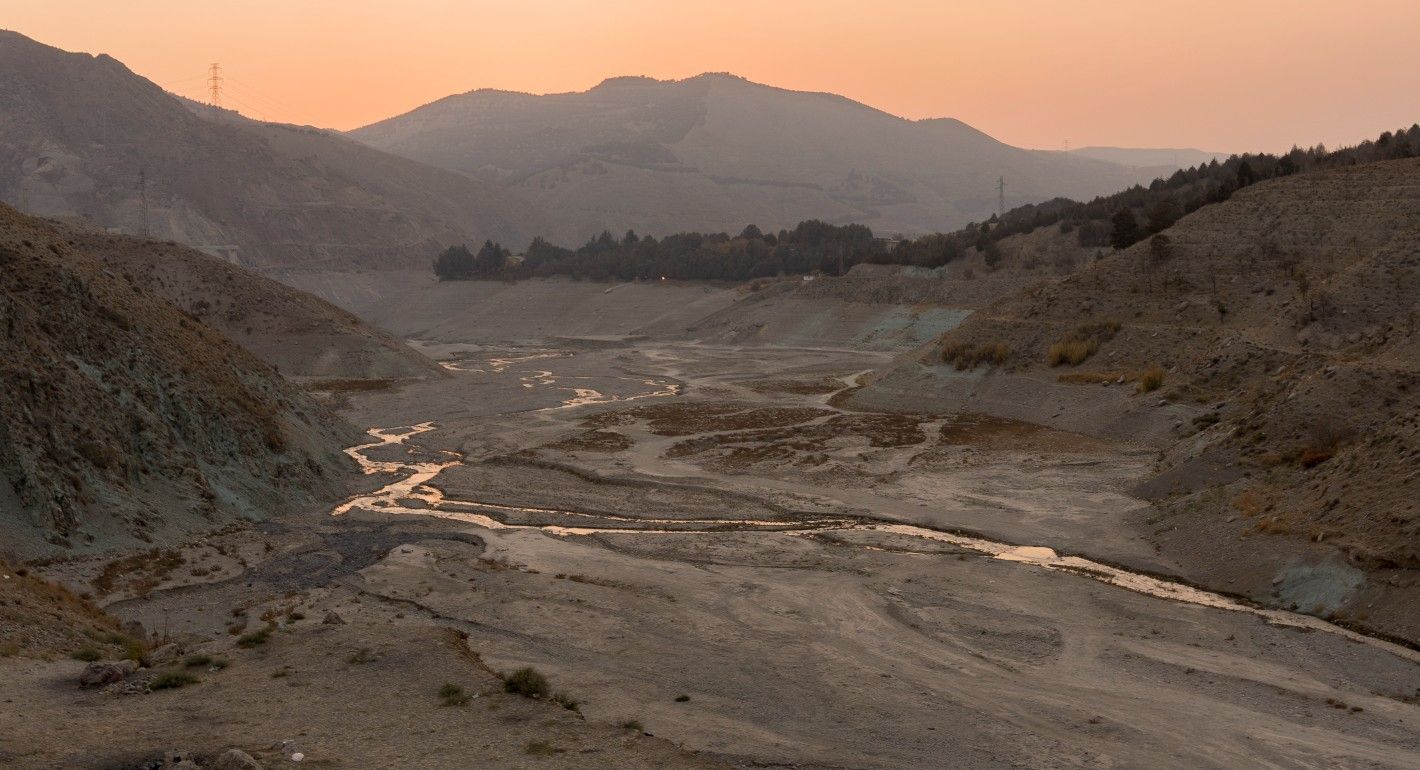
During this period, Iran has encountered economic adversity in the form of elevated inflation that has been exacerbated by economic sanctions and government mismanagement. Under its ultraconservative president Ebrahim Raisi, the regime reimposed religious restrictions that provoked the Amini protests and a government crackdown that caused at least 551 deaths and 19,262 arrests. The Islamic Republic’s legitimacy has been further eroded by an environmental crisis that created prolonged power outages and severe water shortages, which many Iranians blame on mismanagement and inefficiency rather than sanctions and other factors.
Without addressing the worsening issue’s root causes, any mitigation efforts will likely fall short. States in similar situations should take note.
Alongside the legitimacy crisis, the Islamic Republic has faced far more international pressure than it had during the previous protests. Since the end of the Amini protests and the start of the Gaza war in 2023, Iran has found itself increasingly isolated and its regional proxies and partners, including Hamas and Hezbollah, in the so-called Axis of Resistance drastically degraded by Israel. Iran’s isolation further intensified after the fall of the Bashar al-Assad regime in Syria in December 2024.
In 2024 and 2025, the Islamic Republic’s new phase of direct confrontation with Israel and the United States subjected Iran to not just more sanctions, but also military strikes on its own soil, culminating in the devastating twelve-day war last June. The conflict killed at least a dozen nuclear scientists and senior commanders, claimed the lives of 1,190 people, and wounded and displaced thousands more. Any rally-around-the-flag effect the war may have created rapidly dissipated with the latest protests. They again partially attributed the country’s economic challenges to its intervention in regional conflicts.
After the most recent protests started, President Donald Trump attempted to exert greater pressure on the Islamic Republic by threatening to attack it again if it reconstituted its nuclear program and repressed peaceful protesters. As in the past, Trump’s comments caused Khamenei and other leaders and officials to adopt a defiant tone against American aggression and internal meddling. At the same time, on January 10, Pezeshkian met with the foreign minister of Oman— which has been a dependable mediator between Iran and the United States—likely to try to deescalate tensions with Washington. Although inspiring Iranians to demonstrate, Trump’s remarks also risked reinforcing the regime’s narrative that protesters are foreign agents to delegitimize them. Additionally, the Trump administration’s apprehension of Iran’s longtime Latin American ally, Venezuelan President Nicolás Maduro, could further isolate the Islamic Republic (though Maduro’s regime remains largely intact for the time being).
The current protests in Iran project a problematic pattern for the state by parlaying economic grievances into political ones. Confronting a legitimacy crisis and international pressure, the regime responded with its routine repression that may momentarily put down the protests, assuming the security forces continued to remain loyal and refused to defect. However, if the past is any indicator, the state will only succeed in further enraging and emboldening Iranian activists and other citizens to come back out to the streets. Absent any substantive reform or systemic overhaul, the Islamic Republic will likely find itself in the same position of struggling to survive and subdue the next round of protests in a few years’ time—if not sooner.
The latest from Carnegie scholars on the world’s most pressing challenges, delivered to your inbox.

Nonresident Scholar, Middle East Program
Eric Lob is a nonresident scholar in the Carnegie Middle East Program and an associate professor of politics and international relations at Florida International University.
Recent Work


Amr Hamzawy, Andrew Leber, Eric Lob, …
Carnegie does not take institutional positions on public policy issues; the views represented herein are those of the author(s) and do not necessarily reflect the views of Carnegie, its staff, or its trustees.

It signals a new era of tech diffusion and warfare.

Steve Feldstein
Fatima El Mansouri is the country’s first female prime minister. She’s also a privileged insider in a largely ceremonial position.

Sarah Yerkes
The acknowledgment has sparked fears of a new arms race with China and Russia.

Chris O’Meara
The summit may be remembered as a fatal blunder, when Washington, Beijing, and the AI industry collectively chose ceremony over action.
Jeffrey Prescott

The real test may come after the leaders leave the room.



Sheena Chestnut Greitens, Oriana Skylar Mastro, Yukon Huang, …