

Q&A
Dara Massicot, Aaron David Miller, Andrew S. Weiss
{
  "authors": [
    "Aaron David Miller"
  ],
  "type": "commentary",
  "blog": "Emissary",
  "centerAffiliationAll": "dc",
  "centers": [
    "Carnegie Endowment for International Peace"
  ],
  "englishNewsletterAll": "americanStatecraft",
  "nonEnglishNewsletterAll": "",
  "primaryCenter": "Carnegie Endowment for International Peace",
  "programAffiliation": "ASP",
  "programs": [
    "American Statecraft"
  ],
  "regions": [
    "United States",
    "Iran"
  ],
  "topics": [
    "Domestic Politics",
    "Foreign Policy",
    "Military"
  ]
}
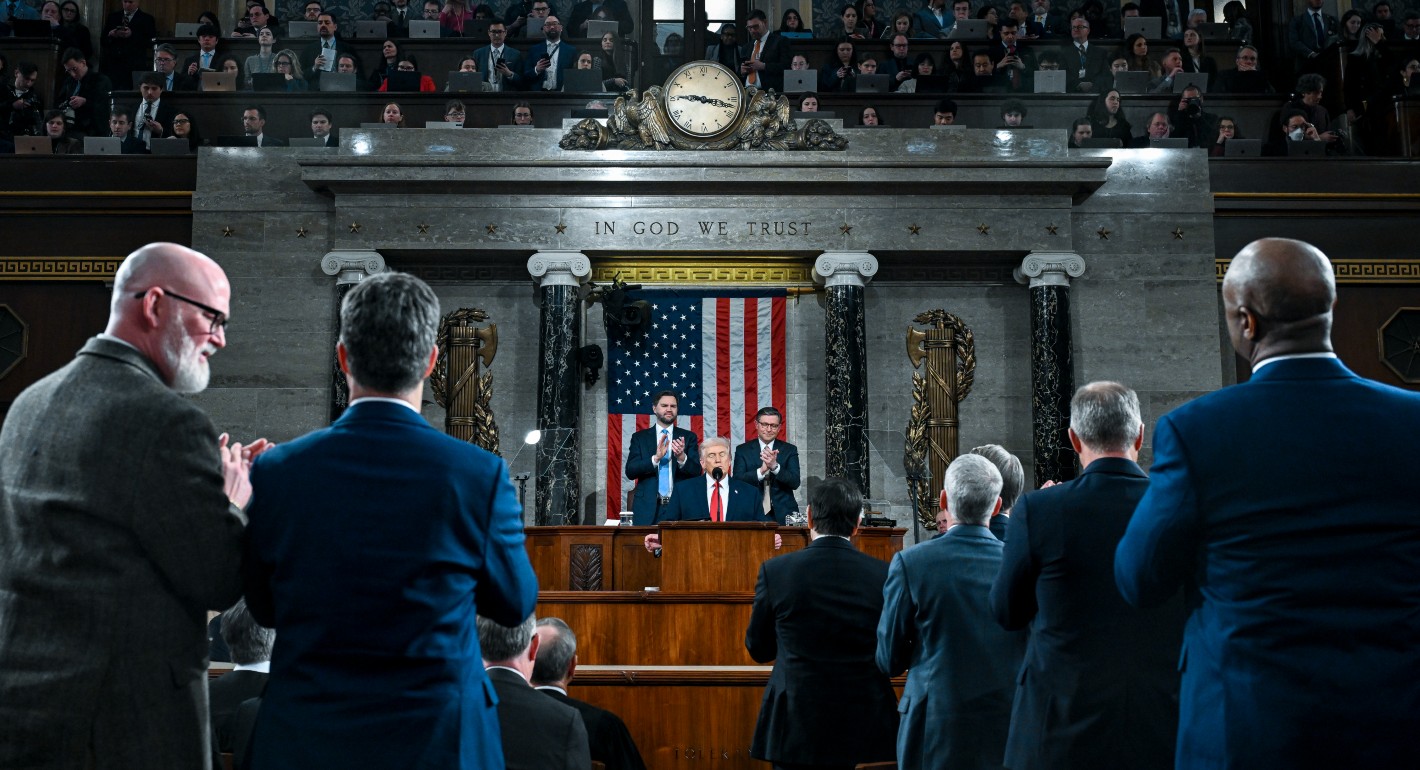
Trump delivers the State of the Union address on February 24, 2026. (Photo by Kenny Holston/pool/Getty Images)
The speech addressed Iran but said little about Ukraine, China, Gaza, or other global sources of tension.
Most State of the Union addresses don’t focus on foreign policy. After all, it’s not voters’ main preoccupation. And the U.S. Constitution talks about “a more perfect union,” not a more perfect world. President Donald Trump’s lengthy speech on Tuesday night was no exception. Still, the final twenty minutes of his address largely focused on praising American heroes’ actions abroad and acted as a kind of world tour victory lap for Trump.
In a way, the foreign policy discussion shouldn’t be surprising. At home, Trump has been battered by low approval ratings, the Supreme Court’s rejection of his tariffs, and the killings of America citizens by federal agents in Minneapolis. So it’s quite natural Trump would look to an arena where he could operate with few constraints and act unilaterally.
Congress goes in and out of session, as does the Supreme Court. But the presidency is the always-on Energizer Bunny of the U.S. political system, with the Constitution’s imprimatur to act—and act boldly. On Tuesday night, Trump leaned into this notion, especially as it relates to his overseas actions.
Trump touted his military successes against Iran’s nuclear sites in June and President Nicolás Maduro in Venezuela, as well as the strikes on alleged drug-running boats in the Caribbean and the Pacific. In an unusual move, he awarded two military pilots—one from the Venezuela raid, and one from the Korean War—the Medal of Honor. Trump referred to his determination to stop Iran from acquiring a nuclear weapon but in an interesting twist dropped much of the threatening language about the massive military buildup in the region. Indeed, no president has ever announced real-time military operations in a State of the Union address. Trump only briefly laid out a case for possible military action against Iran, pointing to the regime and its proxies’ global terror, the repression of its citizens, and its quest for a nuclear weapon.
At the same time, Trump presented himself as a peacemaker, claiming credit for ending no fewer than eight conflicts, including the ceasefire between Israel and Iran. He only briefly mentioned Ukraine, despite that Tuesday marked the beginning of the fifth year of that war. He also seemed to suggest a preference for a negotiated deal with Iran, however unlikely that appears. There was very little on China, even less on the Western Hemisphere, and nothing on North Korea.
Still, one might be forgiven for feeling that Trump’s assertions on foreign policy lacked depth and seriousness. State of the Union addresses aren’t for strategy—they tick off accomplishments and a vision for the coming months.
Trump clearly and deservedly claimed credit for bringing home the remaining Israeli hostages and bringing Maduro to justice and perhaps over time opening up the Venezuelan economy. But on so much else, the president’s foreign policy remains a work in progress. What will be the legacy of policies that cater to strongmen? Or those that undercut U.S. allies? What about those that undermine America’s soft power by taking a wrecking ball to USAID and Voice of America?
Indeed, when you look at the wars between Russia and Ukraine, Israel and Hamas, and Israel and Iran—the three conflicts Trump has deployed his son-in-law and his best friend to negotiate—you see just how far from the finish line Trump is on any of them. Nor—a year into his second and final term—is it clear that Trump has the right strategy to manage, let alone resolve, them.

Senior Fellow, American Statecraft Program
Aaron David Miller is a senior fellow at the Carnegie Endowment for International Peace, focusing on U.S. foreign policy.
Recent Work
Dara Massicot, Aaron David Miller, Andrew S. Weiss



Sophia Besch, Eric Ciaramella, Steve Feldstein, …
Carnegie does not take institutional positions on public policy issues; the views represented herein are those of the author(s) and do not necessarily reflect the views of Carnegie, its staff, or its trustees.

Despite public disputes over trade and immigration, the strategic partnership’s foundations remain sturdy.

Sameer Lalwani

It signals a new era of tech diffusion and warfare.
Steve Feldstein
Despite its flop at the box office, the film raises important questions for the climate community to answer.
Leonardo Martinez-Diaz
Fatima El Mansouri is the country’s first female prime minister. She’s also a privileged insider in a largely ceremonial position.

Sarah Yerkes
The acknowledgment has sparked fears of a new arms race with China and Russia.

Chris O’Meara