

Commentary
Egypt, Jordan, and Saudi Arabia are on the forefront of the opposition.
{
  "authors": [
    "Marwan Muasher"
  ],
  "type": "commentary",
  "blog": "Emissary",
  "centerAffiliationAll": "",
  "centers": [
    "Carnegie Endowment for International Peace"
  ],
  "englishNewsletterAll": "",
  "nonEnglishNewsletterAll": "",
  "primaryCenter": "Carnegie Endowment for International Peace",
  "programAffiliation": "",
  "programs": [
    "Middle East"
  ],
  "projects": [],
  "regions": [
    "Palestine",
    "Jordan",
    "Egypt",
    "Saudi Arabia",
    "United States",
    "Middle East",
    "Israel"
  ],
  "topics": [
    "Foreign Policy",
    "Domestic Politics",
    "Security",
    "Migration"
  ]
}
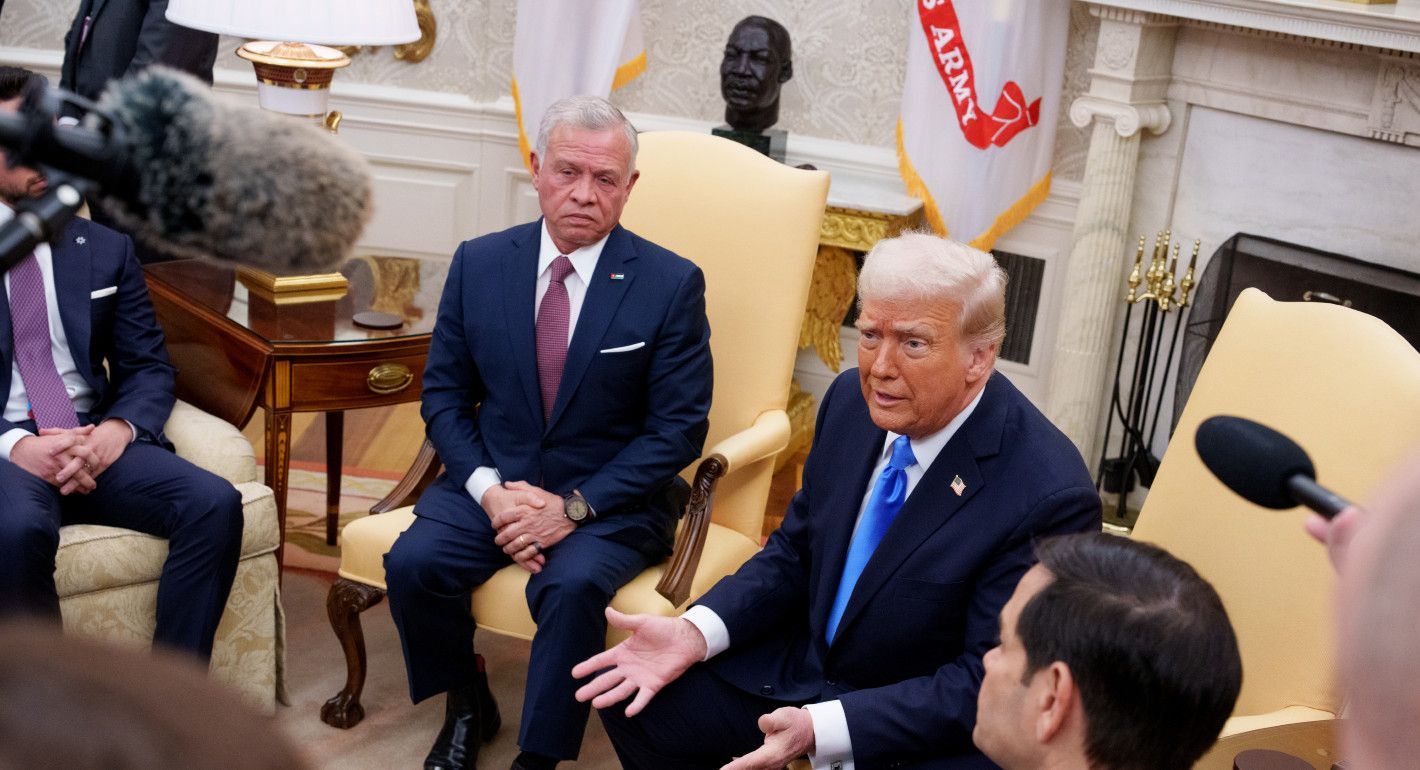
King Abdullah and Trump meet in the Oval Office on February 11, 2025. (Photo by Andrew Harnik/Getty Images)
For Jordan, this is especially true regarding Gaza.
The meeting on Tuesday between U.S. President Donald Trump and Jordan’s King Abdullah II was visibly painful. Trump doubled down on his idea to permanently move 2 million Palestinians out of Gaza and into Jordan and Egypt—in other words, ethnic cleansing, and a plan that all parties reject. “We will have Gaza,” Trump told reporters while sitting next to Abdullah.
King Abdullah tried his best to walk a fine line between avoiding a public confrontation with the president on their first meeting during Trump’s second presidency and unwillingness to acquiesce to a proposal with disastrous results for Jordan.
Why is that so? Jordan has received waves of Palestinian refugees in 1948, 1967, and 1990, and it currently hosts more than half a million Syrian and Iraqi refugees. Adding another million Palestinian refugees to Jordan’s 11 million inhabitants would be roughly proportional to the whole population of Ukraine moving to the United States. Such a mass displacement would present economic and security issues Jordan cannot tolerate. It would also contribute to the emptying of Palestinian lands of their inhabitants and further the Israeli right’s goal of establishing a homeland for Palestinians in Jordan, both of which would create identity issues for Jordanians. And Jordan has no geographical borders with Gaza, nor did it demolish Gaza, but Trump seemingly wants it to compensate for the destruction Israel caused.
In addition to Gaza, Jordan is deeply concerned about Israel’s possible moves to annex the West Bank, which would drive even more Palestinians into Jordan. When asked about that possibility at the press conference, Trump did not rule it out and gave a very muzzled answer. That could not have been reassuring to the king.
The king has been bolstered by a Jordanian public opinion solidly vowing to fight the U.S. proposal. Demonstrations have erupted throughout the kingdom. A strong Arab position also likely boosts the king’s resolve. Egypt has repeatedly issued strong condemnation of the proposal, and Egyptian President Abdel Fattah el-Sisi announced he will postpone his upcoming visit to Washington as long as Gaza displacement is on the agenda.
Perhaps the strongest Arab opposition has come from Saudi Arabia. In recent weeks, Trump and Israeli Prime Minister Benjamin Netanyahu have sounded confident that a normalization agreement between Saudi Arabia and Israel is imminent, with the latter even hinting at sending Gazans to Saudi Arabia. But Saudi public statements on the Gaza displacement plan have been strong and categorical: Without a commitment by Israel to a two-state solution, Saudi Arabia will not normalize its relations with the Jewish state. It added that that position is constant and not subject to change.
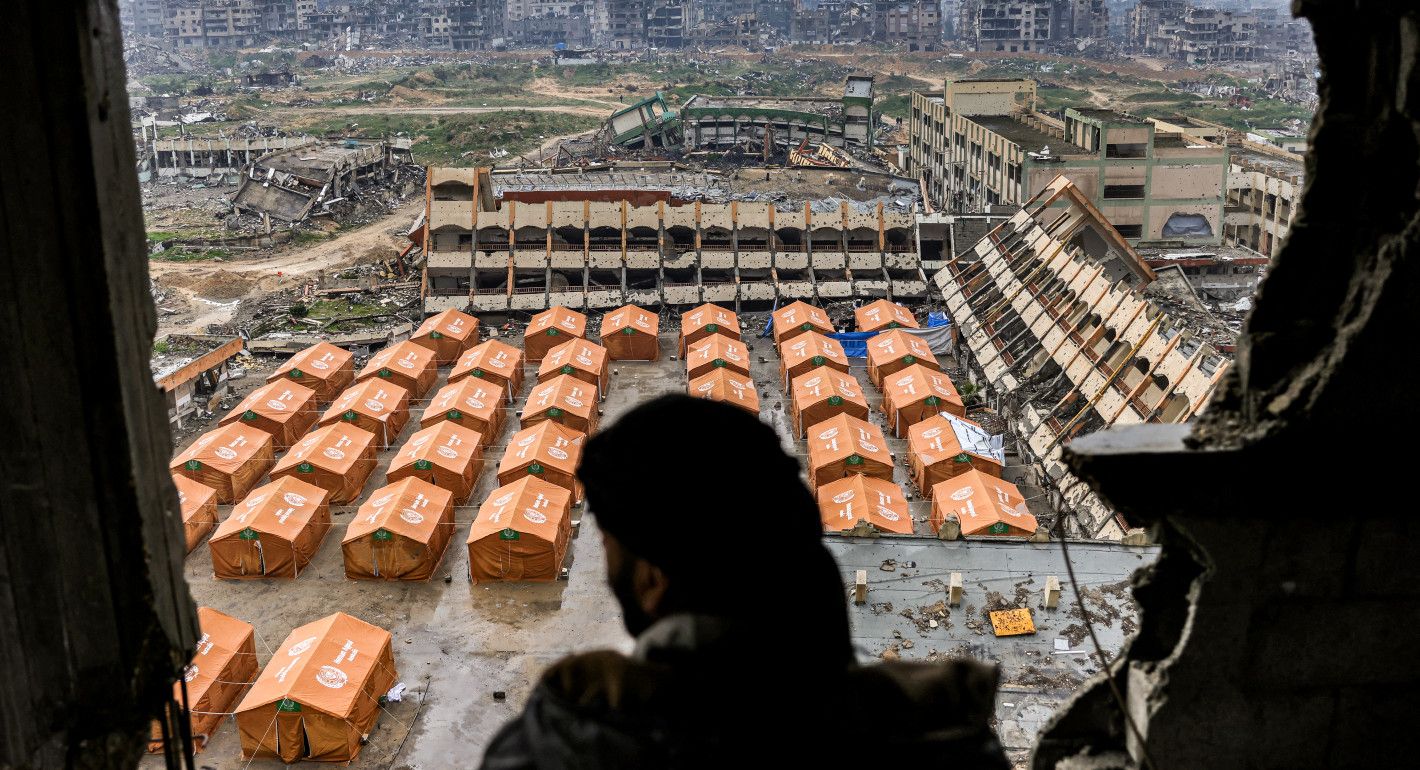
Egypt, Jordan, and Saudi Arabia are on the forefront of the opposition.
Indeed, and in an attempt to deflect pressure from Trump’s public stand, the king announced to the press that Arab states are preparing a unified response. That response will likely be drafted at a summit in Cairo later this month, alongside a counterproposal in which reconstruction of Gaza will take place without uprooting Palestinians from their land. In addition, the summit will likely address stopgap measures to assist Jordan and Egypt, in case Washington cuts its assistance to these countries. Trump suggested earlier in the week that he would cut funds to both if they didn’t accept Palestinians from Gaza, but he refused to answer press questions on the subject during the meeting. Jordan receives roughly $1.5 billion per year, including military aid.
Trump may be used to making deals or employing maximalist tactics in order to extract concessions later. But he might have misfired. His surreal proposal—sending millions of Palestinians outside their land and telling them to their faces they will not be allowed back, then claiming that Palestinians and the whole world loves the idea—is out of touch with reality, let alone a clear violation of international law. Gaza is not owned by the United States to dispense with it as it pleases, and the Palestinians are not pawns to be moved around at will. Almost the whole world, with the notable exception of Israel, has stood against the proposal. Sixteen months of bombing and destruction did not persuade Palestinians to leave their homes—instead, many eagerly returned to their homes (or what remains of them) as soon as the ceasefire allowed. It is not clear what tools the president intends to deploy to force them out now.
The United States has stood by Israel since its creation in 1948, but never before has it so blatantly stood against international law or condoned ethnic cleansing. And never before has it threatened allies such as Jordan and Egypt in such a manner. So far, Trump’s Gaza idea remains a plan with no teeth. Moreover, what the president seems not to understand, is that economic sanctions or incentives pale when compared to existential threats. This is why no amount of pressure by the United States will have the king agree to Trump’s wild proposals. The existential threat to Jordan will trump—pun intended—all other considerations, no matter how difficult a situation they might put the country in.
The latest from Carnegie scholars on the world’s most pressing challenges, delivered to your inbox.
Carnegie does not take institutional positions on public policy issues; the views represented herein are those of the author(s) and do not necessarily reflect the views of Carnegie, its staff, or its trustees.
A conversation with Karim Sadjadpour and Robin Wright about the recent protests and where the Islamic Republic might go from here.


Aaron David Miller, Karim Sadjadpour, Robin Wright

When democracies and autocracies are seen as interchangeable targets, the language of democracy becomes hollow, and the incentives for democratic governance erode.

Sarah Yerkes, Amr Hamzawy

From Sudan to Ukraine, UAVs have upended warfighting tactics and become one of the most destructive weapons of conflict.


Jon Bateman, Steve Feldstein
And how they can respond.

Sophia Besch, Steve Feldstein, Stewart Patrick, …
They cannot return to the comforts of asymmetric reliance, dressed up as partnership.
Sophia Besch