The Sinai Peninsula has been suffering since January 2011 from a continuous security vacuum that deepens every day. Its security problems, in contrast to those in other parts of Egypt, are unique, much more dangerous, and have clear regional implications. This is highlighted by the recent dramatic surge of violence—featuring daily attacks after the ouster of President Morsi— which will likely increase in intensity and frequency after the recent clashes in Cairo between Muslim Brotherhood members and the army. These attacks further destabilize Egypt’s fragile security, escalate regional tensions, and affect neighboring countries—as seen by the destruction of the gas pipeline to Jordan and growing security concerns in Israel. More importantly, the political implications of the recent deterioration in Sinai’s security cannot be discounted. The destabilizing effects of this crisis could potentially affect the smooth implementation of the army-sponsored transition plan, meaning that solving this security problem—rather than just containing it—should be a priority for the Egyptian army.
Sinai’s security challenges are neither new nor a direct product of the January 2011 revolution. The sparsely populated peninsula was always a scene of complicated, long-standing, socioeconomic grievances against the central government’s management of its developmental and economic needs. Coupled with the destabilizing exigencies of the Israeli-Palestinian conflict and an abundance of weapons, these grievances formed an explosive combination that ignited a wave of terrorist attacks in 2011. The brutal counterterrorism tactics of the Egyptian police—developed during the war against the Islamic insurgency in Upper Egypt during the 1990s—proved ineffective: the attacks continued and, more dangerously, acted as a catalyst in exacerbating the discontent of the local population.
The security vacuum that resulted from January 2011 hastened Sinai’s descent into chaos. In the past two years, two incidents highlight the extent of the peninsula’s security crisis. The first occurred in August 2011, when a band of militants crossed into Israel and conducted an attack that resulted in eight Israeli deaths. The attack was followed by a hot pursuit in which the Israeli Defense Forces (IDF) killed several Egyptian soldiers, leading to one the gravest crises in Egyptian-Israeli bilateral relations. One year later, in August 2012, came another cross-border attack. Not only did militants attack and overrun an Egyptian security post (killing sixteen Egyptian soldiers), they also captured two Armored Personnel Carriers (APCs) and stormed the Israeli border before being wiped out in a battle with the IDF. Despite its ultimate failure, this attack illustrated the growing organizational, planning, and executive capabilities of militant groups in Sinai.
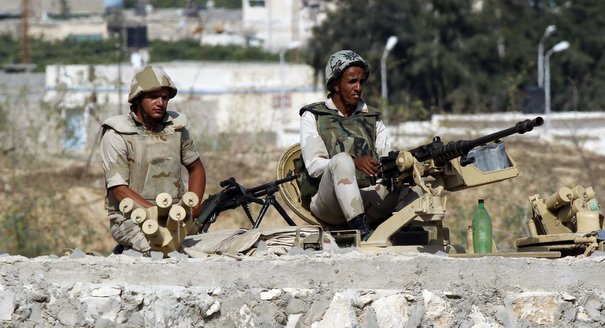
Sinai’s slide into chaos grabbed international and local attention. Locally, every attack was followed by a media uproar featuring a wide variety of explanations and proposed solutions to Sinai’s deepening crisis, coupled with the government’s vows to harshly crack down on militant groups and deal with Sinai’s chronic economic and social problems. The most interesting government efforts, in this respect, were the much publicized military campaigns aiming to rout militant groups. These repeated military campaigns (first codenamed Operation Eagle and afterwards referred to as Operation Sinai) featured several firsts: it was the first time that the Egyptian army deployed such large numbers of soldiers and heavy equipment—including AH-64 Apache attack helicopters—in Sinai since the June 1967 war. Furthermore, the scope and size of the Egyptian military operations were unprecedented; besides the usual ground attacks, they also featured—again for the first time since the Six-Days War—aerial bombardment of suspected militants’ hideouts.
Curiously, despite the big fanfare that accompanied the launching of these military operations, very little accurate information about their exact scope and results was readily available. Yet, it was obvious from the repeated militants’ attacks that those military operations were not as successful as the army claimed and did not present an adequate response. Rather, it seemed that an uneasy, unofficial, status quo agreement had been reached between the warring parties according to which the army (and the security forces) would refrain from conducting military campaigns as long as the militants did not conduct any operations.
The obvious lack of improvement in Sinai’s security situation was attributed by many, especially in Egypt, to the demilitarization of Sinai under the provisions of the security appendix of the 1979 Egyptian-Israeli peace treaty. This argument seemed to be subtly supported by the official version of the events that attributed the delay of launching more military operations to the absence of adequate military hardware in Sinai. Other arguments for failing militarily to remove militants from Sinai included: a lack of adequate information, fears of collateral damage, and the difficult terrains of Sinai’s mountainous regions.
While the above arguments offer a credible explanation for the inability of the Egyptian army to provide a solution to Sinai’s security challenge, it is legitimate to ask whether the situation would be better if restrictions on Egyptian military deployment were removed. And the answer would be no. Limitations on the deployment of troops may be an important factor in a context of conventional military confrontation—such as a war with Israel. In fact, that was the only scenario for which the Egyptian army was prepared; the Egyptian army was amassing tanks, APCs, and fighters and training for rapid mobilization and transfer of forces across the Suez Canal to counter a hypothetical Israeli thrust from the East. Yet no provision was made to address the possibility of an armed insurgency. Even the terror attacks that have rocked Sinai over the last ten years failed to alter such an established view.
The meager achievements of the Egyptian army in Sinai is not a result of the limitations imposed on Egypt’s military presence in Sinai, but rather a consequence of deploying the wrong combination of forces (in terms of training and equipment) in a battle for which they are not trained or prepared to fight. Even if major military operations with larger numbers of troops are conducted—as recently rumored—Sinai’s security crisis will not be solved, as the main challenge is the tactics used not the numbers of troop deployed.
An adequate military response would, therefore, need a different combination of forces that are well armed, highly mobile, and have sufficient information as to exactly whom and where to strike.
Finally, it should be said that any military action that is not part of a wider plan to address deep-rooted socio-economic grievances in Sinai would be, at best, a short-term stopgap measure. Yet even the implementation of such a comprehensive approach needs a minimum level of stabilization, which is not achievable within the framework of the current methods used to deal with Sinai’s security problems.
The existing Egyptian approach to military operations in Sinai is highly problematic and unlikely to achieve the desired results. Egypt’s Sinai dilemma is likely to persist, and the current uneasy and highly flammable status quo is likely to continue, and even to deteriorate further, with serious long term implications not only for Egypt’s security, but also for the geostrategic situation in the region. In the absence of more imaginative and adaptable responses, the opportunity to effectively combat violence in the Sinai may slip away.
Amr Nasr El-Din is a PhD candidate in the University of Osnabrück in Germany.