

Commentary
Judy Dempsey
{
  "authors": [
    "Judy Dempsey"
  ],
  "type": "commentary",
  "blog": "Strategic Europe",
  "centerAffiliationAll": "",
  "centers": [
    "Carnegie Endowment for International Peace",
    "Carnegie Europe"
  ],
  "collections": [],
  "englishNewsletterAll": "",
  "nonEnglishNewsletterAll": "",
  "primaryCenter": "Carnegie Europe",
  "programAffiliation": "",
  "programs": [],
  "projects": [],
  "regions": [
    "Eastern Europe",
    "North America",
    "United States",
    "Russia",
    "Ukraine",
    "Western Europe",
    "Europe"
  ],
  "topics": [
    "Security",
    "Foreign Policy",
    "EU"
  ]
}
Source: Getty
It would be folly for Europeans to interpret Russian actions in Ukraine or Barack Obama’s visit to Europe as marking a reset of the Cold War–era transatlantic alliance.
When leaders from the G7 group of industrialized countries were sitting around the table at a summit in The Hague on March 24, it was just like the good old days. Everything seemed jovial and intimate, just as it was before Russia joined the club in 1998. But appearances can be deceiving, and any suggestions of a transatlantic reset are an illusion.
In the early 1990s, memories were still fresh of the Cold War, which had welded the Western world together. The United States was still in control of Europe’s security agenda, with its focus on NATO and how Europe could continue to serve America’s interests.
Back then, neither the Iraq War nor the War on Terror had happened yet—two events that would deeply divide Americans and Europeans at the beginning of the new millennium. Nor did anybody foresee that within a few years, a U.S. president would announce that his country was shifting its attention to Asia.
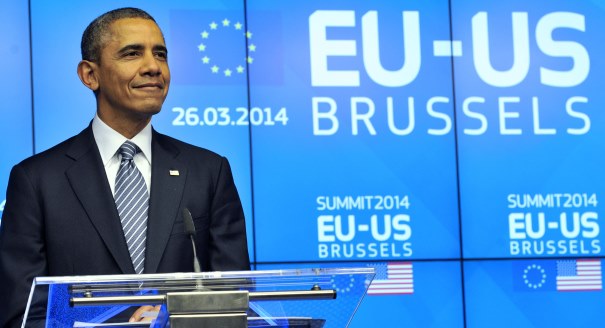
So it really did seem like a throwback to earlier (though perhaps not better) times when U.S. President Barack Obama spoke in Brussels on March 26. He sought to reassure America’s allies of its security commitment to Europe and to stiffen the backbone of European leaders on the issue of sanctions against Russia.
But Russia’s recent annexation of Crimea will not bring back the old transatlantic alliance. If Americans believe for one moment that Russian President Vladimir Putin’s aggression against Ukraine will make the EU pull together in the long term, they are naive. And if Europeans believe that Americans will now return to Europe, they are mistaken.The United States is now led by a post-1945 generation that has steadily lost interest in Europe. Younger Americans do not want to be bothered with the EU’s inability to think and act strategically. Above all, the Obama administration is marked by a deep sense of annoyance over the EU’s unwillingness to share the security burden or at least take care of its own security. It was a shame that Obama did not speak out forcefully in his Brussels speech about this deficit of the transatlantic relationship.
So far, it has been the White House, not the EU, that has taken the lead on imposing tough sanctions against Russia. Several European leaders are still highly uneasy about taking further measures against the Kremlin and Russia’s oligarchs.
Europeans’ reluctance about extra sanctions is due not only to their energy dependence on Russia, which is decreasing over time, or to the close economic and trade ties that many EU countries have with Moscow. It is also due to European leaders’ lack of a common threat perception of Russia. How Poland, Sweden, Finland, and the Baltic states see Putin’s aggression is entirely different from the view in Spain, Portugal, Greece, or Italy.
Above all, Europeans do not have the political or economic strength of will that would be needed for an open-ended struggle with Russia. That would require the EU and NATO to define how far they want their sphere of influence to reach. It is difficult to see European leaders agreeing on any such definition.
Obama’s remarks during his visit to Europe did not touch those issues, let alone resolve the differences. Issuing stern warnings to Russia from a lectern in front of Rembrandt’s magnificent The Night Watch in Amsterdam’s Rijksmuseum was beautifully symbolic. Addressing 2,000 young people in an art deco museum in downtown Brussels was the president’s attempt to bridge the generations. Obama warned his audience against forgetting “that we are heirs to a struggle for freedom.”
But symbolism and Cold War nostalgia won’t create any lasting new bonds.
Putin’s Russia is not Stalin’s Soviet Union. Today, the United States and the EU are dealing with a Russia that has yet to find its place in the globalized and fragile world of the twenty-first century. That world is based on a fierce competition of ideas, economic models, and values. This is the context in which Americans and Europeans have to decide together why they need each other.
If the United States and Europe are serious about establishing a new pact, they should focus on the Transatlantic Trade and Investment Partnership (TTIP) currently under discussion.
So far, the U.S. administration has done most of the legwork of negotiating and promoting the TTIP—unlike European leaders who, for the most part, are reluctant to even debate the partnership. In the twenty-first century, the successful conclusion of the TTIP could be much more important for cementing a new and durable Western bond than a fleeting bit of nostalgia for the Cold War.

Nonresident Senior Fellow, Carnegie Europe
Judy Dempsey is a nonresident senior fellow at Carnegie Europe
Recent Work
Judy Dempsey
Judy Dempsey
Carnegie does not take institutional positions on public policy issues; the views represented herein are those of the author(s) and do not necessarily reflect the views of Carnegie, its staff, or its trustees.

Trump is distracted and Ukraine wants Europe to step up. The continent’s leaders must find their voice and assert it in talks with Russia.

Alissa de Carbonnel

Mounting economic strain and battlefield losses will not necessarily make the Kremlin less dangerous. They could instead push Moscow toward a more aggressive hybrid campaign designed to test NATO’s Eastern flank, exploit allied hesitation, and fracture European resolve.

Maksym Beznosiuk

Over the past ten years, NATO has held almost as many summits as it did during the entirety of the Cold War. Are they still useful, or is it time to stop holding annual meetings?

Rym Momtaz, ed.
Nearly a year and a half after Europeans leaned into sucking up to Trump, the strategy has produced some benefits when it comes to Ukraine.
Rym Momtaz
Far-right leader Marine Le Pen can—and will—run in France’s next presidential election. What does the outcome of her appeal against a 2025 embezzlement conviction mean for the country’s political future?

Catherine Fieschi