

Commentary
Judy Dempsey
{
  "authors": [
    "Judy Dempsey"
  ],
  "type": "commentary",
  "blog": "Strategic Europe",
  "centerAffiliationAll": "",
  "centers": [
    "Carnegie Endowment for International Peace",
    "Carnegie Europe"
  ],
  "collections": [],
  "englishNewsletterAll": "",
  "nonEnglishNewsletterAll": "",
  "primaryCenter": "Carnegie Europe",
  "programAffiliation": "",
  "programs": [],
  "projects": [],
  "regions": [
    "Eastern Europe",
    "North America",
    "United States",
    "Russia",
    "Ukraine",
    "Western Europe",
    "Germany",
    "Europe"
  ],
  "topics": [
    "Democracy",
    "Security",
    "Military",
    "Foreign Policy",
    "EU"
  ]
}
Source: Getty
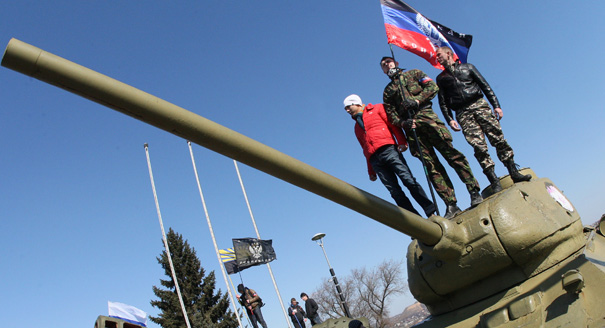
The EU’s unwillingness to protect Ukraine confirms its hypocrisy over its values, principles, and borders. What good news for Russian President Vladimir Putin!
Europe is becoming increasingly wobbly over Ukraine. When EU foreign ministers met in Luxembourg on April 14–15, they postponed imposing tougher sanctions against the Kremlin.
Some countries, notably Germany, Spain, and Italy, argued that now was not the right time. They feared that additional sanctions would jeopardize talks between the United States, the EU, Ukraine, and Russia on the Ukraine crisis to be held in Geneva on April 17.
But when is the right time to take further action as Russia grabs more bits of Eastern Ukraine? Surely, much tougher sanctions would have been the right response to show Europe’s spunk and opposition to what Russian President Vladimir Putin is doing in Ukraine.
Yet a stronger and more united Europe is needed more than ever before if European governments are to stop Putin from forcibly changing even more borders. He did the same thing in 2008 during a short war in Georgia. The EU and NATO failed to learn anything from that episode.
Meanwhile, Russia has never stopped meddling in Moldova’s breakaway region of Transnistria, a highly corrupt and dysfunctional territory that borders Ukraine. Recently, Russia stepped up its interference there to stop a weak Moldovan government from signing a political and economic association agreement with the EU this summer.
As for Ukraine, Russia has never come to terms with its Western neighbor’s independence, which it declared in 1991. Unable to quash Ukraine’s pro-democracy demonstrations, Russia has now gone on the offensive by grabbing parts of the country and destabilizing it in the process.
Even though these developments are taking place on Europe’s doorstep, the EU is refusing to use its economic and moral muscle. Despite warnings by Poland, Sweden, and Estonia, the EU is blinding itself to the implications of what Russia is doing.
These three countries have no illusions about what is at stake: Europe’s post–Cold War borders and the stability of the EU’s Eastern neighbors. Yet European publics and political elites alike prefer to protect their own “comfort zone.”
It is a very special comfort zone, because the majority of EU member states do not believe or do not want to believe that they are threatened by Russia’s actions. And because they do not feel threatened, they do not see the need to protect Ukraine.
This attitude has bred a disturbing intellectual and moral complacency among Europeans. Yet Russia’s behavior affects Europeans’ way of life on two fronts: it undermines democracy by promoting instability in Europe’s East; and it undermines a strong and principled European foreign policy by strengthening national egoism.
So far, NATO has been much more outspoken against Putin than the EU has. Secretary General Anders Fogh Rasmussen has repeatedly pushed for the alliance’s members to boost the air and sea defenses of the Baltic states and Romania. After a meeting with NATO ambassadors in Brussels on April 16, he publicly pledged to “protect every ally and defend against any threat to our fundamental security.”
Rasmussen has unequivocal support from Philip Breedlove, the commander of U.S. forces in Europe and NATO commander for Europe. Indeed, Breedlove believes that not only Europe but also the United States should be doing far more to help Ukraine. He would like the United States to increase its presence in Europe and offer Ukraine military assistance or advice.
Breedlove made his concerns clear on March 26–27 during classified briefings to the Armed Services Committee of the U.S. House of Representatives. He even released satellite pictures of Russian forces amassed along Ukraine’s borders to show Russia’s military preparedness.
So far, however, Rasmussen and Breedlove have received little backing from the administration of U.S. President Barack Obama. For the moment, Obama is relying on sanctions to put pressure on Putin. But even on that issue, Obama has not been fully supported by European governments.
With such an appalling lack of determination, soft power has failed to deter Putin. As a result, Putin has a free hand to change Ukraine’s borders, the consequences of which will soon come to haunt Europe.

Nonresident Senior Fellow, Carnegie Europe
Judy Dempsey is a nonresident senior fellow at Carnegie Europe
Recent Work
Judy Dempsey
Judy Dempsey
Carnegie does not take institutional positions on public policy issues; the views represented herein are those of the author(s) and do not necessarily reflect the views of Carnegie, its staff, or its trustees.

As we close out another season of Strategic Europe, it is worth taking stock of the deep shifts underway.

Rym Momtaz
The EU had to compromise to adopt a twenty-first sanctions package against Russia, exposing growing cracks in the union’s resolve. Is this latest, weaker round worth it to keep pressure on Moscow?
Rym Momtaz, ed.

Trump is distracted and Ukraine wants Europe to step up. The continent’s leaders must find their voice and assert it in talks with Russia.

Alissa de Carbonnel

Mounting economic strain and battlefield losses will not necessarily make the Kremlin less dangerous. They could instead push Moscow toward a more aggressive hybrid campaign designed to test NATO’s Eastern flank, exploit allied hesitation, and fracture European resolve.

Maksym Beznosiuk

Over the past ten years, NATO has held almost as many summits as it did during the entirety of the Cold War. Are they still useful, or is it time to stop holding annual meetings?
Rym Momtaz, ed.