

Commentary
Judy Dempsey
{
  "authors": [
    "Judy Dempsey"
  ],
  "type": "commentary",
  "blog": "Strategic Europe",
  "centerAffiliationAll": "",
  "centers": [
    "Carnegie Endowment for International Peace",
    "Carnegie Europe"
  ],
  "collections": [],
  "englishNewsletterAll": "",
  "nonEnglishNewsletterAll": "",
  "primaryCenter": "Carnegie Europe",
  "programAffiliation": "",
  "programs": [],
  "projects": [],
  "regions": [
    "Eastern Europe",
    "North America",
    "United States",
    "Russia",
    "Ukraine",
    "Western Europe",
    "Germany",
    "Europe"
  ],
  "topics": [
    "Democracy",
    "Security",
    "Foreign Policy",
    "EU"
  ]
}
Source: Getty
Barack Obama wants the Ukraine dossier off his desk. This means relying increasingly on Angela Merkel, whose leadership in Europe is crucial for dealing with Russia.
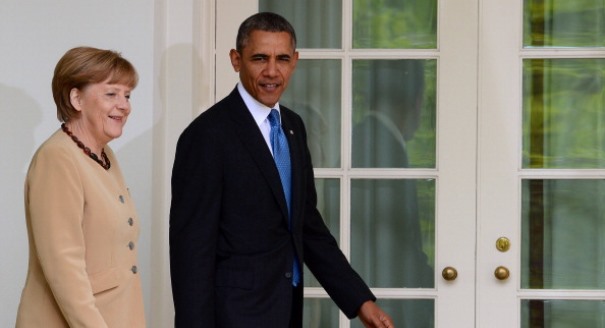
Whenever U.S. President Barack Obama and German Chancellor Angela Merkel meet, there is always an element of anticipation. Arguably, these two people are the West’s most important and most powerful leaders.
So when they spoke to the press in the Rose Garden of the White House on May 2, Obama chose his opening remarks with care. He began by speaking about domestic issues—the economy and the labor market—not about Russia or Ukraine.
This is important. European leaders need no further evidence of Obama’s priorities. Merkel and her European counterparts now need to fill some of the gap left by America’s changing role. The Ukraine crisis should provide the ideal opportunity, but, alas, it might fail to do just that, especially regarding security issues.
Not even the Ukraine crisis and Russia’s own hefty 30 percent increase in defense spending over the past few years have jolted European leaders into realizing that in Europe, it is up to them to defend the West’s values and principles. Less than a handful of European NATO countries are prepared to spend 2 percent of gross domestic product (GDP) on defense, the target set and agreed to by NATO countries.
Of course, several countries can find legitimate excuses. The hard-hit eurozone countries of Spain, Portugal, and Italy have introduced stringent savings. Britain’s armed forces have been severely cut by David Cameron’s Conservative-led government. In France, President François Hollande, who last year introduced big changes to the French army, has kept spending at about 1.7 percent of GDP. As for Germany, Europe’s biggest economy, Merkel’s government has yet to decide the priorities for the armed forces.
Poland, in contrast, has gone on a big spending spree to boost its own defenses, while neighboring Lithuania, Latvia, and Estonia have pledged to increase their defense budgets despite having been hit hard by the financial crisis. These countries in the northeast of Europe feel threatened by Russia.
Defense spending levels matter because Europeans are not going to “pool and share” military capabilities, as NATO has advocated, even though it could lead to substantial savings and efficiency. And without the visibility of hard power, soft power is of limited use—especially when it comes to underpinning diplomacy and sanctions.
Yet during the Ukraine crisis, the EU’s member states have failed to use even its soft power tools to full effect in imposing tough sanctions on Moscow. Russia’s age-old policy of playing off EU countries against each other has proved successful.
The strategic energy deals that Russian President Vladimir Putin has struck with Germany, Italy, and the Netherlands over the years have prevented the EU from speaking and acting in a strong and decisive way over Eastern Ukraine.
This affects the transatlantic relationship. Despite what Atlanticists argue, the Ukraine crisis has not given that bond the fillip it sorely needed. Americans and Europeans cannot even agree on the same set of sanctions, thanks to the energy factor and European industry’s close ties to the Kremlin.
Indeed, during his joint press conference with Merkel in the Rose Garden, Obama showed a surprising amount of understanding for Europe’s unwillingness to be tougher with Russia.
“Energy flows from Russia to Europe—those continued even in the midst of the Cold War, at the height of the Cold War,” he said. “So the idea that you’re going to turn off the tap on all Russian oil or natural gas exports, I think, is unrealistic,” he added. Obama referred to imposing other sanctions, including in the arms and finance sectors and on lines of credit for trade.
In reply, Merkel said that European leaders would consider another round of sanctions if Russia meddled in Ukraine’s presidential election due on May 25—as if Russia had not already meddled enough.
Above all, the sense from the meeting between Obama and Merkel was that the U.S. president wanted the Ukraine dossier off his desk.
Fresh from a whirlwind trip to Asia, he knows where America’s strategic priorities lie. He wants Merkel to use her connections with Putin to try to end the conflict. “She’s been very important in helping to shape a possible diplomatic resolution and reaching out to the Russians to encourage them to take that door while it’s still open,” Obama said.
Passing the diplomatic baton to Merkel amounts to a poisoned chalice—unless the German leader is prepared to prevent Putin from further undermining the West’s ability to defend its values and security.

Nonresident Senior Fellow, Carnegie Europe
Judy Dempsey is a nonresident senior fellow at Carnegie Europe
Recent Work
Judy Dempsey
Judy Dempsey
Carnegie does not take institutional positions on public policy issues; the views represented herein are those of the author(s) and do not necessarily reflect the views of Carnegie, its staff, or its trustees.

Ahead of a tough winter for Ukraine, Donald Trump’s swing back toward Russia bodes ill. But instead of panicking, Kyiv’s European allies are focusing on action.

Rym Momtaz

While the EU and European governments are embracing the much-lauded middle-power moment, this entails three difficult conundrums.

Richard Youngs

Much has been said of the changes Brussels is trying to make to the EU enlargement process. Here’s why gradual integration might—or might not—be the answer.

Dimitar Bechev

The European Commissioner for Trade is headed to China. But after President Xi’s bridge-building visit to Washington, can a more isolated EU overcome Beijing’s stranglehold on critical raw materials? Who will blink first?
Rym Momtaz, ed.

The domestic impacts of how long it is taking to end the war in Ukraine have pushed the French electorate to the political extremes and compromised the country’s diplomatic capacity.
Rym Momtaz