

Commentary
Judy Dempsey
{
  "authors": [
    "Judy Dempsey"
  ],
  "type": "commentary",
  "blog": "Strategic Europe",
  "centerAffiliationAll": "",
  "centers": [
    "Carnegie Endowment for International Peace",
    "Carnegie Europe"
  ],
  "collections": [],
  "englishNewsletterAll": "",
  "nonEnglishNewsletterAll": "",
  "primaryCenter": "Carnegie Europe",
  "programAffiliation": "",
  "programs": [],
  "projects": [],
  "regions": [
    "Eastern Europe",
    "North America",
    "United States",
    "Russia",
    "Ukraine",
    "Western Europe",
    "Europe"
  ],
  "topics": [
    "Security",
    "Foreign Policy",
    "EU"
  ]
}
Source: Getty
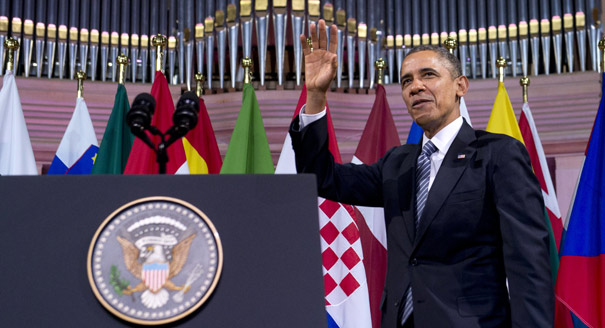
Obama’s forthcoming visit to Poland is a reminder that Washington stands with its Eastern European allies. That is a stark contrast to the position of Western European capitals.
By making Warsaw, not Brussels, the first leg of his trip to Europe that begins on June 3, U.S. President Barack Obama is according Poland immense prestige.
Ostensibly, his visit to Warsaw is to honor Solidarity. Over a quarter of a century ago, the leaders and supporters of this independent trade union movement overturned Poland’s Communist regime and paved the way for an extraordinarily peaceful and successful transition to democracy.
But neither the Poles nor any other Eastern Europeans are in the mood for acts of symbolism and moving words from an American president. What they want from Obama are concrete assurances that NATO, the transatlantic alliance dominated by the United States, will protect them against any threat from Russia.
As if that were not enough, the victory of left- and right-wing fringe parties in the recent European Parliament elections was a godsend to Moscow. Russian President Vladimir Putin could not have asked for anything better than to have anti-American, anti-NATO, anti-enlargement, and anti-globalization parties make big gains.
Obama has no illusions about Europe and its divisions, which he will hear firsthand when he meets other G7 leaders in Brussels on June 4–5. Once the United States had recognized the enormity of the Ukraine crisis, it began pushing its European allies to agree on sanctions against Russia.
The Europeans did put some measures in place. Yet Washington has had to go it alone in targeting prominent people that underpin the Kremlin’s economic power. To be fair, the United States stands to be hurt far less by sanctions against Russia than Europe does, a point that Obama has publicly acknowledged.
The Obama administration has also had little support from NATO countries to boost the defenses of Poland, the Baltic states, and, further south, Romania. Despite pleas from NATO’s top brass to show concrete solidarity, the big Western European countries have made clear that they will not deploy troops permanently or establish bases on NATO’s Eastern flank.
The German government, under pressure from a deeply pacifist public, believes such a move would provoke Russia. As if Russia’s own intervention in Ukraine was neither provocative nor militaristic!
Instead of NATO pulling together, it was initially the United States that unilaterally sent fighter jets to Poland and assisted the Baltic states, giving them much-needed physical and psychological reassurance vis-à-vis Russia. Obama may not want a military confrontation with Russia over Ukraine, but he certainly wasn’t going to abandon NATO’s Eastern members. His visit to Warsaw serves as a useful reminder to Putin—but also to the leaders of Britain, France, and Germany—that Washington stands with its allies.
The contrast to Western Europe’s attitude in this conflict is glaring. Both the EU and NATO will pay a high price over the way Poland and the Baltic states have had to lean on the United States.
Over the past few years, Donald Tusk’s center-right Polish government has invested much energy and support in trying to strengthen the EU’s foreign, security, and defense ambitions. Despite its deeply Atlanticist instincts, Poland shifted its strategy away from the United States toward Europe. Warsaw recognized that Europe, more than ever, needed a strong defense and security policy not only to compensate for America’s pivot toward the Asia-Pacific region but also to give Europe the ability to defend its values and interests.
As a result, Poland went out of its way to send troops to most of the EU’s missions abroad. It even campaigned for the EU to have its own military planning headquarters. Britain vetoed any such idea, fearing that it would undermine the transatlantic alliance.
All the more reason for Poland to feel disappointed now with EU’s feeble reaction to Russia’s incursion into Ukraine. That will carry a high price for the future of European integration.
Poland and its neighbors won’t be able to look to NATO, either, to strengthen their defenses. Instead, as the EU and NATO fumble over Russia, the northeastern part of Europe that consists of Poland and Estonia, Finland and Sweden, and Denmark, Norway, and Iceland could well end up forging a series of bilateral agreements with the United States.
Out of necessity, these northeastern European countries, which are for the most part Atlanticist, could create their own security clusters with support from the United States. Were that to happen, it would be an indictment of the unwillingness of NATO and the EU to pull together in times of crisis. Obama’s rhetoric in Warsaw will be no panacea.

Nonresident Senior Fellow, Carnegie Europe
Judy Dempsey is a nonresident senior fellow at Carnegie Europe
Recent Work
Judy Dempsey
Judy Dempsey
Carnegie does not take institutional positions on public policy issues; the views represented herein are those of the author(s) and do not necessarily reflect the views of Carnegie, its staff, or its trustees.

Trump is distracted and Ukraine wants Europe to step up. The continent’s leaders must find their voice and assert it in talks with Russia.

Alissa de Carbonnel

Mounting economic strain and battlefield losses will not necessarily make the Kremlin less dangerous. They could instead push Moscow toward a more aggressive hybrid campaign designed to test NATO’s Eastern flank, exploit allied hesitation, and fracture European resolve.

Maksym Beznosiuk
Over the past ten years, NATO has held almost as many summits as it did during the entirety of the Cold War. Are they still useful, or is it time to stop holding annual meetings?

Rym Momtaz, ed.
Nearly a year and a half after Europeans leaned into sucking up to Trump, the strategy has produced some benefits when it comes to Ukraine.
Rym Momtaz
Far-right leader Marine Le Pen can—and will—run in France’s next presidential election. What does the outcome of her appeal against a 2025 embezzlement conviction mean for the country’s political future?

Catherine Fieschi