

Commentary
Judy Dempsey
{
  "authors": [
    "Judy Dempsey"
  ],
  "type": "commentary",
  "blog": "Strategic Europe",
  "centerAffiliationAll": "",
  "centers": [
    "Carnegie Endowment for International Peace",
    "Carnegie Europe"
  ],
  "collections": [
    "Europe’s Eastern Neighborhood"
  ],
  "englishNewsletterAll": "",
  "nonEnglishNewsletterAll": "",
  "primaryCenter": "Carnegie Europe",
  "programAffiliation": "",
  "programs": [],
  "projects": [],
  "regions": [
    "Russia",
    "Europe",
    "Western Europe",
    "Germany"
  ],
  "topics": [
    "Foreign Policy",
    "EU",
    "Security"
  ]
}
Source: Getty
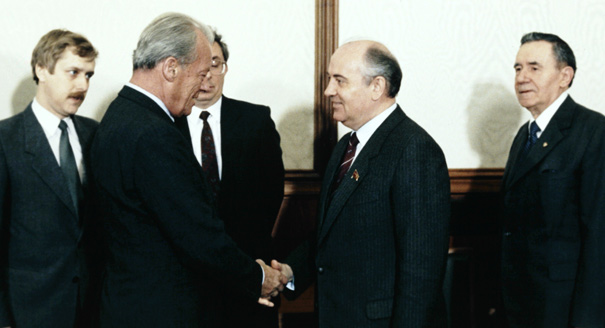
Germany’s Social Democratic Party is starting to reassess its stance toward Russia. That debate will have consequences for broader relations between Europe and Russia.
Over the past several months, Karsten D. Voigt has been traveling between Kiev, eastern Ukraine, and Moscow. This retired diplomat (although you would not think it) and long-serving member of Germany’s Social Democratic Party has been shaken by Russia’s actions in Ukraine and its attitudes toward the West.
Voigt’s conclusions are grim. “The vision of a pan-European peace order is not a realistic option,” he explained in an interview to Carnegie Europe. “Russia is turning away from Europeans norms and principles.” The consequences for European security are immense and dangerous.
These are strong words for a Social Democrat who hoped and believed that Russia could be integrated into Europe and, more importantly, that Europe with Russia could enjoy a stable security architecture.
This was because of Ostpolitik. This “Eastern policy” was based on a deep belief and wish among Social Democrats that if Germany reached out to Russia, the relationship between the two countries—and, by extension, between Europe and Russia—could be predictable. Relations would be secure. They would be based on the sovereignty of states and the inviolability of borders.
That was the point of the 1975 Helsinki Final Act, which sought to improve relations between the Communist bloc and the West.
Now, Russian President Vladimir Putin’s leadership and the Ukraine crisis have changed all that. He has violated European treaties and international law, which Germany’s Social Democrats had assumed were intact. In fact, Putin has derailed Ostpolitik, alienating Russia’s most important ally in Europe.
This dismantling of Europe’s post–Cold War relationship with Russia convinced Voigt to begin a debate inside the Social Democratic Party about the future of Ostpolitik. He does not want to believe that the policy is dead. Instead, as he argued in the journal Russland-Analysen, a new phase of Russia policy and Ostpolitik has begun. It is a phase devoid of illusions.
Putin has derailed #Ostpolitik, alienating Russia's no. 1 ally in Europe.Tweet This
Voigt knows all too well that Germany’s Social Democrats could no longer continue or even justify the Ostpolitik that it has pursued since the days of former chancellor Willy Brandt. “The younger generation of Social Democrats understands this,” Voigt said. “The older generation is a different matter.”
The younger generation realizes too that the old Ostpolitik is no longer applicable because of Putin’s domestic and foreign policies and the way far-right parties in Europe identify with Putin’s rejection of European values.
Yet there are other Social Democrats who would be hard-pressed to challenge Putin’s vitriolic condemnation of the United States. Putin’s leitmotiv is to blame America for the crises in Iraq and Libya and for the chaos in the international order.
But Russia’s narrative also has another dimension.
Under Putin, Russia believes that ever since the collapse of the Soviet Union in 1991, the United States has wanted to keep Russia down. Europe, until recently, was spared Putin’s ire. That is changing, especially since the European Union followed the United States in imposing sanctions on Russia. Moscow has retaliated by imposing embargoes on European food and dairy products.
“Russia is alienating itself more and more from the democratic countries of Europe through its increasingly authoritarian development,” Voigt said. He referred to how Russia was resorting to the symbols and policies of the czarist period, and to how the country was so unwilling to deal with its Soviet past.
But it is Russia’s foreign policy that is now fundamentally changing the structures that predate the end of the Cold War in 1991.
Russia’s use of energy to exert political pressure “undermines the trust that has been the basis of cooperation between Russia and Western Europe since the beginning of the 1970s,” Voigt said. As for Russia’s annexation of Crimea in March 2014, “it violated the principles of inviolable borders and peaceful resolutions of conflicts that were agreed to in the 1975 Helsinki Final Act,” he added.
More depressing for Voigt is that Russia’s actions in Ukraine violate the 1994 Budapest Memorandum, a treaty that made Ukraine give up its nuclear weapons. Yet surely, because not only Russia but also Britain and the United States signed that treaty, London and Washington should have acted when Russia annexed Crimea. As Voigt says, “the annexation undermines the nonproliferation of nuclear weapons.”
#Russia's domestic and foreign policies are challenging Europe's peace order.Tweet This
Germany’s Social Democrats are at a loss over how to revive or rewrite Ostpolitik. Voigt knows that European peace and security is permanently stable only as long as Russia is part of that order. But Russia’s domestic and foreign policies are challenging that arrangement.
What is more, Russia is not bothering in any serious way to use European multilateral institutions such as the Organization for Security and Cooperation in Europe or the Council of Europe to resolve conflicts. “It seems likely that Russia would rather be a counterpart than a partner in conflicts, such as efforts to stabilize Ukraine,” Voigt said.
This means that Germany, the EU, and NATO have to take precautions. European security is no longer a given. Moreover, Voigt believes that this changed environment makes it more necessary than ever to try to resolve the conflicts in Georgia, Moldova, and Armenia—not to mention eastern Ukraine. There is no scope for illusions. “For the foreseeable future, the vision of a pan-European peace order, regrettably, is not a realistic option.”

Nonresident Senior Fellow, Carnegie Europe
Judy Dempsey is a nonresident senior fellow at Carnegie Europe
Recent Work
Judy Dempsey
Judy Dempsey
Carnegie does not take institutional positions on public policy issues; the views represented herein are those of the author(s) and do not necessarily reflect the views of Carnegie, its staff, or its trustees.

The EU is putting together a new security strategy to meet today’s myriad challenges. But for any proposal to be effective, the union needs to grapple with its identity and ambitions.

Pierre Vimont

The EU’s new migration policy is not suited to today’s realities. With climate change increasingly becoming a driver of displacement, Europe needs to rethink its deterrence-focused approach.

Shana Tabak
The battle over free speech has taken center stage since U.S. Vice President JD Vance accused Europe of censorship. From travel bans to social media regulation, especially around the Israel-Palestine conflict, are liberal democratic governments weaponizing free speech?

Rym Momtaz, ed.
Europe seems to have accepted its sidelining in the Middle East. The EU must reassert its support for the international rules-based order and step up engagement.
Rym Momtaz
Amid uncertainty caused by the Iran war, the global drive for nonproliferation has stalled. With Europe diplomatically marginalized and countries reassessing their nuclear options, efforts to curb the spread of nuclear weapons risk becoming irrelevant.

Jane Darby Menton