

Commentary
Judy Dempsey
{
  "authors": [
    "Judy Dempsey"
  ],
  "type": "commentary",
  "blog": "Strategic Europe",
  "centerAffiliationAll": "",
  "centers": [
    "Carnegie Endowment for International Peace",
    "Carnegie Europe"
  ],
  "collections": [],
  "englishNewsletterAll": "",
  "nonEnglishNewsletterAll": "",
  "primaryCenter": "Carnegie Europe",
  "programAffiliation": "",
  "programs": [],
  "projects": [],
  "regions": [
    "Asia",
    "Europe",
    "East Asia",
    "Japan",
    "Western Europe"
  ],
  "topics": [
    "Foreign Policy",
    "EU",
    "Economy",
    "Climate Change",
    "Trade"
  ]
}
Source: Getty
The EU seems determined to clinch a trade accord with Japan by the end of 2017. That might be wishful thinking.
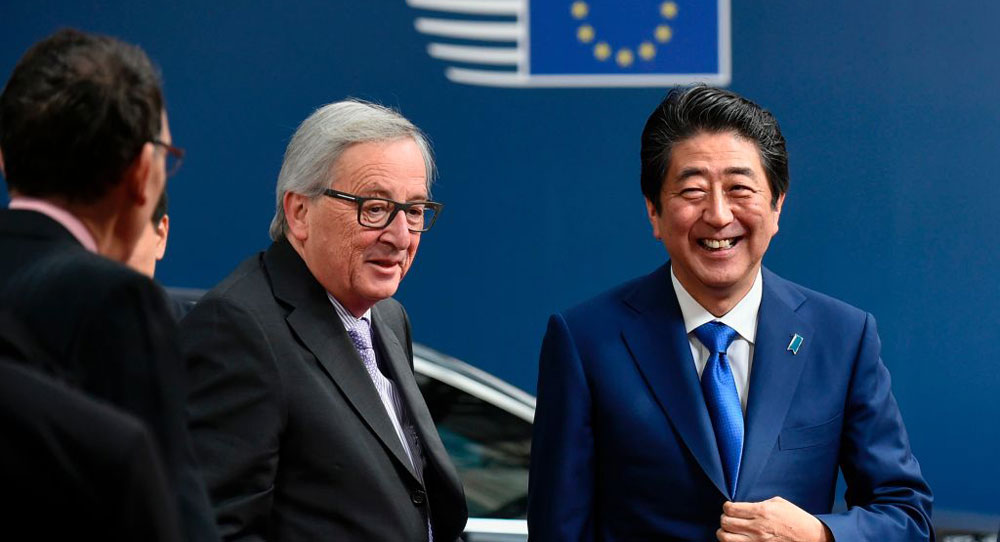
How France, Germany, Italy, and the EU rolled out the red carpet for Shinzo Abe. During his whistle-stop tour of some of Europe’s largest economies and the Brussels-based institutions on March 19–22, the Japanese prime minister was given the royal treatment. European leaders said they wanted a trade accord with Japan, all the more so given the protectionist policies of the administration of U.S. President Donald Trump.
Those policies hit this side of the Atlantic on March 17–18, when G20 finance ministers failed during a meeting in Germany to agree on a statement to repudiate protectionism. The Trump administration seems intent on rolling back free trade. So do several populist leaders in Europe, including the leader of France’s National Front, Marine Le Pen, who is making a bid to become the country’s next president.
Free trade matters to the EU. As Patricia Wruuck, a trade analyst at Deutsche Bank Research, wrote in a report in January, the EU is the world’s largest trader in goods and services. It ranks second in imports and is number one when it comes to exports. “It is hard to overstate the importance of trade policy for Europe,” she argued. As it is, the EU and Japan together account for more than one-third of the world’s GDP.
But free trade is not just about facilitating the unhindered flow of goods between countries. It is also about adopting common standards.
When Jean-Claude Juncker, the president of the European Commission, met Abe, he spelled out as clearly as he could what a trade deal between the EU and Japan would mean. “We believe this agreement is necessary, it is necessary because we believe in free, fair and rules-based trade. And so we will continue to look out towards the world, rather than return to isolationism. The European Union is open for business – for fair business. . . . Following our discussions today, I am very confident this will pave the way for a swift agreement this year.”
That may be hard to achieve. The EU—and certainly Germany—is approaching trade negotiations from a different perspective from Japan. During the early stages of the talks that began in 2013, the EU wanted Japan’s three railroad companies, which are 100 percent privatized, to be placed under the government’s procurement rules. “European companies do not want Japanese railway companies entering the European market,” said Hosuk Lee-Makiyama, director of the European Centre for International Political Economy. Tokyo did not oblige.
Japan, for its part, clearly sees the benefits of forging a trade accord with the EU. It’s a big and lucrative market. But Tokyo has had other trade priorities. Japan was bitterly disappointed when the Trump administration tore up the Trans-Pacific Partnership (TPP), which would have bound the United States and several countries in the region into a special trade relationship with strategic implications.
Tokyo now fears that China will fill that vacuum in Southeast Asia. That is why Abe was so quick to visit Trump soon after he entered the White House on January 20. Japan wants a bilateral trade deal with the United States, and not just because it would give Japanese businesses access to the U.S. market at a time when Trump wants to heavily invest in infrastructure.
“Japan had put TPP first,” Lee-Makiyama said. “That alliance with the United States had regional implications for regional integration. It also has a high security imperative, which Europe cannot provide in the Asia-Pacific region.”
So while some EU governments might balk at Tokyo’s attempts to negotiate a bilateral trade deal with Washington, it has nothing to do with Japan’s unswerving commitment to multilateralism or globalization. Such a trade deal has security implications for a country that fears the unstoppable rise of China and growing uncertainty in the Korean Peninsula.
As for doing a deal with Europe, it is increasingly in Japan’s interests to maintain and increase its access to the EU’s single market, in case Europe turns more protectionist.
Given what is happening to U.S. trade policy, this is a chance for the EU and its member states to speed up or ratify trade accords not only with Japan but also with Singapore and New Zealand. Doing so is in Europe’s strategic and economic interests. But as Wruuck warned in her report, “EU trade policy risks being caught up between domestic and global challenges at the moment.” It’s going to require political will and strategic foresight to clinch the deal with Japan and prevent the contagion of U.S. protectionism.

Nonresident Senior Fellow, Carnegie Europe
Judy Dempsey is a nonresident senior fellow at Carnegie Europe
Recent Work
Judy Dempsey
Judy Dempsey
Carnegie does not take institutional positions on public policy issues; the views represented herein are those of the author(s) and do not necessarily reflect the views of Carnegie, its staff, or its trustees.

While the EU and European governments are embracing the much-lauded middle-power moment, this entails three difficult conundrums.

Richard Youngs

Much has been said of the changes Brussels is trying to make to the EU enlargement process. Here’s why gradual integration might—or might not—be the answer.

Dimitar Bechev

The European Commissioner for Trade is headed to China. But after President Xi’s bridge-building visit to Washington, can a more isolated EU overcome Beijing’s stranglehold on critical raw materials? Who will blink first?

Rym Momtaz, ed.

The domestic impacts of how long it is taking to end the war in Ukraine have pushed the French electorate to the political extremes and compromised the country’s diplomatic capacity.
Rym Momtaz

Before the next wave of EU enlargement takes place, the union needs to grapple with thorny questions of how power is distributed among its members.


Emil Sondaj Hansen, Ditte Brasso Sørensen