

Commentary
Judy Dempsey
{
  "authors": [
    "Judy Dempsey"
  ],
  "type": "commentary",
  "blog": "Strategic Europe",
  "centerAffiliationAll": "",
  "centers": [
    "Carnegie Endowment for International Peace",
    "Carnegie Europe"
  ],
  "collections": [
    "Europe’s Eastern Neighborhood",
    "EU Integration and Enlargement"
  ],
  "englishNewsletterAll": "",
  "nonEnglishNewsletterAll": "",
  "primaryCenter": "Carnegie Europe",
  "programAffiliation": "",
  "programs": [],
  "projects": [],
  "regions": [
    "Russia",
    "Europe",
    "Western Europe",
    "Germany"
  ],
  "topics": [
    "EU",
    "Economy",
    "Democracy",
    "Climate Change",
    "Foreign Policy"
  ]
}
Source: Getty
Russian energy is still one of the Kremlin’s geostrategic weapons in Europe, but it need not be.
Vladimir Putin has a soft spot for Hungary. Whether under the former socialist government or under the current conservative party, Fidesz, the Russian president has always been welcome.
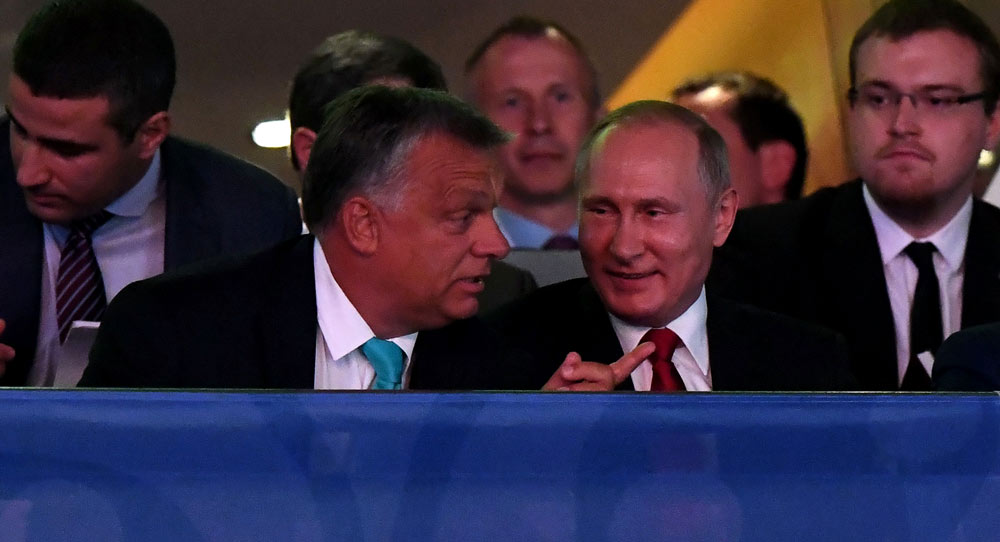
On August 28, Putin was in Budapest, just seven months since his last visit, during which energy topped the agenda.Of course, this week’s trip was different. Putin is honorary president of the International Judo Federation, so it was fitting for him to attend the opening ceremony of the World Judo Championships hosted by Budapest. And during talks in the capital with Hungarian Prime Minister Viktor Orbán, the energy issue, naturally, was raised.
Orbán has come in for a lot of criticism for signing a €10 billion ($12 billion) loan with Russia back in 2014—during the height of the Ukraine crisis. The idea was that this agreement would finance and expand Paks, Hungary’s only Soviet-era nuclear power plant.
The expansion will be built by Rosatom, the Russian state nuclear energy agency. The European Commission, the EU’s executive arm, scrutinized the accord and eventually cleared the investment—although for the Hungarian public, the terms of the deal are a state secret.
Hungary has recently signed yet another energy deal, this time with Gazprom, Russia’s state-owned gas giant. This agreement will link Hungary with the Turkish Stream pipeline that Gazprom is building. Hungary’s foreign minister, Péter Szijjártó, said that deal would “improve Hungary’s energy security a great deal, so it is in our strategic interest for this cooperation to start.”
Forget the fact that Orbán was vehemently against forging any energy deal when the socialists were in power. Back then, in the early 2000s, Orbán wanted much greater energy diversification, not only for Hungary but for the rest of the EU, too. He was also very critical of the close political and economic ties between Russia and former socialist prime minister Ferenc Gyurcsány, who led Hungary from 2004 to 2009.
Not only do Orbán’s policies contradict his previous stance when he was in the opposition, they also run counter to the Visegrád group of countries that consist of Poland, Hungary, Slovakia, and the Czech Republic. Poland in particular has been at the forefront of making the region less dependent on Russian energy and making energy security and diversification of resources key elements of EU policy.
Yet while it is easy to criticize Orbán’s energy policies, which from a purely strategic and political angle increase Hungary’s dependence on Russian energy, just look at what has been happening in Germany.
Before the collapse of the Berlin Wall in November 1989, the then West Germany, through constructing a gas pipeline with the former Soviet Union, established very close energy ties with Moscow, much to the irritation of the United States.
Gazprom sent gas to Western Europe via Ukraine. But since the early 2000s, Moscow wanted to reduce its dependence on Ukraine as a transit country for its gas exports. Hence Putin’s decision, backed by Germany, to build Nord Stream. This project, signed in early September 2005, now brings Russian gas directly to Germany via pipelines under the Baltic Sea.
A second Nord Stream pipeline is in the works. German Chancellor Angela Merkel, who was elected in late September 2005, has done nothing to stop it. Her predecessor, the Social Democrat Gerhard Schröder, was not only appointed to join and then head the board of Nord Stream just weeks after losing the election to Merkel. Last month, Schröder was appointed non-executive director of Rosneft, the huge Russian state-owned oil company that has been hit by Western sanctions after Russia illegally annexed Crimea in 2014 and invaded parts of Eastern Ukraine.
Merkel, who described Nord Stream as a purely commercial venture, took several weeks to criticize Schröder’s move to Rosneft. “I do not think what Mr. Schröder is doing is okay,” Merkel, a conservative, told Bild newspaper in an interview broadcast live online.
Both Schröder and Orbán have criticized sanctions on Russia. Orbán, however, has never broken EU consensus in rolling them over. One wonders how Schröder would have reacted had he been chancellor or indeed if the Social Democrats headed the German government.
Several EU countries have criticized Nord Stream, most notably the Baltic states and Poland. But the big EU member states seem indifferent to the project. No wonder. Apart from Germany, Austria, France, and the Netherlands are also part of the Nord Stream consortium.
The European Commission continues to push for greater energy diversification and greater energy liberalization. Both would increase EU energy security. But the unwillingness to challenge policies being adopted by Germany and Hungary only perpetuates Europe’s dependence on Russian energy—and the political ties and influence that go with it.

Nonresident Senior Fellow, Carnegie Europe
Judy Dempsey is a nonresident senior fellow at Carnegie Europe
Recent Work
Judy Dempsey
Judy Dempsey
Carnegie does not take institutional positions on public policy issues; the views represented herein are those of the author(s) and do not necessarily reflect the views of Carnegie, its staff, or its trustees.

Are Germany’s economic, industrial, and political struggles becoming a liability for the EU’s ability to rise to the geopolitical moment?

Rym Momtaz, ed.

European Commission President Ursula von der Leyen is about to give her annual address on the state of the EU. Here’s what she won’t—but should—say.
Rym Momtaz

The aftermath of the Ceuta crisis shows Europe has drawn the wrong lessons. Rather than doubling down on failed migration policies, the EU needs to address the underlying roots of such episodes.

Richard Youngs

An overwhelming victory by a far-right-wing party in a small state in eastern Germany will have major repercussions for Chancellor Friedrich Merz’s coalition.
Judy Dempsey

Canadian Prime Minister Mark Carney has twice inspired praise for standing up to U.S. President Donald Trump: at the 2026 World Economic Forum in Davos and on Canada-U.S. trade negotiations. Is Carney showing a third way better than the EU has in dealing with the Trump administration?
Rym Momtaz, ed.