

Commentary
Judy Dempsey
{
  "authors": [
    "Judy Dempsey"
  ],
  "type": "commentary",
  "blog": "Strategic Europe",
  "centerAffiliationAll": "",
  "centers": [
    "Carnegie Endowment for International Peace",
    "Carnegie Europe"
  ],
  "collections": [
    "Transatlantic Cooperation"
  ],
  "englishNewsletterAll": "",
  "nonEnglishNewsletterAll": "",
  "primaryCenter": "Carnegie Europe",
  "programAffiliation": "",
  "programs": [],
  "projects": [],
  "regions": [
    "Europe",
    "North America",
    "United States",
    "Eastern Europe",
    "Western Europe"
  ],
  "topics": [
    "Foreign Policy",
    "EU",
    "Security",
    "Political Reform"
  ]
}
Source: Getty
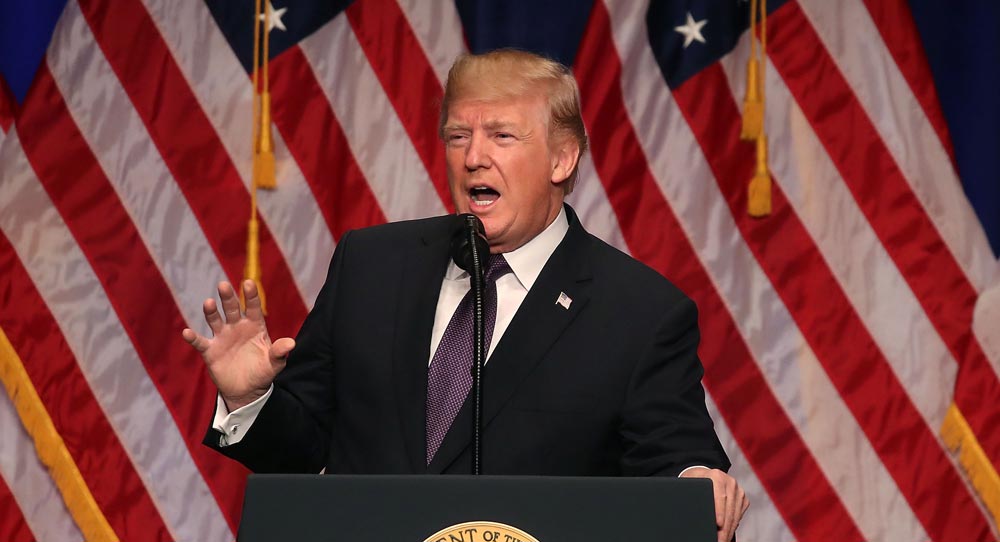
Europeans can take some solace from Trump’s support for NATO and the EU. But the U.S. president will want value for money.
Remember when Donald Trump was running for president of the United States, and he said that NATO was obsolete? Remember how he belittled the European Union when he asked what other EU member would follow Britain by leaving the bloc? Remember how he praised President Vladimir Putin and questioned Russia’s illegal annexation of Crimea?
European leaders, particularly those in Eastern and Central Europe, believed the transatlantic relationship was on the wane. They even feared America’s security guarantee—enshrined in Article 5 of the Washington Treaty and NATO’s raison d’être—was no longer a given. A reading of Trump’s first National Security Strategy (NSS) puts paid to these almost existential concerns by some of America’s allies.
The NSS acknowledged that “a strong and free Europe is of vital importance to the United States.” Sceptics might believe this is just lip service. Yet the NSS mentions how the United States rebuilt Western Europe after World War II (and it was instrumental in establishing the European Union.) It had only praise for a Europe that is “one of the most prosperous regions in the world and our most significant trading partner.”
For all that, the NSS recognized that Europe is threatened. It specifically blamed Russia for using subversive measures “to weaken the credibility of America’s commitment to Europe, undermine transatlantic unity, and weaken European institutions and governments.” By its invasions of Georgia and Ukraine, Russia “demonstrated its willingness to violate the sovereignty of states in the region.” And, the NSS argues, Moscow “continues to intimidate its neighbors with threatening behavior, such as nuclear posturing and the forward deployment of offensive capabilities.” NATO’s Eastern allies clearly have supporters in the Pentagon.
Given such threats, the NSS insisted that the United States remained committed to its European allies and partners and to Article 5.
The NSS could have used that commitment to criticize NATO for spending far too little on its defense, as Trump has often said in the past. But this time, the NSS didn’t cajole or complain. It simply said NATO could become stronger when all members “assume greater responsibility for and pay their fair share to protect our mutual interests, sovereignty, and values.” That means increasing defense spending “to two percent of gross domestic product by 2024, with 20 percent of it devoted to increasing military capabilities.”
At the same time, the NSS pledged to strengthen deterrence and defense on NATO’s Eastern flank. Integrated air and missile defense capabilities should be increased to counter cruise missile threats, “particularly from Iran.” NATO’s Eastern members, especially the Baltic states, cannot but be reassured by this security strategy.
Energy security—another concern of several EU countries, particularly those that are openly opposed to the Nord Stream 2 pipeline that is being built by Russia, along with German and other big Western European energy companies—got a mention too. The NSS stated that the United States would “work with our allies and partners to diversify European energy sources to ensure the energy security of European countries.” No mention was made of Germany’s dependence on Russian energy or how the United States would try and increase its energy exports to Europe. It was implied.
The NSS didn’t spare criticism of China’s role in Europe, either. It stated that China was “gaining a strategic foothold in Europe by expanding its unfair trade practices and investing in key industries, sensitive technologies, and infrastructure.”
Such concerns reflect similar views held by Germany, which wants to protect some of its strategic sectors—including energy and specialized manufacturing—from Chinese investments or takeovers. Trump called on the Europeans to “contest China’s unfair trade and economic practices and restrict its acquisitions of sensitive technologies.” In short, Trump wants a more rigorous approach to protecting intellectual property, something that German business leaders would support.
Since taking office last January, Europeans have had more than a jaundiced view of Trump, criticizing him for walking away from the Paris Agreement, for his ambiguous relationship with Putin, for cutbacks to the State Department, and for pulling out of the Trans-Pacific Partnership. They criticized him, too, for putting too little emphasis on democracy and values—as if the Europeans didn’t often put interests before values.
Yet moving beyond the NSS’s view of NATO and the EU, those who wrote the strategy were pulled in many directions. They had to reconcile Trump’s “America First” doctrine with the rapidly changing pace of globalization, and especially the impacts that cyber security and digitization are having on institutions and governance. With those tensions in mind, the NSS attempted to set out America’s place in the world.
The NSS stated there would be no imposing “our values on others… we develop policies that enable us to achieve our goals while our partners achieve theirs.” Human rights advocates and civil society activists and movements may be disappointed by these words, especially a time when values are under siege from fake news, disinformation and authoritarian countries.
The Europeans, however, can take solace that NATO and the EU do matter to the United States—despite what was said over a year ago. But they should make no mistake about Trump’s inherent suspicion of other multilateral organizations. The subset of the NSS was that the president wants value for money.

Nonresident Senior Fellow, Carnegie Europe
Judy Dempsey is a nonresident senior fellow at Carnegie Europe
Recent Work
Judy Dempsey
Judy Dempsey
Carnegie does not take institutional positions on public policy issues; the views represented herein are those of the author(s) and do not necessarily reflect the views of Carnegie, its staff, or its trustees.

Trump is distracted and Ukraine wants Europe to step up. The continent’s leaders must find their voice and assert it in talks with Russia.

Alissa de Carbonnel

Mounting economic strain and battlefield losses will not necessarily make the Kremlin less dangerous. They could instead push Moscow toward a more aggressive hybrid campaign designed to test NATO’s Eastern flank, exploit allied hesitation, and fracture European resolve.

Maksym Beznosiuk
Over the past ten years, NATO has held almost as many summits as it did during the entirety of the Cold War. Are they still useful, or is it time to stop holding annual meetings?

Rym Momtaz, ed.
Nearly a year and a half after Europeans leaned into sucking up to Trump, the strategy has produced some benefits when it comes to Ukraine.
Rym Momtaz
Far-right leader Marine Le Pen can—and will—run in France’s next presidential election. What does the outcome of her appeal against a 2025 embezzlement conviction mean for the country’s political future?

Catherine Fieschi