

Commentary
Judy Dempsey
{
  "authors": [
    "Judy Dempsey"
  ],
  "type": "commentary",
  "blog": "Strategic Europe",
  "centerAffiliationAll": "",
  "centers": [
    "Carnegie Endowment for International Peace",
    "Carnegie Europe"
  ],
  "collections": [
    "Transatlantic Cooperation",
    "Europe’s Southern Neighborhood"
  ],
  "englishNewsletterAll": "",
  "nonEnglishNewsletterAll": "",
  "primaryCenter": "Carnegie Europe",
  "programAffiliation": "",
  "programs": [],
  "projects": [],
  "regions": [
    "Middle East",
    "Europe",
    "North America",
    "Iran",
    "Western Europe"
  ],
  "topics": [
    "Foreign Policy",
    "Security",
    "EU"
  ]
}
Source: Getty
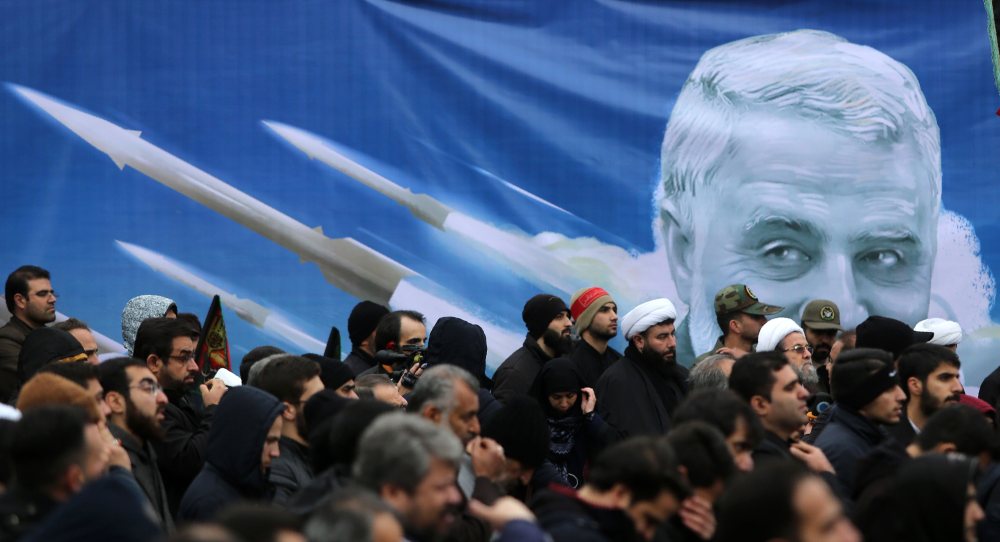
The Europeans have neither the political will nor military means to contain the fallout of the assassination of Iranian Quds Force leader Qassem Soleimani.
The Middle East is in turmoil, but the Europeans are hapless bystanders.
The decision by U.S. President Donald Trump to assassinate Qassem Soleimani, the leader of Iran’s ruthless Quds Force, has shaken the leaders of the biggest European countries.
Their attempts to salvage the Joint Comprehensive Plan of Action (JCPOA), the 2015 landmark nuclear deal, are in tatters after Iran said on January 5 it was abandoning all limitations on uranium enrichment. It’s unlikely the accord could have survived once Trump pulled out of it in 2018. Soleimani’s death has strengthened the hand of hardliners in Tehran. They disliked the nuclear deal.
As for the Europeans’ reaction to the decision by Iraq’s parliament to order American troops out of the country, coupled with Iran’s growing influence in Baghdad, they amounted to hand-wringing and the ritual rhetorical statements.Britain, France, and Germany, signatories to the JCPOA, called for a special meeting of EU foreign ministers, stressing the need to “de-escalate” and emphasizing their “deep concern”—an expression that has zero meaning.
But the potential conflagration unfolding in front of their eyes is symptomatic of a much more profound malaise, and its consequences will either shake Europe out of its strategic helplessness or reduce it to a mere object of external influences, benign or destructive.
First of all, it is symptomatic of the profound crisis in the transatlantic relationship.
It’s not just about Trump’s views on NATO. His predecessors were scathing about the military competence of the alliance’s European members. It’s about how the Europeans, collectively grouped in the European Union, don’t seem to matter to this American administration.
One reason is that as a bloc, the Europeans don’t project power in the traditional sense. Nor do they project unity when it comes to a common perception of threats. Nor do they defend their interests.
If they did, France and Germany would have joined America’s Operation Sentinel, now known as the International Maritime Security Construct, launched in July 2019 to respond to threats to shipping in the Strait of Hormuz. Protecting shipping lanes is crucial for European, U.S., and world trade flows. But barring Britain’s participation in the U.S.-led mission, other European countries declined to join, while a few signed up to France’s own competing initiative—without Germany.
Perhaps working with the Americans would have sent the wrong signal to Iran: that the Europeans are siding with Trump. But adopting an equidistance between the United States and Iran, or a separate policy when it comes to Iran attacking oil tankers, confirms what’s wrong with the transatlantic relationship.
The worrying consequence of Soleimani’s assassination is that it leaves Iraq even more vulnerable to Iranian influence on the one hand and on the other, if American troops are withdrawn, could offer a chance for the so-called Islamic State to regroup.
Either way, the sovereignty that the Iraqi parliament argued had been undermined by the American occupation in the first place will be just as undermined by Iran’s influence and the Islamic State. And Europe will not be able to escape the specter of terrorist attacks on American targets in addition to more flows of refugees.
Above all, what players, or who, will now persuade Iran to return to the JCPOA, which after all was an attempt at curbing the proliferation of lethal weapons? A nuclear Iran will change the geostrategic contours of the region, with Israel, Saudi Arabia, and Turkey, to name only a few, scared of such a development.
If and when American troops leave, Iraq’s stability will hang in the balance. The military assistance that Germany provided to the Kurds and the training NATO provided to the Iraqi military will be suspended. Berlin and NATO have made the safety of their personnel a priority. If Iran is going to guarantee Iraq’s stability, it will surely extract a high price.
Tehran’s increasing role in the region and its support for terrorist movements should rob Europeans—and Americans—of any doubt about the regime’s intentions.
“Unlike the Trump administration, which cannot reconcile its desire to get tough on Iran with its desire to leave the region altogether, the Iranian regime has a strategy . . . to its desired ends: keeping the clerics in power, keeping its imperial project in the region alive, and keeping sworn enemies, including America, off balance and out of its neighborhood,” argue William J. Burns, president of the Carnegie Endowment for International Peace, and Jake Sullivan, nonresident senior fellow, in the Atlantic.
Such an analysis hardly bodes well for German Chancellor Angela Merkel ahead of her visit to Moscow on January 11—at the invitation of Russian President Vladimir Putin. With his influence writ large in eastern Ukraine and Syria, in addition to his disruptive influences in Europe, the new crisis in Iraq and Iran could throw him a diplomatic dice.
Especially since Trump has eschewed diplomacy and the Europeans still believe in it despite lacking leverage and strategy.

Nonresident Senior Fellow, Carnegie Europe
Judy Dempsey is a nonresident senior fellow at Carnegie Europe
Recent Work
Judy Dempsey
Judy Dempsey
Carnegie does not take institutional positions on public policy issues; the views represented herein are those of the author(s) and do not necessarily reflect the views of Carnegie, its staff, or its trustees.

The domestic impacts of how long it is taking to end the war in Ukraine have pushed the French electorate to the political extremes and compromised the country’s diplomatic capacity.

Rym Momtaz

Before the next wave of EU enlargement takes place, the union needs to grapple with thorny questions of how power is distributed among its members.


Emil Sondaj Hansen, Ditte Brasso Sørensen

A summer of escalation in the Black Sea has hurt Ukraine economically and is exacerbating world food security. A truce is needed—as is a broader reframing of Europe’s Ukraine strategy.

Thomas de Waal

Are Germany’s economic, industrial, and political struggles becoming a liability for the EU’s ability to rise to the geopolitical moment?
Rym Momtaz, ed.

European Commission President Ursula von der Leyen is about to give her annual address on the state of the EU. Here’s what she won’t—but should—say.
Rym Momtaz