

Commentary
Judy Dempsey
{
  "authors": [
    "Judy Dempsey"
  ],
  "type": "commentary",
  "blog": "Strategic Europe",
  "centerAffiliationAll": "",
  "centers": [
    "Carnegie Endowment for International Peace",
    "Carnegie Europe"
  ],
  "collections": [
    "Europe’s Eastern Neighborhood"
  ],
  "englishNewsletterAll": "",
  "nonEnglishNewsletterAll": "",
  "primaryCenter": "Carnegie Europe",
  "programAffiliation": "",
  "programs": [],
  "projects": [],
  "regions": [
    "Russia",
    "Europe",
    "Eastern Europe",
    "Western Europe",
    "Germany",
    "Belarus"
  ],
  "topics": [
    "Foreign Policy",
    "EU",
    "Economy",
    "Democracy",
    "Climate Change"
  ]
}
Source: Getty
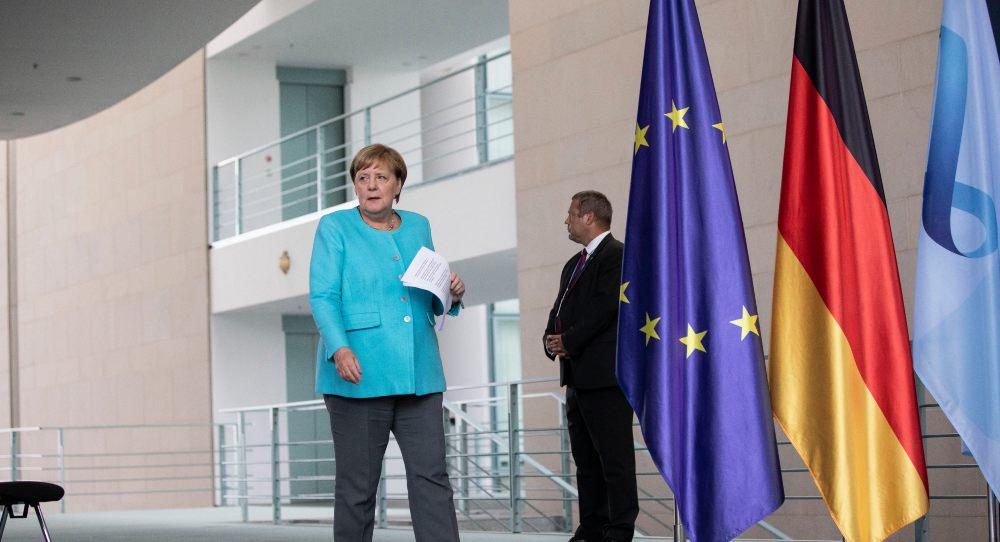
Angela Merkel, in her last stint as German chancellor, can still make a major difference for her country’s—and Europe’s—policy toward Belarus and Russia.
Germany’s security services are taking no chances. They are positioned outside and inside Berlin’s Charité hospital where Russia’s most outspoken opposition leader, Alexei Navalny, is being treated.
He was flown to Berlin when German Chancellor Angela Merkel personally intervened to have Navalny brought to Germany after he fell ill on a domestic flight back from Siberia to Moscow. He was at first treated in a hospital in Omsk. There, his wife was not allowed to see him. The doctors prevaricated about his condition.Navalny’s supporters said he had been poisoned after drinking tea at the airport. Doctors at the Charité, who by now have had enough experience in treating individuals who have been victims of Russian President Vladimir Putin’s attempts to silence his critics, have confirmed that he was poisoned. Navalny is still in a medically induced coma.
Merkel and German Foreign Minister Heiko Maas called on Moscow to launch an immediate investigation: “In view of Mr Navalny’s major role in Russia’s political opposition, the country’s authorities are urgently called upon to fully investigate this act as a matter of urgency—and to do so in a completely transparent way,” they said in a statement. “Those responsible must be identified and brought to justice.” That will be the day.
There have been far too many cases in which Putin’s critics have been killed or attempts have been made on their lives. Navalny, an indefatigable campaigner who has exposed the corruption that has come to characterize Putin’s circle, is just the latest in the Kremlin’s attempts to snuff out any opposition.
It coincides with the extraordinary events unfolding in neighboring Belarus. There, hundreds of thousands of citizens on August 23, 2020, again took to the streets to protest the way in which Belarusian President Alexander Lukashenko was reelected on August 9.
The protest leaders have enough evidence to show the results were falsified. And despite the arrests, the beatings, the torture, the disappearances, the killings of activists, the intimidation, and the police brutality, people have not been cowed into submission.
On August 19, the Belarusian chief prosecutor launched a criminal investigation into the newly established thirty-five–member Coordination Council, which is calling for new, free, and fair elections. Three of its leaders, Nobel Prize winner for literature Svetlana Alexievich, Olga Kovalkova, and Sergei Dylevsky, were detained. So was Anatoly Bokan, one of the strike leaders at a potash plant.
It’s too difficult to predict how events will unfold in Belarus, the EU’s immediate neighbor. So far, Lukashenko shows no willingness to negotiate with the Coordination Council. After over a quarter of a century in power, the idea of compromise or negotiation or sharing power seems out of the question for him. Just as it is for Putin.
But using force against peaceful demonstrators or finding ways to provoke them into violence won’t return Belarus to the status quo ante. Both Belarus and Russia, to differing degrees, are already entering complex transition modes.
Since that is the case, and since European leaders—if they don’t already know it—now have instability on their doorstep, Germany should exert its influence.
With regard to Russia, Berlin can act in a number of ways. Treating Navalny in Berlin was the decent, humane thing to do. But it will hardly change Putin. If Berlin or Paris did offer Navalny asylum, that would just be one major dissident out of the Kremlin’s way.
Instead, the German government can step up its support for Russian civil society. This could be done by supporting the independent social media, granting scholarships to young people, and supporting environmentalists. Above all, Merkel could stop the construction of Nord Stream 2, the gas pipeline that will transport Russian gas directly to Germany via the Baltic Sea.
Leaving aside the pressure her government is under by the administration of U.S. President Donald Trump, which has threatened sanctions on European companies involved in the project, Germany has no political or economic reasons to become more dependent on Russian energy. Indeed, by continuing to support Nord Stream 2, Germany is compensating Russia for today’s very low energy prices.
Abandoning Nord Stream 2 would be seen by the German public as giving into American pressure. But continuing with it makes a mockery of Europe’s and Germany’s policies to diversify its energy sources.
Moreover, after so many years during which Germany’s political elites hoped that economic ties would bring Russia closer to Europe, Putin’s style of leadership has proved the opposite. Nord Stream 2 won’t change the Kremlin’s course.
The same could be said of Lukashenko.
Belarus’s economy is very closely tied to Russia. It gives Moscow some leverage over the regime in Minsk. But Germany—and the European Union—see all too well how the old guard is struggling. Lukashenko can still resort to more force to assert his rule, but it would be a very high price to pay.
Germany and the EU need to support Belarusian civil society—as Lithuania has been doing for several years. But that’s not enough. They need to engage Lukashenko. This is not interfering, despite the state propaganda blaming NATO and “foreign” powers for the demonstrations. The demonstrators are not calling for their country to join the EU or NATO. They are trying to make a peaceful, nonviolent transition away from an authoritarian regime toward democracy.
That’s the biggest threat to the regime in Minsk—and to the one in Moscow.

Nonresident Senior Fellow, Carnegie Europe
Judy Dempsey is a nonresident senior fellow at Carnegie Europe
Recent Work
Judy Dempsey
Judy Dempsey
Carnegie does not take institutional positions on public policy issues; the views represented herein are those of the author(s) and do not necessarily reflect the views of Carnegie, its staff, or its trustees.

With its public finances in shambles, the far right polling at 35 percent ahead of the 2027 presidential election, and a growing protest movement, is France’s crisis a threat to the EU’s geopolitical awakening?

Rym Momtaz, ed.

Ahead of a tough winter for Ukraine, Donald Trump’s swing back toward Russia bodes ill. But instead of panicking, Kyiv’s European allies are focusing on action.
Rym Momtaz

While the EU and European governments are embracing the much-lauded middle-power moment, this entails three difficult conundrums.

Richard Youngs

Much has been said of the changes Brussels is trying to make to the EU enlargement process. Here’s why gradual integration might—or might not—be the answer.

Dimitar Bechev

The European Commissioner for Trade is headed to China. But after President Xi’s bridge-building visit to Washington, can a more isolated EU overcome Beijing’s stranglehold on critical raw materials? Who will blink first?
Rym Momtaz, ed.