

Commentary
Thomas de Waal
{
  "authors": [
    "Thomas de Waal"
  ],
  "type": "commentary",
  "blog": "Strategic Europe",
  "centerAffiliationAll": "",
  "centers": [
    "Carnegie Endowment for International Peace",
    "Carnegie Europe"
  ],
  "collections": [
    "Europe’s Eastern Neighborhood"
  ],
  "englishNewsletterAll": "",
  "nonEnglishNewsletterAll": "",
  "primaryCenter": "Carnegie Europe",
  "programAffiliation": "",
  "programs": [],
  "projects": [],
  "regions": [
    "Russia",
    "Europe",
    "Eastern Europe",
    "Caucasus",
    "Azerbaijan",
    "Armenia",
    "Western Europe"
  ],
  "topics": [
    "Foreign Policy",
    "Security",
    "EU"
  ]
}
Source: Getty
Russia’s peace deal for Armenia and Azerbaijan has halted the war over Nagorny Karabakh and exposed the Western countries as bystanders. The Europeans must now try to help shape a lasting peace on the ground.
In Nagorny Karabakh, the guns have fallen silent, but the aftermath of the six-week conflict between Armenia and Azerbaijan is still messy and unclear.
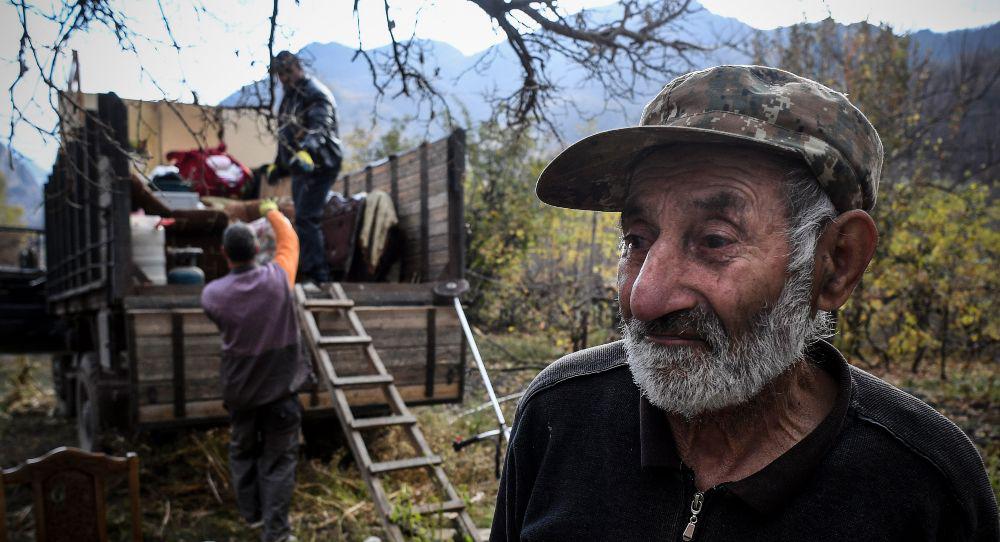
A Russian-enforced truce means an end to six weeks of bloodshed that claimed more than 5,000 lives. It promises the chance to return home for hundreds of thousands of Azerbaijanis displaced between 1992 and 1994, when Armenian forces captured seven Azerbaijani regions around the disputed territory of Nagorny Karabakh. However, a massive reconstruction program is needed before resettlement can begin.It is a much-needed truce, but it is not a peace agreement. Much bitterness on the Armenian side persists. To name but one grievance, the new war displaced thousands of Armenians living within Nagorny Karabakh from their homes, and they now face an uncertain future.
Full normalization of relations between Armenia and Azerbaijan is also off the table as long as the issue of the status of Nagorny Karabakh itself, the question which triggered the conflict in 1988, remains unresolved.
In a victory speech on November 10, 2020, Azerbaijani President Ilham Aliyev abandoned commitments he had made to grant Karabakh “the highest status in the world” and mocked his Armenian counterpart with the words, “The status went to hell. It failed; it was shattered to smithereens. It is not and will not be there. As long as I am President, there will be no status.”
Despite having suffered a crushing defeat—the worst of which he could almost certainly have prevented by negotiating more seriously—Armenian Prime Minister Nikol Pashinyan also refused to concede on the status issue and again called for international recognition of “Artsakh,” as Armenians call Karabakh.
Russia, with 1,960 peacekeepers deployed on the ground, now stands squarely in the center of this process.
Russian President Vladimir Putin might see reasons to push for a full peace agreement that restores relations between two important neighbors, Armenia and Azerbaijan.
Then again he might not: if the two sides are in a state of suspended hostilities, that is a good reason for the Russian peacekeepers to stay. Russia’s agenda is probably more about projecting its own power and about trade routes than about long-term peace in the South Caucasus.
One outcome of the conflict is very clear: Western countries were pushed to the margins and will need to work hard to make themselves relevant again. Attempts by France and the United States—the two other co-chairs of the OSCE’s mediating Minsk Group alongside Russia—to broker a ceasefire failed.
Following a failed meeting in Washington, DC, U.S. Secretary of State Mike Pompeo more or less advertised his own botched performance by visiting Tbilisi on November 17–18 but not traveling to Baku or Yerevan.
The fighting stopped only with Moscow’s intervention—with, according to Putin himself, intense personal telephone mediation.
Could it have been otherwise? European engagement in this conflict was quite strong in the 1990s as the OSCE was formed. The United States and France both made a concerted push to broker a negotiated settlement in the years 1999–2001.
But since about 2008, Moscow has been the main mediator. At major meetings, the French and U.S. co-chairs were excluded from the room where the main talks happened, instead waiting outside to be briefed afterward.
When fighting broke out, Washington and other European capitals were barely visible. They lost public credibility amongst Armenians and Azerbaijanis during the fighting. European statements of “concern” at the death of civilians and reports of human rights abuses were derided on social media, especially on the Armenian side.
At this crucial moment, France also turned out to be an unfortunate mediator. Given France’s large Armenian diaspora and deep antagonism with Turkey, French President Emmanuel Macron had almost no leverage with Azerbaijan.
As Russia needs some legitimacy for its peace deal, we can expect the Minsk Group co-chair format to continue. On November 19, the EU reaffirmed its support for the mechanism. But this conflict-mediation format would surely benefit from a big shake-up.
France should seriously consider renouncing its co-chair position in favor of another European country or an EU-wide position. It has held the position for twenty-three years, and a country like Germany or Sweden—having more balanced relations with Armenia and Azerbaijan—would almost certainly be able to deliver more. A new UN Security Council resolution that spells out the new realities and remaining challenge would also be very helpful.
An armed conflict between two Eastern Partnership countries has challenged the EU’s aspirations for a strategic role in the South Caucasus. The EU simply lacked the institutional tools to deal with this crisis.
Georgia, extremely wary of Russia’s new, assertive role in the South Caucasus, is drawing conclusions. Georgian opposition politicians called on Pompeo to pledge “the deployment of U.S. military infrastructure in Georgia” in response to the Russian peacekeepers in Karabakh to the south.
Having lost the war, can Europeans and Americans help shape a peace?
There is a huge amount to be done—both in Nagorny Karabakh itself and in the seven former occupied territories—that would benefit from European expertise, in partnership with UN agencies, from reconstruction and demining to facilitating resettlement.
The important and controversial issue of protecting cultural heritage and allowing access for Armenians to places of worship now under Azerbaijani control calls for international facilitation—and will be a concern that the Armenian-American community puts before the incoming U.S. administration of President-elect Joe Biden.
European NGOs also have good expertise in facilitating dialogue initiatives between fearful communities separated by war but now fated to live as neighbors once again.
This is all work that is suited to European skills. Engagement here and money spent should also provide some political leverage for both the EU and UN.
But that engagement also requires great humility. The Western powers should acknowledge that they basically allowed themselves to be bystanders to the great-power deal that halted the new war over Nagorny Karabakh.

Senior Fellow, Carnegie Europe
Thomas de Waal is a senior fellow at Carnegie Europe, specializing in Eastern Europe and the Caucasus.
Recent Work
Thomas de Waal
Thomas de Waal
Carnegie does not take institutional positions on public policy issues; the views represented herein are those of the author(s) and do not necessarily reflect the views of Carnegie, its staff, or its trustees.

The EU can impose sanctions but struggles to enforce them without the United States. With Washington increasingly disinterested in backing European interests, the bloc must now fend for itself.


Nicu Popescu, Tiago Antunes

Russia is testing the waters of NATO’s mutual defense clause. What do strikes in Romanian territorial waters mean for the alliance’s posture toward Moscow?

Dimitar Bechev

With its public finances in shambles, the far right polling at 35 percent ahead of the 2027 presidential election, and a growing protest movement, is France’s crisis a threat to the EU’s geopolitical awakening?

Rym Momtaz, ed.

Ahead of a tough winter for Ukraine, Donald Trump’s swing back toward Russia bodes ill. But instead of panicking, Kyiv’s European allies are focusing on action.
Rym Momtaz

While the EU and European governments are embracing the much-lauded middle-power moment, this entails three difficult conundrums.

Richard Youngs