

Commentary
Cornelius Adebahr
{
  "authors": [
    "Cornelius Adebahr"
  ],
  "type": "commentary",
  "blog": "Strategic Europe",
  "centerAffiliationAll": "",
  "centers": [
    "Carnegie Endowment for International Peace",
    "Carnegie Europe"
  ],
  "collections": [],
  "englishNewsletterAll": "",
  "nonEnglishNewsletterAll": "",
  "primaryCenter": "Carnegie Europe",
  "programAffiliation": "",
  "programs": [],
  "projects": [],
  "regions": [
    "Middle East",
    "Europe",
    "Iran",
    "Western Europe"
  ],
  "topics": [
    "Foreign Policy",
    "Security",
    "Economy",
    "Political Reform",
    "EU",
    "Climate Change"
  ]
}

Source: Getty
With the election of a hardliner as Iranian president, eight years of European thinking that Tehran could be a partner will come to an end. It’s time for the EU to address not only the nuclear file but also regional security threats.
In Iran, political fortunes can turn quickly. Usually, this happens for the worse, but not when you’re a hardline conservative judge like Ebrahim Raisi. After clearly losing against the incumbent in 2017, he won a decisive victory on June 18 in his second attempt to become president of Iran.
It helped that the system’s rules directly favored the frontrunner. The obvious part was the clearing of the field of candidates by the Guardian Council, a clerical-legal body whose members were mostly handpicked either by the Supreme Leader Ali Khamenei or by Raisi himself, as head of the judiciary for the past two years.
The less visible element was the support arranged within the religious establishment as well as in the security apparatus for the candidate endorsed by Khamenei—plus possibly playing with ballot numbers. The officially announced result—nearly 62% of the votes, with less than 49% turnout—cannot be fully trusted.
Either way, the Europeans will have a much tougher time once Raisi enters office, whether in the ongoing nuclear negotiations, the bilateral approach to Iran, or the regional file.
As for reviving the 2015 nuclear deal, talks continued for one day after the ballot and were then adjourned for another, now seventh, “final final” round. Negotiators initially aimed to find a compromise over both the United States’ and Iran’s return to compliance with the terms of the Joint Comprehensive Plan of Action, or JCPOA, prior to the presidential election. Now, the goal is to do so before the inauguration of the next government by early August.
The poll does not change much on Iran’s side, as a return to the JCPOA has generally been green-lit by the supreme leader, pending an agreement with the United States on sanctions-lifting.
The immediate concern is rather with the International Atomic Energy Agency’s ability to inspect and verify Iran’s nuclear installations. Here, an interim agreement is expiring at the end of this month, threatening to severely curtail the agency’s eyes and ears on the ground.
Given that the Iranian leadership appears to have banked on the eventual lifting of sanctions, however, this hurdle should be surmountable. Effectively, when Raisi assumes the presidency, he will be able to bask in the benefits of that decision while blaming any remaining faults on his predecessor, Hassan Rouhani. And the Europeans will be able to set their sights on the many other problems Iran poses for them.
The more difficult question is what the return of the hardliners to the presidency—and in fact their full control of all levers of power in the Islamic Republic—means for Iranian society.
The sixty-year-old Raisi is a middle-ranked cleric—hojatoleslam—steeped in the country’s judicial system. He rose from being deputy prosecutor of Tehran after the 1979 revolution to attorney general by 2014, becoming chief justice in 2019 following his failed presidential bid.
With Raisi leading the Iranian government, any hope some had still harbored about reforms from within will be gone. He holds conservative views on social issues from dress code to Internet use, and when charged with investigating the hundreds of deaths during the 2019 protests, he only found fault with those filing a complaint.
Unlike Rouhani, who spoke of a referendum to reform the state leadership in the moment of Khamenei’s passing, Raisi appears determined to maintain—even cement—the status quo, possibly seeing himself as the next supreme leader.
Moreover, Raisi is most notorious for his alleged role as a member of a four-person death panel in the 1988 mass killing of thousands of political prisoners, a charge that he has steadfastly denied. As much as this repels any civic-minded Iranian, it endears Raisi to the regime’s insiders, as he has a vested interest in maintaining the system as it is.
It may also spell trouble for European-Iranian relations, as an Iranian currently is on trial in Sweden for his own involvement. A juridical implication of Iran’s new president in those executions will likely disrupt any political dialogue, just as the Mykonos verdict of a German court incriminating Iran’s leadership in the murder of four opposition politicians did back in 1997.
All this will make any European initiative directed at Iran’s domestic sphere more difficult to execute. Given that the Iranian leadership has refused Western vaccines and aid, and views academics with international contacts as potential spies, there is little room for the “constructive engagement” the EU keeps hoping for once the nuclear deal is back on track. The latter may bring renewed control over Iran’s nuclear program and limited trade but won’t be a springboard for an opening of the country to the outside world.
Lastly, Raisi will continue to pursue Iran’s regional policies of extending its reach through proxies while being open to diplomacy with worried neighbors.
Having given little indication about his own priorities, the new president is expected to yield to the powerful Islamic Revolutionary Guards Corps, which controls regional activities in consultation with the supreme leader. This means continuing the past years’ trend of combining violent attacks, such as those on Arab tankers and oil installations, with diplomatic talks on issues such as maritime security and regional de-escalation with the United Arab Emirates and Saudi Arabia, respectively.
Hence, the new Iranian leadership will be hard-nosed about its security interests, but without any isolationist streaks. For the EU, this represents an opportunity to update its own approach by expanding its focus on the nuclear file to a bigger, regional picture.
The political grounds are shifting: Israel concluded diplomatic accords with two Gulf states, some of the latter have begun talking to Tehran, and Washington seeks to extricate itself from a conflict-prone theater. Time for Europe to come in with proposals for how to organize collective security in the Persian Gulf.
Former Nonresident Fellow, Carnegie Europe
Cornelius Adebahr was a nonresident fellow at Carnegie Europe. His research focuses on foreign and security policy, in particular regarding Iran and the Persian Gulf, on European and transatlantic affairs, and on citizens’ engagement.
Recent Work
Cornelius Adebahr
Cornelius Adebahr, Barbara Mittelhammer
Carnegie does not take institutional positions on public policy issues; the views represented herein are those of the author(s) and do not necessarily reflect the views of Carnegie, its staff, or its trustees.
European reactions to the war in Iran have lost sight of wider political dynamics. The EU must position itself for the next phase of the crisis without giving up on its principles.

Richard Youngs
Europe isn’t as weak in the new geopolitics of power as many would believe. But to leverage its assets and claim a sphere of influence, Brussels must stop undercutting itself.

Dimitar Bechev
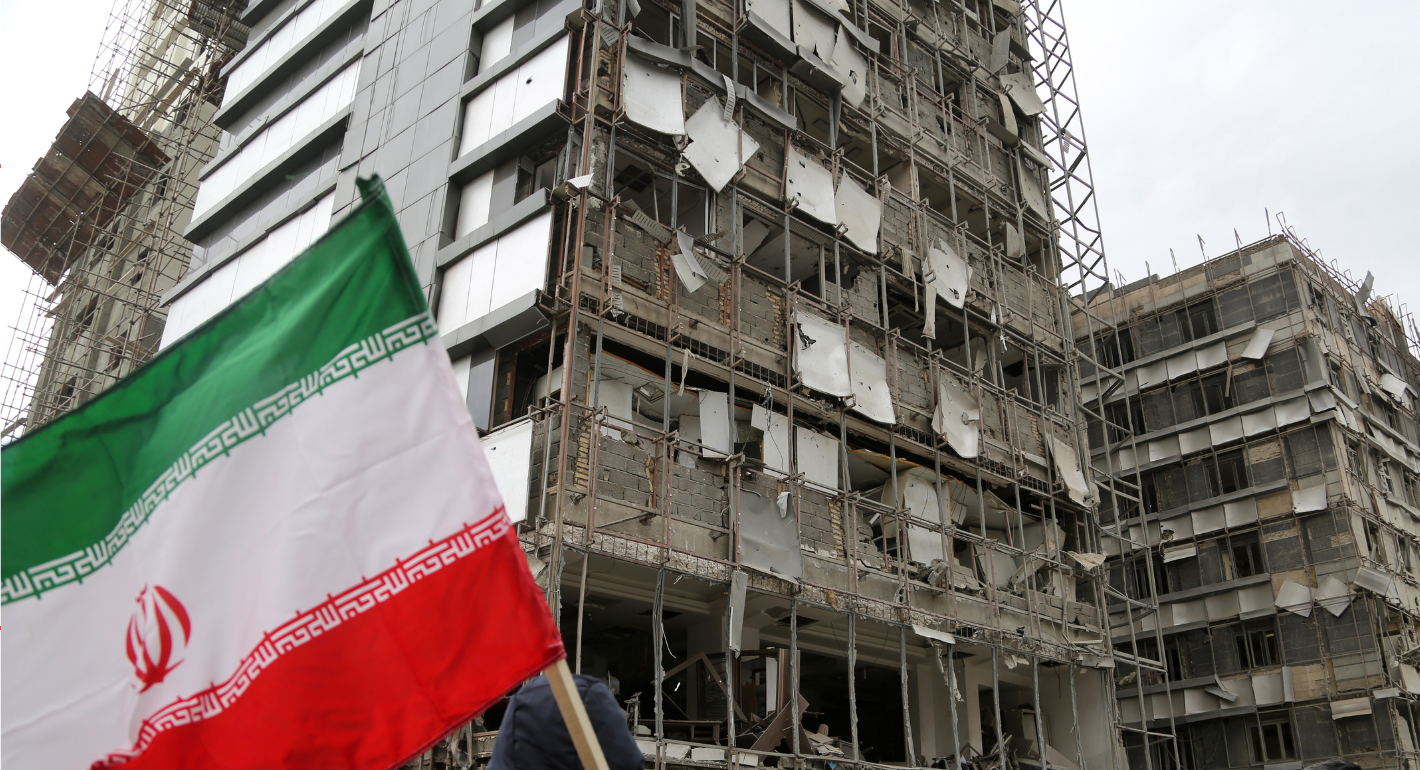
Europe’s reaction to the war in Iran has been disunited and meek, a far cry from its previously leading role in diplomacy with Tehran. To avoid being condemned to the sidelines while escalation continues, Brussels needs to stand up for international law.

Pierre Vimont
France and Germany’s failure to agree on the Future Combat Air System (FCAS) raises questions about European defense. Amid industrial rivalries and competing strategic cultures, what does the future of European military industrial projects look like?

Rym Momtaz, ed.
France has stopped clinging to notions of being a great power and is embracing the middle power moment. But Emmanuel Macron has his work cut out if he is to secure his country’s global standing before his term in office ends.
Rym Momtaz