

Commentary
Judy Dempsey
{
  "authors": [
    "Judy Dempsey"
  ],
  "type": "commentary",
  "blog": "Strategic Europe",
  "centerAffiliationAll": "",
  "centers": [
    "Carnegie Endowment for International Peace",
    "Carnegie Europe"
  ],
  "collections": [],
  "englishNewsletterAll": "",
  "nonEnglishNewsletterAll": "",
  "primaryCenter": "Carnegie Europe",
  "programAffiliation": "",
  "programs": [],
  "projects": [],
  "regions": [
    "Asia",
    "Europe",
    "East Asia",
    "China",
    "Taiwan",
    "Western Europe"
  ],
  "topics": [
    "Foreign Policy",
    "EU",
    "Economy",
    "Climate Change"
  ]
}
Source: Getty
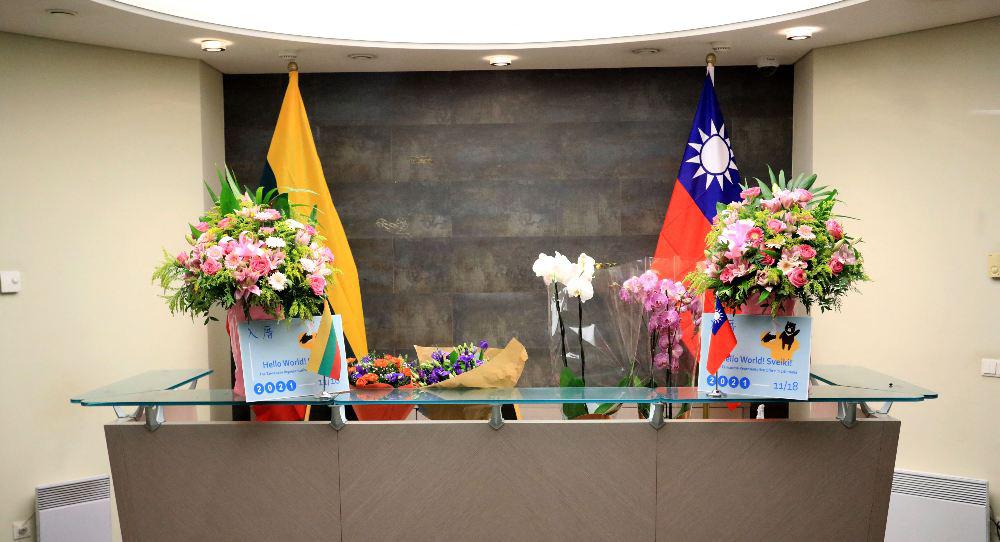
Beijing has gone to great lengths to punish Lithuania for opening a Taiwanese representative office. In the long run, China’s tactics may end up making the EU stronger and more resilient.
When Lithuania, a Baltic country of 2.8 million people, decided last year to open a Taiwanese representative office in Vilnius and a Lithuanian one in Taiwan, China’s response was swift and draconian.
Giving Taiwan any kind of legitimacy or status that challenged Beijing’s One China principle, which considers Taiwan an inalienable part of the mainland, would not be tolerated.
So when Lithuania announced the new office would bear Taiwan’s name— rather than that of Chinese Taipei, used by other countries to avoid conflict with China—Beijing began to pile the pressure on Vilnius. Over the past few years, Lithuania has attracted lucrative investments from fellow EU member states as well as the United States. The latter strongly supports Lithuania’s criticism of China’s human rights and trade policy.
In December 2021, Vilnius was temporarily removed from China’s customs clearance system. Earlier that year, Beijing stopped direct China-Lithuanian freight trains. It also closed credit lines for Lithuanian companies and blocked imports of existing orders from China.
Vilnius didn’t change its stance, even when China downgraded diplomatic ties with Lithuania to chargé d’affaires level, forcing the Lithuanian ambassador to return home.
Beijing then applied a different, stronger kind of pressure. It warned multinational companies, European and otherwise, to reduce their investments in Lithuania and stop sourcing supplies in the country. Beijing even threatened to retaliate against these companies’ operations in China—a well-tested policy aimed at playing EU member states off against each other.
At first, the German Chamber of Commerce in the Baltic States warned the Lithuanian government about the economic consequences of opening a Taiwanese representation office. German companies bringing goods from China to Lithuania and vice versa would face big difficulties.
But the Federation of German Industries (BDI), which has taken a very tough stance against China’s economic policies and human rights policies, often in contrast to the previous and current government in Berlin, was much more critical. Beijing’s actions amounted to a “trade boycott.”
“This is about the weaponization of trade. This is about the weaponization of European value chains,” Žygimantas Pavilionis, the Lithuanian parliament’s foreign affairs expert, told Strategic Europe. “It’s no longer just a bilateral issue. It’s a European one. It needs a European solution,” he added.
One could be on its way. It’s called the Anti-Coercion Instrument (ACI), presented by the European Commission on December 8, 2021. In a nutshell, the instrument “is a response to the rising problem of economic coercion and aims to protect the Union’s and Member States’ interests and sovereign choices.”
In clear language, the Commission also warns that “as a last resort, when the economic coercion persists, the Union may consider taking countermeasures against the country in question in order to counter act such economic coercion.”
The ACI has been on the Commission’s desk for some time. “The impetus grew under the Trump administration,” said Theresa Fallon, founder and director of the Centre for Russia Europe Asia Studies.
Former U.S. president Donald Trump not only took a hard line against China’s trade, economic, and political policies. He also threatened Germany and other EU countries with sanctions if Berlin didn’t stop the Nord Stream 2 gas pipeline project. According to Fallon, “The EU’s proposed anti-coercion instrument will be designed to protect the EU from various forms of economic coercion, not only from Beijing, but also from Washington and Moscow.”
One can only imagine the strains on the transatlantic relationship if the ACI was applied to the United States, particularly over its continued threat to impose sanctions on German and other European companies involved in completing Nord Stream 2.
Leaving aside the ACI and China’s weaponization of European trade in attempt to force Lithuania to change its Taiwan policy, Beijing’s actions have exposed the vulnerability of the EU’s trade and security policy.
The bloc’s trade is dependent on the Chinese economy, not to mention the global supply chains so dominated by Beijing.
“Beijing has shown us what they are capable of by threatening to impose sanctions on EU member states that have Lithuania products in their value chains,” Fallon said. “The only correct response to this threat is to decrease dependence, build resilience, and invest in future technologies in the EU. The Commission cannot carry on with business as usual.”
That, of course, is easier said than done. In practice, it would require a major EU strategic shift. Pavilionis and other Lithuanian officials are pinning their hopes on the French presidency of the Council of the EU. They want President Emmanuel Macron to hold an EU 27+1 summit that should set out a united European stance toward China. And Lithuania, which pulled out of the 17+1 format, a group for China’s engagement with many countries in Central Europe and the Western Balkans, would like to see the demise of that particular divisive venture.
By forcing Europe to diversify supply chains, China’s weaponization of European value chains may end up boosting the EU’s Indo-Pacific strategy and strengthening France’s growing strategic, military, and economic presence in the region. Such are the unintended consequences of China’s bullying tactics towards Lithuania. “Chinese diplomacy is backfiring,” Fallon said.
But don’t expect China to give up such tactics overnight.

Nonresident Senior Fellow, Carnegie Europe
Judy Dempsey is a nonresident senior fellow at Carnegie Europe
Recent Work
Judy Dempsey
Judy Dempsey
Carnegie does not take institutional positions on public policy issues; the views represented herein are those of the author(s) and do not necessarily reflect the views of Carnegie, its staff, or its trustees.

The EU can impose sanctions but struggles to enforce them without the United States. With Washington increasingly disinterested in backing European interests, the bloc must now fend for itself.


Nicu Popescu, Tiago Antunes

Russia is testing the waters of NATO’s mutual defense clause. What do strikes in Romanian territorial waters mean for the alliance’s posture toward Moscow?

Dimitar Bechev

With its public finances in shambles, the far right polling at 35 percent ahead of the 2027 presidential election, and a growing protest movement, is France’s crisis a threat to the EU’s geopolitical awakening?

Rym Momtaz, ed.

Ahead of a tough winter for Ukraine, Donald Trump’s swing back toward Russia bodes ill. But instead of panicking, Kyiv’s European allies are focusing on action.
Rym Momtaz

While the EU and European governments are embracing the much-lauded middle-power moment, this entails three difficult conundrums.

Richard Youngs