

Report
- +9
Richard Youngs, Erik Jones, Dan Baer, …
{
  "authors": [
    "Rosa Balfour"
  ],
  "type": "commentary",
  "blog": "Strategic Europe",
  "centerAffiliationAll": "",
  "centers": [
    "Carnegie Endowment for International Peace",
    "Carnegie Europe"
  ],
  "collections": [
    "EU Integration and Enlargement"
  ],
  "englishNewsletterAll": "",
  "nonEnglishNewsletterAll": "",
  "primaryCenter": "Carnegie Europe",
  "programAffiliation": "",
  "programs": [],
  "projects": [],
  "regions": [
    "Russia",
    "Europe",
    "Eastern Europe",
    "Western Europe"
  ],
  "topics": [
    "Foreign Policy",
    "EU",
    "Democracy",
    "Political Reform",
    "Security"
  ]
}
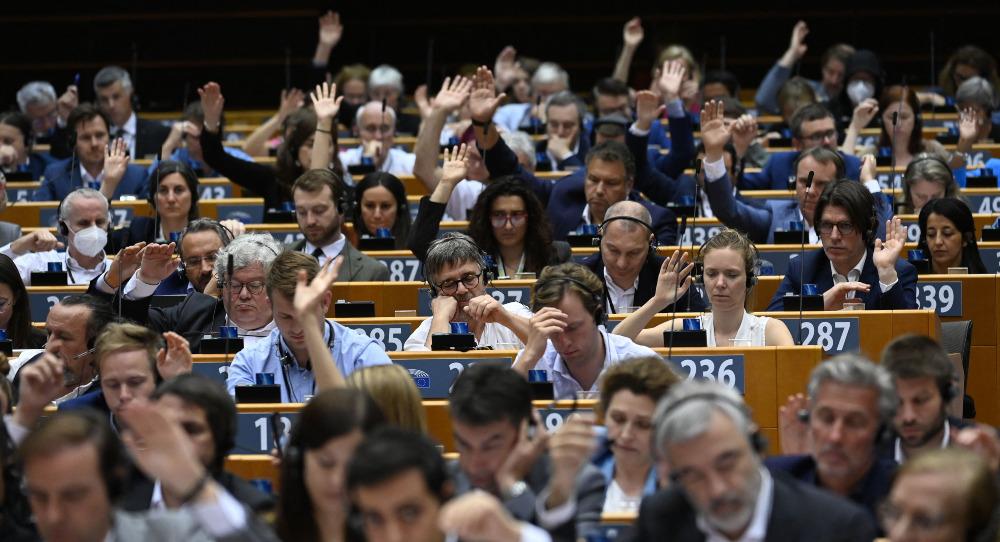
Source: Getty
After a decade of crises in Europe, historic decisions were taken at the EU and NATO summits to strengthen the continent. To overcome today’s challenges, Brussels must confront the causes of its paralysis in the 2010s.
“Europe will be forged in crisis” must be the most frequently used and abused Jean Monnet quotation about European integration. Brussels-based EU observers have heard it time and again as the continent somersaulted from crisis to crisis.
In 2008 Russia invaded Georgia and the eurozone crisis started. In 2015–16 the EU seemed on the brink of collapsing under the weight of refugees seeking protection from conflict, the British vote to leave the EU, and the election of a viscerally anti-European U.S. president. Throughout, governments trembled at every election, fearful of being swept away by a populist wave.
Yet very little was forged. “Muddling through” became the norm throughout the 2010s. The reasons for which the EU was unable to better address its crises were brushed under the carpet.
The combined force of the coronavirus pandemic and the war in Europe seems to usher in a historical turn: a Zeitenwende, as the German Chancellor Olaf Scholz put it, a Hamiltonian moment, and a “geopolitical awakening”—the rhetoric of EU leaders is rather repetitive.
The promise of enlargement to Ukraine, Moldova, and Georgia will require a commitment to build a stronger and deeper union where a geopolitical choice is melded to democratic reform. Treaty reform—a taboo idea since the Lisbon Treaty entered into force—has even been mentioned by a few leaders and called for by the citizen conclusions of the Conference on the Future of Europe. But will the EU live up to this?
War fatigue and inflation are likely clouds on the horizon of European unity and purpose, instigated by the Russian invasion of Ukraine. To deal with the present crisis and to avoid further turmoil, the EU needs to address the three major weaknesses exposed by the decade of muddling through.
The first was the lack of economic convergence between the European core and periphery, which created a rift between those advocating for fiscal austerity and those in favour of more burden sharing in the eurozone.
The pandemic swept away austerity politics and EU leaders broke eurozone rules when they agreed to the NextGenerationEU back in 2020. This is a work in progress, but advances have been made.
The second was divergences in threat perceptions, with Russia as the most divisive issue for Europe’s foreign policy historically. Deep strategic divisions on European foreign and security policy have held back the development of the EU’s international posture.
The remarkable array of decisions that EU leaders have taken since Russia invaded Ukraine is closing that gap, even if wrinkles remain between the member states; Paris and Warsaw, for example, have differing emphases on European strategic autonomy and NATO. Admittedly, leadership of the response to the war has come from Washington, but the EU too has taken bold steps that will shape its future, with the Strategic Compass, energy diversification, and a wide range of economic and financial tools.
Strategic cleavages run deep not just among political elites, but also in public opinion. These are relevant also to the third area of weakness that has been brushed under the carpet: the health of Europe’s democracy.
Eurosceptic populism has been blamed for many of Europe’s past ills. What is overlooked is that populism is also a revolt against the way democracy is conducted.
The EU has always relied upon the quality of democracy of its members as a source of legitimacy; unfortunately, that quality has been steadily eroding. Even if Europe continues to be one of the most democratic regions of the world, according to the Economist Intelligence Unit, it hosts the worst-performing democracies since 2006 together with North America.
Europe’s geopolitical turn cannot be sustained without investing in democratic reform. This is not just a matter for the EU, nor it is merely a question of institutional reform; democracy at the national and local levels is even more important in the complex multilevel system governing the European Union.
This story, of the interconnection between the quality of democracy and foreign policy, is unfolding in the United States, which has been rocked by the inquiry into the insurrection at Capitol Hill and the overturning of women’s rights. Privately, European political leaders wonder about the United States’ ability to continue leading the West’s war effort and worry that this new unity will end in 2024.
But Europe is not immune to some of the democratic weaknesses that are troubling American society.
Democrats in Eastern Europe and the Western Balkans who want their countries to join the club also look at the quality of democracy in the union. Europe’s domestic failures are mirrored in the eyes of observers. Twinning democracy with geopolitics is the only way to ensure that the process of bringing in new EU members will be credible and effective.
Exiting today’s crises will require much self-examination, reform, and ingenuity. The wartime posture will ring hollow if Europe’s underlying troubles are not addressed. Perhaps a more apt Jean Monnet quotation for Europeans to reference is, “war is in men’s minds [sic—but he was writing in the 1950s], and it must be opposed by imagination.”

Director, Carnegie Europe
Rosa Balfour is the director of Carnegie Europe. Her fields of expertise include European politics, institutions, and foreign and security policy.
Recent Work


Richard Youngs, Erik Jones, Dan Baer, …
Rosa Balfour
Carnegie does not take institutional positions on public policy issues; the views represented herein are those of the author(s) and do not necessarily reflect the views of Carnegie, its staff, or its trustees.

In supporting Europe’s far-right, MAGA and Russia both want the same thing: a weaker EU. Europe must defend itself without abandoning the openness these forces exploit.

Armida van Rij

As we close out another season of Strategic Europe, it is worth taking stock of the deep shifts underway.

Rym Momtaz

The EU had to compromise to adopt a twenty-first sanctions package against Russia, exposing growing cracks in the union’s resolve. Is this latest, weaker round worth it to keep pressure on Moscow?
Rym Momtaz, ed.

Trump is distracted and Ukraine wants Europe to step up. The continent’s leaders must find their voice and assert it in talks with Russia.

Alissa de Carbonnel

Mounting economic strain and battlefield losses will not necessarily make the Kremlin less dangerous. They could instead push Moscow toward a more aggressive hybrid campaign designed to test NATO’s Eastern flank, exploit allied hesitation, and fracture European resolve.

Maksym Beznosiuk