

Article
Stefan Lehne
{
  "authors": [
    "Stefan Lehne"
  ],
  "type": "commentary",
  "blog": "Strategic Europe",
  "centerAffiliationAll": "",
  "centers": [
    "Carnegie Endowment for International Peace",
    "Carnegie Europe"
  ],
  "englishNewsletterAll": "",
  "nonEnglishNewsletterAll": "",
  "primaryCenter": "Carnegie Europe",
  "programAffiliation": "",
  "programs": [],
  "projects": [],
  "regions": [
    "Western Europe",
    "Europe"
  ],
  "topics": [
    "EU",
    "Foreign Policy",
    "EU Foreign Policy",
    "Security"
  ]
}
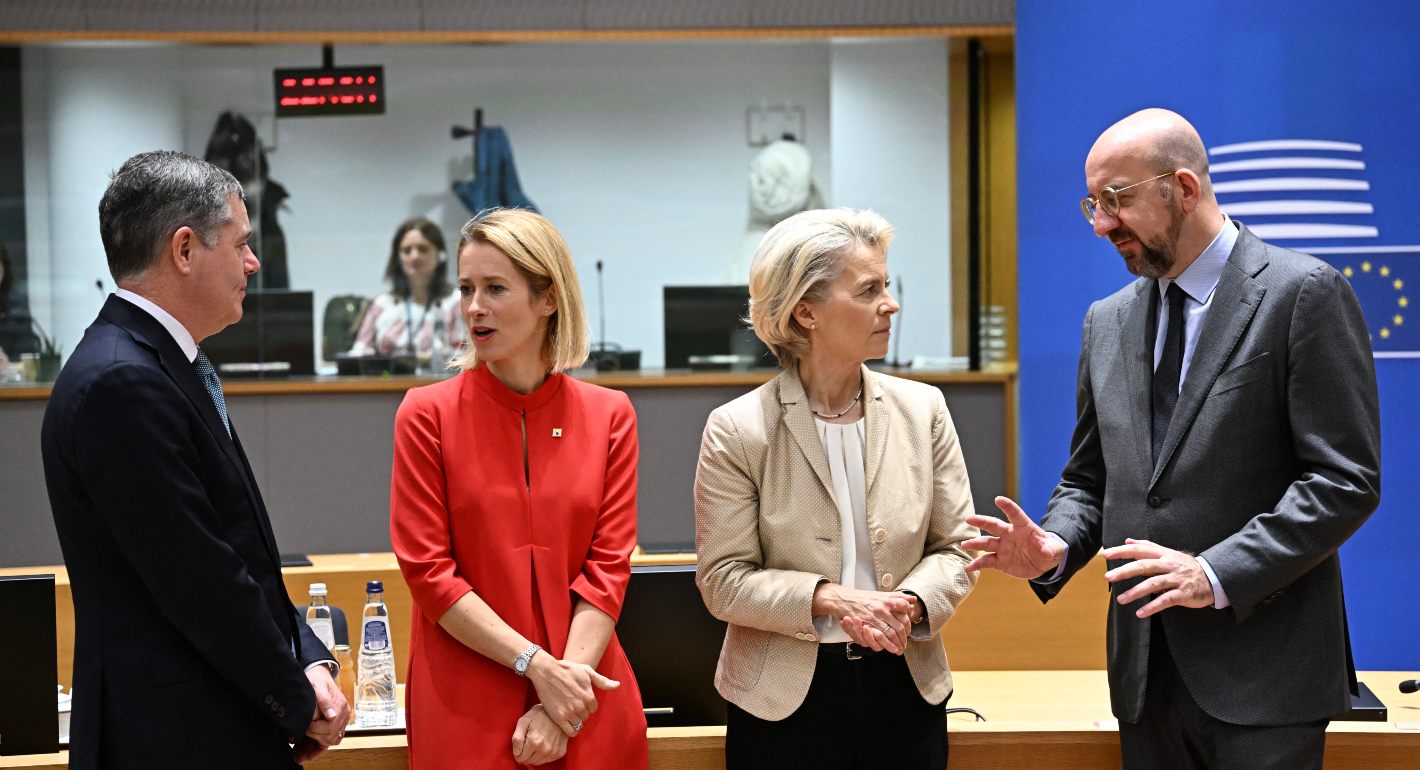
Source: Getty
The incoming EU leadership will have to navigate political turbulence and internal power dynamics. Working together as a real team would help in tackling the challenges ahead.
Despite some last-minute bickering among party groups, the European Council, which represents the EU member states, appears on track to decide on who will get the EU’s top jobs at its meeting on June 27-28.
Preliminary talks have indicated broad support for three names. Ursula von der Leyen is set to get another term at the helm of the European Commission, Portugal’s former prime minister António Costa should assume the presidency of the European Council, and Estonian Prime Minister Kaja Kallas has good chances to be designated as the new high representative for foreign and security policy.
Of course, several hurdles remain to be cleared. The European Council has to propose the new commission president to the European Parliament, which will probably decide on her election mid-July. Ursula von der Leyen’s chances of achieving the required majority of 361 votes have improved, as the European Parliament elections confirmed the majority for the traditional coalition of the European People’s Party, the Socialists and Democrats, and the Liberals. In the fall, the entire commission will be subject to another vote in the European Parliament, after the parliamentary hearings with the individual commissioners have been completed.
In terms of real influence, there is a clear hierarchy between the three positions. The president of the commission is now indisputably on top. Confronting a series of crises, the EU had to move beyond its traditional norm-setting role into the realm of executive action. And the commission was the only institution with the capacity for setting up a vaccination program, managing a huge recovery fund after the COVID-19 pandemic, or rapidly launching massive support projects for Ukraine. As a result, the commission’s institutional position is stronger now than it has been in decades.
Von der Leyen has steered the commission’s crisis-management efforts ably and displayed real leadership during the pandemic and on Ukraine. She has been criticized for concentrating power in her office and for a less-than-collegial leadership style, but the process of internal centralization started long before her time. If re-elected, von der Leyen would be in a better position than in 2019 to influence the selection of commissioners and assemble a more coherent team. However, she might also have to deal with a number of commissioners from Euroskeptic governments who will be sent to Brussels primarily to advance national agendas.
An even bigger challenge awaits her in the European Council and the Council of Ministers. In both bodies, the presence of populist and radical-right politicians has grown and could further increase. These forces envisage an EU in which the commission’s powers are curtailed and aim at strengthening the sovereignty of member states.
Von der Leyen might thus face a situation where urgent challenges like the climate and digital transitions, EU competitiveness and resilience, defense, and support for Ukraine require ramping up collective EU action, but the political support and necessary funding is lacking. She will be particularly worried about the situation in France and Germany, where the far right surged. If internal politics in both countries handicap their ability to play a constructive role at the EU level, she might well come to regret having run for a second term.
The role of the permanent president of the European Council was originally conceived by France as a counterweight to the president of the commission. But the council’s president lacks the instruments and the budget for significant political initiatives. Even on external representation the commission president, who has real competencies for key aspects of external relations, is in a much stronger position.
Today, the key tasks of the council’s president is setting the agenda for the European Council and working behind the scenes to facilitate consensus among its members. At a time of political fragmentation this work becomes ever more crucial. As a longstanding member of the European Council—from 2015 to 2024—who is well liked by colleagues and respected as a highly skilled negotiator, António Costa seems to be a good fit for this role.
The role of the high representative for foreign and security policy has also not lived up to expectations. Internal crises, geopolitical turmoil, and external factors have weakened the EU’s coherence on foreign policy. Foreign ministers and the high representative who chairs their meetings have lost ground, as decisionmaking on foreign and security policy has shifted to member states’ prime ministers and to the European Council.
The current incumbent, Josep Borrell, faces the added challenge that von der Leyen sees herself as a major foreign-policy actor, thus further diminishing his role. As high representative, Kaja Kallas would have the advantage of having been a head of government. She has been and would no doubt continue to be a strong voice of support for Ukraine but will yet have to prove herself on other topics of EU foreign policy. Whether she manages to enhance the profile of her office will to a large extent depend on her ability to forge a constructive relationship with von der Leyen and Costa.
Undoubtedly, one of the worst aspects of the outgoing team was their inability to work together. Von der Leyen and outgoing European Council President Charles Michel regarded each other as rivals and little love was lost between Borrell and Von der Leyen. From all one knows, it is likely that the future top officials will be more congenial and actually capable of acting as a team. This would not be sufficient to overcome the EU’s many problems, but it would certainly help.

Senior Fellow, Carnegie Europe
Stefan Lehne is a senior fellow at Carnegie Europe in Brussels, where his research focuses on the post–Lisbon Treaty development of the European Union’s foreign policy, with a specific focus on relations between the EU and member states.
Recent Work
Stefan Lehne
Stefan Lehne
Carnegie does not take institutional positions on public policy issues; the views represented herein are those of the author(s) and do not necessarily reflect the views of Carnegie, its staff, or its trustees.

While the EU and European governments are embracing the much-lauded middle-power moment, this entails three difficult conundrums.

Richard Youngs

Much has been said of the changes Brussels is trying to make to the EU enlargement process. Here’s why gradual integration might—or might not—be the answer.

Dimitar Bechev

The European Commissioner for Trade is headed to China. But after President Xi’s bridge-building visit to Washington, can a more isolated EU overcome Beijing’s stranglehold on critical raw materials? Who will blink first?

Rym Momtaz, ed.

The domestic impacts of how long it is taking to end the war in Ukraine have pushed the French electorate to the political extremes and compromised the country’s diplomatic capacity.
Rym Momtaz

Before the next wave of EU enlargement takes place, the union needs to grapple with thorny questions of how power is distributed among its members.


Emil Sondaj Hansen, Ditte Brasso Sørensen