

Commentary
Judy Dempsey
{
  "authors": [
    "Judy Dempsey"
  ],
  "type": "commentary",
  "blog": "Strategic Europe",
  "centerAffiliationAll": "",
  "centers": [
    "Carnegie Endowment for International Peace",
    "Carnegie Europe"
  ],
  "englishNewsletterAll": "",
  "nonEnglishNewsletterAll": "",
  "primaryCenter": "Carnegie Europe",
  "programAffiliation": "",
  "programs": [],
  "projects": [],
  "regions": [
    "Europe",
    "Eastern Europe",
    "Central Europe"
  ],
  "topics": [
    "Defense",
    "EU",
    "Foreign Policy",
    "Security",
    "EU Foreign Policy",
    "Military"
  ]
}
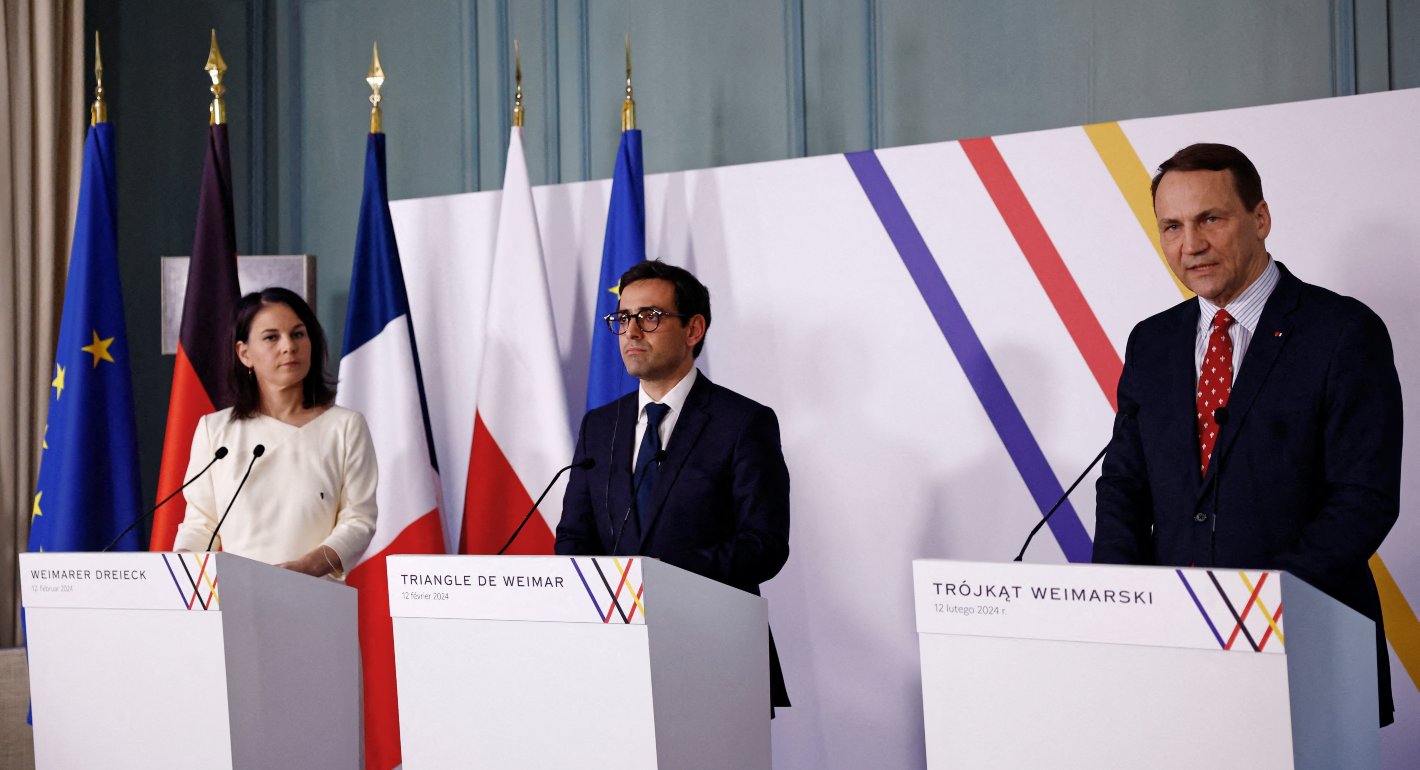
Source: Getty
France, Germany, and Poland have concrete ideas for making EU foreign policy more coherent and effective. The union’s incoming leadership should use these proposals to strengthen the bloc.
These are uncertain times for the EU.
France is in the middle of an election campaign after President Emmanual Macron called a snap parliamentary election in the wake of his party’s disastrous defeat in the recent European Parliament vote. The far right in Austria, France, and Germany is beating at the door of the status quo.
Russia’s war in Ukraine is putting big pressure on EU member states to boost defense spending, revamp the EU’s enlargement policy, and counter the Kremlin’s pervasive disinformation campaigns.
On top of that, the EU’s top jobs are up for grabs. The horse-trading to carve up the positions is in full swing. And don’t forget the other side of the Atlantic, where there is the specter of Donald Trump returning to the White House after November’s president election.
The scope for paralysis and gloom inside the EU is great. But according to the foreign ministers of France, Germany, and Poland, making the union “a true geopolitical actor and security provider, able to respond to today’s security challengers and strengthen the international order” is possible—and urgent.
The ministers were speaking on May 22 in the eastern German city of Weimar. That was where, in August 1991, the three countries’ foreign ministers launched the Weimar Triangle. The idea was to forge a special relationship between these nations now that Poland was free and independent. It was based on the Franco-German model that overcame centuries of war and rivalry after 1945. It was this tandem that over the decades drove the EU toward more integration.
Over the past few years, that tandem barely functioned. Macron’s ambitions for the EU gained no traction in other member states. Under former chancellor Angela Merkel and her successor, Olaf Scholz, Germany buried its head in the sand when it came to thinking and acting strategically to secure the EU’s future. And the Weimar Triangle floundered, especially under Poland’s previous Euroskeptic nationalist-conservative Law and Justice party. Not a lot of good news to hand.
But now, there’s a lively and positive movement in train by the French, German, and Polish foreign ministries. In the Weimar format, last month they issued a focused document on how to make the EU more effective. Yes, this has been attempted so many times in the past. But this document is different in tone.
It focuses firstly on the need to strengthen European security and defense by creating a strong European pillar inside NATO. This is long overdue. The Europeans need to be more vocal inside the U.S.-dominated alliance. That demands more capabilities. Their call also debunks the idea that France’s proposal for more strategic autonomy is about competing with or sidelining NATO.
The Weimar three also call for spending defense funds that are more strategic in choice and allocation, and for closing Europe’s military capability gaps. Stronger and more coherent defense policies are linked to ensuring a long-term European commitment to Ukraine.
The section on the effectiveness of EU foreign policy—or lack thereof—is clear-headed. The outgoing European Commission, the European Council, and the European External Action Service were dogged by infighting. The Weimar trio suggests a “Team Europe” to ensure “coherence in action and messaging.” So much will depend on the willingness of the new EU leaders to achieve this.
“I like the call for the need to strengthen the high representative,” Monika Sus from the Hertie School told Carnegie Europe. “This position has already suffered far too long, on the one hand from the appointment of previously unknown politicians and on the other from their role being limited by the president of the European Commission and the European Council due to interinstitutional competition,” she added.
To get around such wrangling and create coherence, the ministers suggest reviving a successful practice of a “one for all” diplomacy in which one or more foreign ministers could conduct specific diplomatic missions representing the EU.
These ideas are not just another analysis about what the incoming EU leaders should do. They are about three important countries with different historical experiences forging a special coalition of interests; a kind of coalition of the willing to make Europe secure, safe, and ready to defend itself.
This is a sea change, not only because the center-right Polish government realizes that the immense threats facing Europe need France and Germany to work together with the Central Europeans, led by Poland.
Macron, who has fundamentally shifted his views of Poland and the region in a positive way since Russia’s full-scale invasion of Ukraine in February 2022, is crucial for giving Weimar teeth. This needs to entail integrating Poland’s view of strategic threats into a coherent European mindset. It must also mean getting Germany to assume greater leadership in the EU, which Scholz declines to do.
To realize these ideas and make Europe more effective, the Weimar Triangle will need to get the EU’s incoming leadership on board. It’s time to translate analysis into action.

Nonresident Senior Fellow, Carnegie Europe
Judy Dempsey is a nonresident senior fellow at Carnegie Europe
Recent Work
Judy Dempsey
Judy Dempsey
Carnegie does not take institutional positions on public policy issues; the views represented herein are those of the author(s) and do not necessarily reflect the views of Carnegie, its staff, or its trustees.

The aftermath of the Ceuta crisis shows Europe has drawn the wrong lessons. Rather than doubling down on failed migration policies, the EU needs to address the underlying roots of such episodes.

Richard Youngs

An overwhelming victory by a far-right-wing party in a small state in eastern Germany will have major repercussions for Chancellor Friedrich Merz’s coalition.
Judy Dempsey

Canadian Prime Minister Mark Carney has twice inspired praise for standing up to U.S. President Donald Trump: at the 2026 World Economic Forum in Davos and on Canada-U.S. trade negotiations. Is Carney showing a third way better than the EU has in dealing with the Trump administration?

Rym Momtaz, ed.

The EU’s responses to two recent incidents expose the gulf between European perceptions and capabilities. Unless the union can bridge that gap, it will never become a real geostrategic power.
Rym Momtaz

In supporting Europe’s far-right, MAGA and Russia both want the same thing: a weaker EU. Europe must defend itself without abandoning the openness these forces exploit.

Armida van Rij