

Other
Fiona Hill, Anatol Lieven, Thomas de Waal
{
  "authors": [
    "Anatol Lieven"
  ],
  "type": "legacyinthemedia",
  "centerAffiliationAll": "dc",
  "centers": [
    "Carnegie Endowment for International Peace"
  ],
  "collections": [],
  "englishNewsletterAll": "",
  "nonEnglishNewsletterAll": "",
  "primaryCenter": "Carnegie Endowment for International Peace",
  "programAffiliation": "russia",
  "programs": [
    "Russia and Eurasia"
  ],
  "projects": [],
  "regions": [
    "Caucasus",
    "Russia",
    "Eastern Europe"
  ],
  "topics": [
    "Security",
    "Military",
    "Foreign Policy"
  ]
}
REQUIRED IMAGE
Source: Carnegie
Originally published in the December 2001 edition of Prospect
In the elaborate dance being conducted over European participation in the US
war in Afghanistan the steps are as follows: the Europeans pretend that they
want to send troops to Afghanistan; the Americans pretend that they want them
there; and all participants have to pretend that the dance is taking place to
the music of Nato.
Why? The Europeans have to show willingness to send troops to help America because
they know that otherwise US domestic pressure to withdraw US troops from the
Balkans will become overwhelming. The Europeans also know that their own populations
will never accept either serious casualties among their own troops or the kind
of Afghan civilian casualties which are only too likely, and which the US public
regards with some equanimity.
The Americans have to pretend that they want these troops both because they
need to preserve the fiction of a coalition against terrorism, and more importantly
because they still regard Nato as an essential vehicle for US interests in Europe.
If Nato were revealed to be completely irrelevant to the greatest security crisis
of the era, some wicked dissidents might really begin to wonder why it is still
around. But of course the Americans don't want European troops in Afghanistan.
With few exceptions they regard the European armies as providers of adventure
holidays for subsidised backpackers. The Americans want "allies" like
the British, who do what they are told. They know that other Europeans would
not behave in this way, and they do not want any interference in the conduct
of the war.
As to Nato, it is almost completely worthless as far as the "war against
terrorism" is concerned. This campaign and all future such campaigns will
be "coalitions of the willing," completely dominated by the US, and
with contributions made on a bilateral basis. Efforts in joint policing are
being made, but this is not Nato's business. Intelligence sharing, meanwhile,
has always been Nato's weakest point, because the Americans trust no one but
the British with their intelligence.
Even before 11th September the Alliance was looking decidedly seedy. One of
the explicit justifications for breaking international law and launching the
Kosovo campaign was the need to defend the security of the western Balkans and
in particular Macedonia. Very strong commitments were made to defend it. Yet
when the crisis there finally erupted, the Europeans hesitated shamefully before
deploying a very limited and temporary force, while the US refused to participate
on the ground at all. After this, it was clear that grand ideas for Nato interventions
"out of area" were a fantasy.
Nevertheless, in a half-dead state, Nato will probably be around for many years
to come. One reason is the number of uniformed and civilian bureaucrats whose
jobs depend on it. But more fundamental interests are also at work. The Europeans
need the US in Europe so that they can go on spending a scandalously low proportion
of their budgets on defence, and so that US firepower can act as the ultimate
deterrent against potential troublemakers in the Balkans. The problem here is
that US firepower may simply not be useful when it comes to deterring Albanian
guerrilla forces; and secondly, if the US is pinned down in wars in Afghanistan
or elsewhere, a threat of US military action in the Balkans may well be utterly
unconvincing.
The US desire to preserve Nato is rooted in one rather foolish, and now fading
calculation, and one more serious one which has not yet been fully recognised
by either the US or Europe. The foolish reason was the one which in recent years
led some Americans (including at first the Bush administration) to oppose the
creation of an EU security identity-on the grounds that it would challenge US
hegemony.
The much more serious motive is that the US needs airfields and supply dumps
in Europe as staging posts for the support of Israel and for the conduct of
actual and future campaigns in the Muslim world. In future, advances in aircraft
and aerial refuelling technology may make such bases unnecessary-but this will
not be the case for a good many years to come.
Without Nato as a frame, the US would have to seek agreements with individual
European countries, which would then become vulnerable to domestic protest against
US policies; or increase reliance on Turkey or Israel, risking greater deference
to these countries' dangerous agendas; or face an expensive permanent deployment
at Diego Garcia or elsewhere.
European discontent at being cast as "Airstrip One" does not really
matter as long as it is confined to fringe radical groups, and as long as it
is set in the context of an alliance in which the Europeans see an interest
in US strategies they broadly share. But these conditions are not necessarily
stable. It is likely that at some point in the future, thanks to developments
in the Balkans or elsewhere, Nato will become visibly moribund; and it is possible
that US-Israeli policies in the middle east may diverge so radically from European
ones that they turn into an obvious clash of vital interests. (This possibility
would be especially great in the context of a new oil shock or a terrorist campaign
against Europe).
Even without such radical scenarios, it is inevitable that one effect of 11th
September will be a long-term reduction of US interest in security issues around
the fringes of Europe. This means that however unprepared and divided it may
be, the EU will have no choice but to assume greater responsibility for aspects
of continental security.
This new responsibility brings with it three urgent priorities. The first is
the creation of usable European armed forces on the pattern of the British.
Secondly, the EU needs to treat enlargement to the central European and Baltic
states-and hence the stabilisation of these regions-as a vital European security
interest.
Equally important, the EU needs to improve, stabilise and as far as possible
institutionalise security relationships with Europe's two main non-EU military
powers, Turkey and Russia. For if the US does pull back from the Balkans, then
every nationalist radical in the region is going to be emboldened, and a great
many of them will look to Russians or Turks for support. The ultimate European
nightmare would be if these two countries lined up on opposite sides in wars
in the Balkans or the Caucasus.
In the case of Turkey, it is impossible to accede to that country's desire for
early admission to the EU. Economic realities rule this out. However, we can
and should discard immediately the absurd Greek-inspired provocation of inviting
southern Cyprus to join. With Russia, things are easier, given its greater degree
of isolation and greater desire for reconciliation with the EU as a counterweight
to Turkey.
When it comes to creating new security relationships with non-members or part-members
of the west, the EU is in a stronger position than Nato. The latter was created
as a defensive military alliance against the Soviet Union. Not only does that
give it an enduring anti-Russian bias and ensure Russian suspicion of it but
it means that Nato is a clear-cut alliance. You're in, or you're out. In security
terms and, increasingly, in economic and social ones, this is not so with Europe-and
the position of Britain is a good example of this. When it comes to economics,
Europe is as a series of concentric circles. At the heart are members of the
eurozone; then those EU countries like Britain which are not euro members, and
a couple (Norway and Switzerland) which are not even in the EU. Then there comes
the next ring, of central European and Baltic applicants. Hopefully, these will
soon be EU members. Finally come a host of countries which are without question
part of Europe-and even vital for European security-but which are not going
to be EU members for the foreseeable future.
Britain is not part of the euro core, but has to be at the heart of any security
identity. Meanwhile, some rich but small countries which are part of the eurozone
must be left outside where serious European security issues are concerned. Such
already existing asymmetries should allow in principle the creation of a European
Security Council including Russia, Turkey and America and the development of
structures which will stand a chance of replacing Nato as the latter rots away.
It may be true that 11th September has ushered in a struggle of civilisation
against barbarism, but if so, in its Afghan manifestation and probably others
too, this is not a struggle in which the Europeans can play a military role.
Europe can play its part by finally taking responsibility for its own space.
Il faut defendre notre jardin.
Former Senior Associate
Recent Work

Fiona Hill, Anatol Lieven, Thomas de Waal
Carnegie does not take institutional positions on public policy issues; the views represented herein are those of the author(s) and do not necessarily reflect the views of Carnegie, its staff, or its trustees.
If the succession process can be carried out as Khamenei intended, it will likely bring a hardliner into power.

Eric Lob
But to achieve either, it needs to retain Washington’s ear.

Alper Coşkun
If the regime in Tehran survives, it could be obliged to hand Moscow significant political influence in exchange for supplies of weapons and humanitarian aid.

Nikita Smagin

Just look at Iraq in 1991.

Marwan Muasher
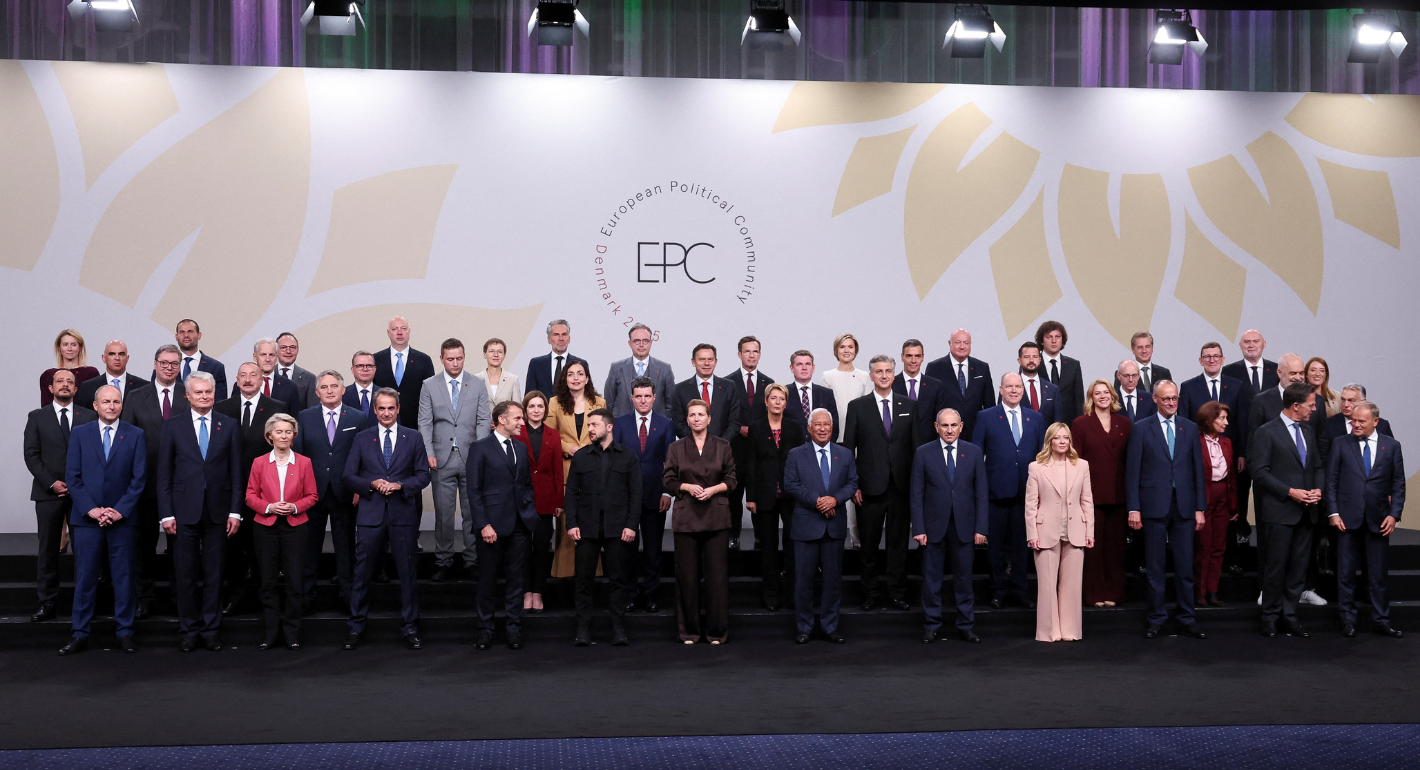
Europe isn’t as weak in the new geopolitics of power as many would believe. But to leverage its assets and claim a sphere of influence, Brussels must stop undercutting itself.

Dimitar Bechev