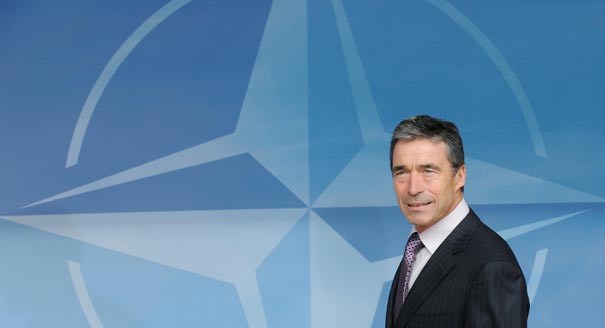
NATO at 60: Save the Champagne— This year will mark two significant — and largely incompatible — anniversaries: the 60th anniversary of NATO and the 20th anniversary of the fall of the Berlin Wall.
One could argue that without NATO’s show of Western unity, the Berlin Wall may not have fallen as soon as it did. Yet with the Soviet Union receding in memory, it is a wonder that NATO still exists. Its survival can be explained by ordinary institutional inertia and an understandable desire to buttress Russia’s insecure East European neighbors. Yet these are not sufficient reasons to ensure the alliance’s future. And the search for a new purpose has not gone well. The depth of the problem is shown by the debate raging in capitals across the Atlantic about how to reform NATO.
Iconoclasts view it as a hollow alliance that has plainly outlived its usefulness and represents a misallocation of scarce resources. The NATO priesthood calls it the most successful alliance in history and sees it as a sacred touchstone of Western security with a promising future in “out of area” places like Afghanistan. Perhaps each side has a piece of the truth but both overstate their case.
It is important to see that this debate is a sign of strength not weakness in the trans-Atlantic community. The vitality of any international institution depends on allowing room between orthodox pieties and strident revisionism. This means being open to realistic assessments of costs and benefits.
For their part, the high priests of NATO should move beyond institutional fetishism. Those whose military and diplomatic careers have been tied up with the institution are unlikely to have unbiased views about its future. NATO should not be considered too big to fail.
Many NATO boosters have decried the de facto two-tier structure that has emerged among members, split between serious players and backbenchers. Even the alliance’s most ardent fans admit that it has been a failure in Afghanistan, with many key members, like Germany and France, unwilling to pony up the resources needed for extended engagement.
After 9/11, the then U.S. secretary of defense, Donald Rumsfeld, revealed the realist position when he snubbed NATO allies who had invoked mutual security guarantees in a noble gesture of solidarity with America. Rumsfeld understood that the most important threats to U.S. security lay far outside the European theater and that the Atlantic alliance could do little to assist in these areas.
Yet NATO critics should take seriously the Cold War insecurities that still hang over Eastern Europe. If NATO didn’t exist, we would need to use alternative security structures to integrate these countries or devise new ones.
Since the Soviet collapse, NATO has been a useful tool of regional integration, although it has done little in this regard that the European Union could not do better.
Despite efforts to create a special advisory council with Moscow, NATO has been a poor tool of engagement with Russia. To Moscow, the enlarged alliance reflects the U.S. aim to consolidate post-Cold War gains and the European desire to hedge against Russia’s intentions toward former Soviet satellites.
If the East European nations are understandably paranoid about Russia, the Kremlin is a tad paranoid about assumed U.S. encirclement plans. One of President Obama’s main goals should be to lead the way out of this Eurasian phobia trap.
To be clear: As long as NATO exists, it is rational for countries like Ukraine and Georgia to aspire to membership. But the West should disabuse these countries of any totemic notions about NATO. There are other ways to be secure.
President Dmitri Medvedev of Russia has called for a new Eurasian security concept, but it not clear whether he has anything concrete in mind. It would be a relief if the Europeans themselves would put a clear idea forward. It would also be helpful for Russia to tone down it truculent postures.
After the fall of the Soviet bloc many voices called for disbanding NATO. That was not an outrageous idea. In the event, NATO expanded in order to survive. The expansion focused on the political element in the NATO charter rather than its core military mission.
The instinct of NATO insiders has been to push further enlargement. They dream of a global NATO embracing countries like India, Japan and Israel. It is a vision of modern Knights Templar prepared to defend a “league of democracies.”
Instead of disbanding or expanding, a better option would be radical re-branding. It is not necessarily too late for this. Re-branding could start with a new name, such as POTATO, which would be far less neuralgic, at least in Moscow.
Given all the uncertainties, it would be wise to save some of the champagne for the Berlin Wall celebration later this year. NATO needs a sober re-think.
Medish served in the Clinton administration as special assistant to the President and senior director for Russian, Ukrainian, and Eurasian Affairs on the National Security Council from 2000 to 2001.
Carnegie does not take institutional positions on public policy issues; the views represented herein are those of the author(s) and do not necessarily reflect the views of Carnegie, its staff, or its trustees.
More Work from Carnegie Endowment for International Peace
Despite a new textbook, an influx of Russian teachers and managers, and an end to the teaching of Ukrainian, the Kremlin is unlikely to have “reprogrammed” locals.
For every ruble allocated to social policy, health, and education in 2027, double that amount is earmarked for the army, the police, and the security services.
The European Commissioner for Trade is headed to China. But after President Xi’s bridge-building visit to Washington, can a more isolated EU overcome Beijing’s stranglehold on critical raw materials? Who will blink first?