• Research
  • Emissary
  • About
  • Experts
Carnegie Global logoCarnegie lettermark logo
DemocracyIran
  • Donate
{
  "authors": [
    "Eduardo Zepeda",
    "Timothy A. Wise",
    "Kevin P. Gallagher"
  ],
  "type": "other",
  "centerAffiliationAll": "",
  "centers": [
    "Carnegie Endowment for International Peace"
  ],
  "collections": [],
  "englishNewsletterAll": "",
  "nonEnglishNewsletterAll": "",
  "primaryCenter": "Carnegie Endowment for International Peace",
  "programAffiliation": "",
  "programs": [],
  "projects": [],
  "regions": [
    "North America",
    "United States",
    "South America"
  ],
  "topics": [
    "Economy",
    "Trade"
  ]
}

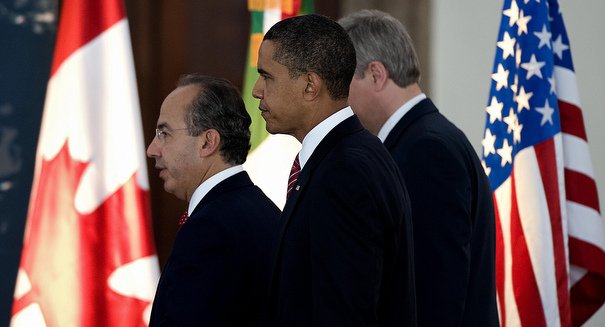
Source: Getty

Other

Rethinking Trade Policy for Development: Lessons From Mexico Under NAFTA

Mexico’s disappointing experience with NAFTA underscores the need to reform trade agreements between the United States and developing countries.

Link Copied
By Eduardo Zepeda, Timothy A. Wise, Kevin P. Gallagher
Published on Dec 7, 2009

Despite an increase in trade, foreign investment, and productivity since NAFTA took effect in 1994, Mexico has been disappointed by slow economic growth and weak job creation. In addition, recession in the United States is hitting Mexico particularly hard, given its dependence on its northern neighbor. 

Mexico’s experience with NAFTA underscores the need to reform trade agreements between the United States and developing countries. There are five things to remember in future trade agreements with the United States, contends a new paper by Eduardo Zepeda of the Carnegie Endowment and Timothy A. Wise and Kevin P. Gallagher of Tufts’ Global Development and Environment Institute:

  1. Incorporate stronger provisions on labor and the environment—even stronger than the recent bipartisan proposals incorporated into recent U.S. trade agreements, such as the one with Peru.
     
  2. Liberalization of sensitive agricultural sectors should be undertaken carefully and be coordinated with investments in agricultural productivity and job creation.
     
  3. Allow governments to selectively promote strategic industries that offer long-term benefits, including rural development, job creation, and environmental protection.
     
  4. Include funding for development that will increase the competitiveness of emerging economies and level the playing field among trade partners.
     
  5. Trade agreements are not a substitute for coherent national development strategies. 


“There is increasing international recognition that trade policy in the Western Hemisphere should be overhauled,” conclude the authors, based on this comprehensive review of Mexico’s economic performance under NAFTA. “Now is the time for the U.S., Canadian, Mexican, and other developing country governments to take a fresh look at NAFTA’s experience and shape trade and development policies to better meet the needs of their people in a manner that respects the right to development, job creation, and the environment.”

About the Authors

Eduardo Zepeda

Former Senior Associate, Trade, Equity and Development Program

Zepeda is inter-regional policy coordinator of the Development Policy and Analysis Division, Department of Economic and Social Affairs at the United Nations General Secretariat. He was previously a senior associate in the Trade, Equity, and Development Program at the Carnegie Endowment for International Peace.

Timothy A. Wise

Global Development and Environment Institute

Kevin P. Gallagher

Authors

Eduardo Zepeda
Former Senior Associate, Trade, Equity and Development Program
Eduardo Zepeda
Timothy A. Wise
Global Development and Environment Institute
Kevin P. Gallagher
EconomyTradeNorth AmericaUnited StatesSouth America

Carnegie does not take institutional positions on public policy issues; the views represented herein are those of the author(s) and do not necessarily reflect the views of Carnegie, its staff, or its trustees.

More Work from Carnegie Endowment for International Peace

  • Xi walking into a room with people standing and applauding around him
    Commentary
    Emissary
    The Xi Doctrine Zeros in on “High-Quality Development” for China’s Economic Future

    In the latest Five-Year Plan, the Chinese president cements the shift to an innovation-driven economy over a consumption-driven one.

      • Damien Ma

      Damien Ma

  • Article
    Kenya’s Health Deal Is a Stress Test for the America First Global Health Strategy

    U.S. agreements must contend with national data protection laws to make durable foreign policy instruments.

      • A Black woman with long hair wears a black blazer

      Jane Munga, Rose Mosero

  • Commentary
    Diwan
    Trump’s Plan for Gaza Is Not Irrelevant. It’s Worse.

    The simple conclusion is that the scheme will bring neither peace nor prosperity, but will institutionalize devastation.

      Nathan J. Brown

  • Trump seated and gesturing while speaking
    Commentary
    Emissary
    The Iran War Is Making America Less Safe

    A conflict launched in the name of American security is producing the opposite effect.

      • Sarah Yerkes

      Sarah Yerkes

  • illustration of AI chat bubbles
    Commentary
    California Sees Ways AI Can Support Policymaking. Here’s What It Needs to Succeed.

    For AI to capture the public’s policy concerns, people need to know that the models are elevating human concerns in human words, not generating their own.

      • Micah Weinberg headshot

      Micah Weinberg

Get more news and analysis from
Carnegie Endowment for International Peace
Carnegie global logo, stacked
1779 Massachusetts Avenue NWWashington, DC, 20036-2103Phone: 202 483 7600Fax: 202 483 1840
  • Research
  • Emissary
  • About
  • Experts
  • Donate
  • Programs
  • Events
  • Blogs
  • Podcasts
  • Contact
  • Annual Reports
  • Careers
  • Privacy
  • For Media
  • Government Resources
Get more news and analysis from
Carnegie Endowment for International Peace
© 2026 Carnegie Endowment for International Peace. All rights reserved.