
• Research
  • Emissary
  • About
  • Experts
Carnegie Global logoCarnegie lettermark logo
DemocracyIran
  • Donate
{
  "authors": [
    "Pieter Bottelier"
  ],
  "type": "other",
  "centerAffiliationAll": "dc",
  "centers": [
    "Carnegie Endowment for International Peace",
    "Carnegie Europe"
  ],
  "collections": [],
  "englishNewsletterAll": "asia",
  "nonEnglishNewsletterAll": "",
  "primaryCenter": "Carnegie Endowment for International Peace",
  "programAffiliation": "AP",
  "programs": [
    "Asia"
  ],
  "projects": [],
  "regions": [
    "East Asia",
    "China",
    "Asia"
  ],
  "topics": [
    "Political Reform",
    "Economy"
  ]
}
Source: Getty

Other

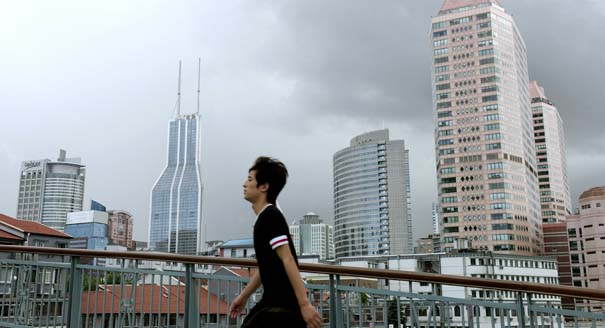
Beijing's New Challenge: China's Post-Crisis Housing Bubble

The central bank of China has cautiously begun to tighten monetary policy in response to a massive residential property bubble, demonstrating Beijing’s belief that it has both the policy tools and the political will to control the bubble and avoid a burst.

Link Copied
By Pieter Bottelier
Published on Jul 1, 2010
Program mobile hero image

Program

Asia

The Asia Program in Washington studies disruptive security, governance, and technological risks that threaten peace, growth, and opportunity in the Asia-Pacific region, including a focus on China, Japan, and the Korean peninsula.

Learn More

With an overheating economy and an expanding bubble in residential property, China began tightening its monetary policy in early 2010. Pieter Bottelier writes that an uncontrolled collapse of the housing market is unlikely if Beijing can effectively cool speculative demand for housing. Still, China should remain wary of the potentially destabilizing social consequences associated with unaffordable housing.

Key Conclusions

  • Bubble largely due to loose monetary policy. Concentrated in eastern cities, China’s residential property bubble is mainly the result of excessive credit expansion in 2009. Other factors include significant inflows from abroad, low bank deposit rates, widespread property speculation, corruption, and incentives for local governments to drive up land prices to augment local fiscal revenues.
  • Beijing recognizes the risks and appears determined to control the property bubble. The central bank has carefully begun tightening monetary policy, but greater reliance is placed on administrative measures to reduce property speculation.
  • Bubble unlikely to burst. If Beijing effectively uses the policy tools at its disposal, an uncontrolled meltdown will likely be avoided. But a market correction of 20–30 percent over the next 6–12 months is likely.
  • Housing prices are key social and political issue. Housing affordability for first-time home buyers has become a major social and political issue and could trigger potentially destabilizing public discontent—even if the property bubble can be controlled. Accordingly, the government has started ambitious national “affordable housing” programs.

 “Given the scarcity of land and high population density in eastern China, residential property prices will tend to be high relative to incomes, even if there is a market correction in the near-term,” writes Bottelier. “Widespread discontent over housing affordability could become a source of social instability and is for that reason very much on the government’s radar screen.”
About the Author

Pieter Bottelier

Former Nonresident Scholar, International Economics Program

Bottelier was a nonresident scholar in Carnegie’s International Economics Program and senior adjunct professor of China studies at the School of Advanced International Studies (SAIS), the Johns Hopkins University. His work currently focuses on China’s economic reform and development.

    Recent Work

  • Article
    China's Economy is Slowly Becoming More Normal

      Pieter Bottelier

  • Article
    China's Economy: Slower Growth, But Structural Reforms Progressing

      Pieter Bottelier

Pieter Bottelier
Former Nonresident Scholar, International Economics Program
Pieter Bottelier
Political ReformEconomyEast AsiaChinaAsia

Carnegie does not take institutional positions on public policy issues; the views represented herein are those of the author(s) and do not necessarily reflect the views of Carnegie, its staff, or its trustees.
More Work from Carnegie Endowment for International Peace

  • One man tossing a sack to another to stack on a truck
    Commentary
    Emissary
    The Other Global Crisis Stemming From the Strait of Hormuz’s Blockage

    Even if the Iran war stops, restarting production and transport for fertilizers and their components could take weeks—at a crucial moment for planting.

      • Noah  Gordon ​​​​

      Noah Gordon, Lucy Corthell

  • Commentary
    Strategic Europe
    The EU Needs a Third Way in Iran

    European reactions to the war in Iran have lost sight of wider political dynamics. The EU must position itself for the next phase of the crisis without giving up on its principles.

      Richard Youngs

  • Trump United Nations multilateralism institutions 2236462680
    Article
    Resetting Cyber Relations with the United States

    For years, the United States anchored global cyber diplomacy. As Washington rethinks its leadership role, the launch of the UN’s Cyber Global Mechanism may test how allies adjust their engagement.

      • Christopher Painter

      Patryk Pawlak, Chris Painter

  • People visit the World Artificial Intelligence Conference (WAIC) at the Shanghai World Expo and Convention Center in Shanghai on July 28, 2025.
    Article
    China’s AI-Empowered Censorship: Strengths and Limitations

    Censorship in China spans the public and private domains and is now enabled by powerful AI systems.

      Nathan Law

  • Commentary
    Carnegie Politika
    Why Are China and Russia Not Rushing to Help Iran?

    Most of Moscow’s military resources are tied up in Ukraine, while Beijing’s foreign policy prioritizes economic ties and avoids direct conflict.   

      • Alexander Gabuev

      Alexander Gabuev, Temur Umarov

Get more news and analysis from
Carnegie Endowment for International Peace
Carnegie global logo, stacked
1779 Massachusetts Avenue NWWashington, DC, 20036-2103Phone: 202 483 7600Fax: 202 483 1840
  • Research
  • Emissary
  • About
  • Experts
  • Donate
  • Programs
  • Events
  • Blogs
  • Podcasts
  • Contact
  • Annual Reports
  • Careers
  • Privacy
  • For Media
  • Government Resources
Get more news and analysis from
Carnegie Endowment for International Peace
© 2026 Carnegie Endowment for International Peace. All rights reserved.








