

Paper
Douglas H. Paal
{
  "authors": [
    "Douglas H. Paal"
  ],
  "type": "legacyinthemedia",
  "centerAffiliationAll": "dc",
  "centers": [
    "Carnegie Endowment for International Peace",
    "Carnegie Europe",
    "Carnegie Russia Eurasia Center"
  ],
  "collections": [],
  "englishNewsletterAll": "asia",
  "nonEnglishNewsletterAll": "",
  "primaryCenter": "Carnegie Endowment for International Peace",
  "programAffiliation": "AP",
  "programs": [
    "Asia"
  ],
  "projects": [],
  "regions": [
    "East Asia",
    "China",
    "North Korea",
    "Asia"
  ],
  "topics": [
    "Security"
  ]
}
Source: Getty
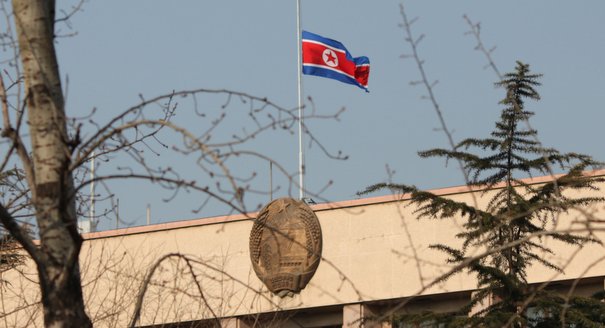
Beijing should exercise its unique and major influence with North Korea in order to return peace and stability to the region and to protect China’s own interests.
Source: The National Interest

China’s best friend does. Under the urban mythical Pottery Barn rule, if you break it, you own it. China took ownership of North Korea’s behavior when it stood between Pyongyang and punishment by the United Nations Security Council for its sinking of the South Korean corvette, Cheonan, last March, with the loss of forty-six lives.
China is the last lifeline to North Korea. It provides or facilitates virtually all the foreign goods needed to sustain the state and its elite. While Beijing probably did not provide the nuclear–related materials displayed by Pyongyang last week and appears to be strictly adhering to the letter of existing UN sanctions, there is nonetheless a brisk commerce between the two communist neighbors. Without it, the North’s regime could barely sustain itself.
China has claimed repeatedly that it supports denuclearization of North Korea and stability in the region. But Beijing has lamely reacted to the shelling of Yeonpyeong Island and the loss of life there by calling for the parties to meet and talk, under the framework of the six-party talks that China hosts. What is more, the Chinese government refuses to use its unique and major influence to leverage a better outcome from the North Koreans. This posture assures more of the same from Pyongyang.
There is a longer running story that weaves these events together. North Korea had a deal with previous–South Korean President Roh Moo Hyun in 2008 to access the waters near the disputed Northern Limit Line west of the demilitarized zone. Current President Lee Myung-bak repudiated that deal, and there has been a series of brief hostilities since then, including the sinking of the Cheonan.
North Korea has also regularly reacted to the large-scale, annual-combined-forces exercises held in the South, and now underway, to deter aggression from the North. Last time, the North fired artillery shells into the sea around the Yeonpyeong Island, and this time they escalated the response to the island itself.
Moreover, there appears to be a pattern in the North’s unique dynastic-succession system of demonstrating toughness during times of transition. This may be done to reflect the priority attached to the military on which the regime depends for survival. It might be intended to spotlight the new leader’s sangfroid. It may also help anneal a beleaguered populace behind an otherwise-challenged regime.
Finally, the North has been seeking a nuclear-weapons capability for over twenty years. It is its only diplomatic card, and the United States and others have been persuaded in the past to pay to hold it, to look at it, to put it in temporary storage, but never to take it away and destroy it. Now, the North looks to open a new bidding game, and has invited a reliable bunch of foreign observers to start the auction.
Options are few, and they put China in the bull’s-eye. Military strikes would enflame the region and not guarantee success against the well-hidden nuclear program. No self-respecting government would engage in diplomacy just to rent the North’s nuclear apparatus for a third time.
Someone needs to put the wood to Pyongyang, and that someone is Chinese President Hu Jintao. China has preferred the stability of the repulsive Northern regime to the goodwill of the people of South Korea, to ultimate reunification of the peninsula, and to peace and stability in the region. But plainly the regime itself is the source of instability, ending the notion that there is a choice between stability and instability. And Pyongyang is directly damaging China’s interests.
This promises to be a very difficult topic during President Hu’s expected January state visit to the United States, if China does not get North Korea’s behavior onto a less provocative and more constructive course. America should strategically, patiently, but urgently press China to assume the responsibility it has taken for the regime in North Korea.

Distinguished Fellow, Asia Program
Paal previously served as vice chairman of JPMorgan Chase International and as unofficial U.S. representative to Taiwan as director of the American Institute in Taiwan.
Recent Work
Douglas H. Paal

Douglas H. Paal, Tong Zhao, Chen Qi, …
Carnegie does not take institutional positions on public policy issues; the views represented herein are those of the author(s) and do not necessarily reflect the views of Carnegie, its staff, or its trustees.
A leak of Russian gas price data helps establish that China is paying Russia far less than Central Asian countries and Gazprom’s former European customers.

Sergey Vakulenko

China’s political future will be shaped between now and next October. As the Communist Party enters its intense “campaign season” to prepare for a major political transition in 2027, reading Beijing's actions and responses may become more difficult as domestic politics weigh on its behavior more than usual.

Damien Ma

Japan’s long-term security policy is driven by concerns about China, and there is little appetite for (or interest in) pursuing a confrontation with Moscow.

James D.J. Brown

Russia is testing the waters of NATO’s mutual defense clause. What do strikes in Romanian territorial waters mean for the alliance’s posture toward Moscow?

Dimitar Bechev

China has showcased its engineering prowess with small modular reactor demonstration projects. But turning these technological achievements into commercial success will be a greater challenge.
Tong Zhao