• Research
  • Emissary
  • About
  • Experts
Carnegie Global logoCarnegie lettermark logo
DemocracyIran
  • Donate
{
  "authors": [
    "Michele Dunne"
  ],
  "type": "legacyinthemedia",
  "centerAffiliationAll": "dc",
  "centers": [
    "Carnegie Endowment for International Peace",
    "Malcolm H. Kerr Carnegie Middle East Center"
  ],
  "collections": [
    "Arab Awakening"
  ],
  "englishNewsletterAll": "menaTransitions",
  "nonEnglishNewsletterAll": "",
  "primaryCenter": "Carnegie Endowment for International Peace",
  "programAffiliation": "MEP",
  "programs": [
    "Middle East"
  ],
  "projects": [],
  "regions": [
    "North Africa",
    "Egypt"
  ],
  "topics": [
    "Political Reform"
  ]
}
Source: Getty

In The Media

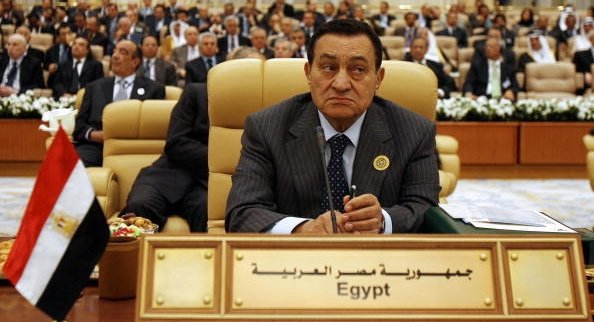
An Immediate Exit For Mubarak?

Mubarak’s continued unwillingness to acknowledge his complicity in the recent violence sharply undermines his ability to play a role in a peaceful transition toward democracy.

Link Copied
By Michele Dunne
Published on Feb 4, 2011
Program mobile hero image

Program

Middle East

The Middle East Program in Washington combines in-depth regional knowledge with incisive comparative analysis to provide deeply informed recommendations. With expertise in the Gulf, North Africa, Iran, and Israel/Palestine, we examine crosscutting themes of political, economic, and social change in both English and Arabic.

Learn More

Source: Politico

An Immediate Exit For Mubarak?Mubarak’s argument for staying in power for more than 30 years — reiterated to Christiane Amanpour in a Feb. 3 interview — was that he was the only bulwark against chaos in Egypt. Paradoxically, Mubarak himself put the final nail in the coffin of the stability argument last week, when he unleashed violence against peaceful protesters, journalists and human rights activists. Egyptians have long been familiar with the security services’ use of agent provocateurs, and it took the international media only a few hours to catch on that these were not really “pro-Mubarak demonstrators” but paid thugs.

Mubarak made a fatal error in using such tactics. His Feb. 2 offer to step down at the end of his term and carry out political reforms in the interim had a reasonable chance of taking the air out of demonstrations and splitting the opposition. But accompanying the offer with brutal coercion — and continuing to lie about his complicity in the violence — completely discredited him in terms of playing a role in a peaceful transition toward democracy.
 
It also raises serious questions about the reliability of Vice President Omar Suleiman. In light of this, Mubarak should step aside now.

About the Author

Michele Dunne

Former Nonresident Scholar, Middle East Program

Michele Dunne was a nonresident scholar in Carnegie’s Middle East Program, where her research focuses on political and economic change in Arab countries, particularly Egypt, as well as U.S. policy in the Middle East.

    Recent Work

  • Research
    Islamic Institutions in Arab States: Mapping the Dynamics of Control, Co-option, and Contention
      • +6

      Yasmine Farouk, Nathan J. Brown, Maysaa Shuja Al-Deen, …
  • Research
    From Hardware to Holism: Rebalancing America’s Security Engagement With Arab States
      • +8

      Robert Springborg, Emile Hokayem, Becca Wasser, …

Michele Dunne
Former Nonresident Scholar, Middle East Program
Michele Dunne
Political ReformNorth AfricaEgypt

Carnegie does not take institutional positions on public policy issues; the views represented herein are those of the author(s) and do not necessarily reflect the views of Carnegie, its staff, or its trustees.
More Work from Carnegie Endowment for International Peace

  • Photo of garment workers sewing jeans in Kenya.
    Article
    The Strategic Stakes of AGOA Reform and Renewal

    Strengthening U.S.-Africa trade and advancing U.S. interests aren’t conflicting goals.

      • Tyler Beckelman
      • Kholofelo Kugler

      Tyler Beckelman, Kholofelo Kugler

  • Europe flags citizens demonstration
    Commentary
    Strategic Europe
    EU Enlargement Forgets Europeans

    Preparing candidate countries for EU membership is no longer enough. As the enlargement process becomes a reality, the union must also prepare its own societies.

      Iliriana Gjoni

  • Article
    India–Africa Strategic Partnership: Challenges, Potential, and Possible Pathways

    A partnership between India, a country of subcontinental size, and Africa, a continent of fifty-four countries, may seem asymmetric until one notes that both are home to nearly the same number of people—1.4 billion. This essay spells out the existing challenges to the partnership, its optimal potential, and the possible pathways to realize it over the next quarter-century.

      Rajiv Bhatia

  • Commentary
    Cities Have a Crucial Role to Play in Advancing Climate Mobility Priorities

    Ensuring that cities’ perspectives shape international discussions at this year’s forums is not just equitable; it is likely to produce better outcomes.

      • Marissa Jordan

      Liliana Gamboa, Marissa Jordan

  • Commentary
    Carnegie Politika
    Could the Rise of the New People Party Reshape Russia’s Managed Political System?

    Anger over online restrictions has led to a surge in support for the New People party, which has replaced the Communists as Russia’s second most popular political party.  

      Andrey Pertsev

Get more news and analysis from
Carnegie Endowment for International Peace
Carnegie global logo, stacked
1779 Massachusetts Avenue NWWashington, DC, 20036-2103Phone: 202 483 7600
  • Research
  • Emissary
  • About
  • Experts
  • Donate
  • Programs
  • Events
  • Blogs
  • Podcasts
  • Contact
  • Annual Reports
  • Careers
  • Privacy
  • For Media
  • Government Resources
Get more news and analysis from
Carnegie Endowment for International Peace
© 2026 Carnegie Endowment for International Peace. All rights reserved.