{
  "authors": [
    "Henri J. Barkey",
    "Morton Abramowitz"
  ],
  "type": "legacyinthemedia",
  "centerAffiliationAll": "dc",
  "centers": [
    "Carnegie Endowment for International Peace",
    "Malcolm H. Kerr Carnegie Middle East Center"
  ],
  "collections": [],
  "englishNewsletterAll": "menaTransitions",
  "nonEnglishNewsletterAll": "",
  "primaryCenter": "Carnegie Endowment for International Peace",
  "programAffiliation": "MEP",
  "programs": [
    "Middle East"
  ],
  "projects": [],
  "regions": [
    "Middle East",
    "Türkiye",
    "Levant"
  ],
  "topics": [
    "Political Reform"
  ]
}
Source: Getty
In The Media
Turkey: Democracy, Yes, But No Model
Turkey’s role as a political model for the Arab world would prove more compelling if its leaders demonstrated that Turkey is ready to accept democracy everywhere in the region and promoted genuine democratic opportunities for the country's own minorities.
Turkey: Democracy, Yes, But No ModelThe momentous events in Tunisia and Egypt focused attention on Turkey as a paradigm for change in the Muslim Middle East.
In an ironic twist of fate, Turkish President Abdullah Gul was in Tehran just as peaceful Green movement protesters were tear gassed. Gul tried subtly to convey a notion of change — but it largely went over the heads of the regime and the opposition.
Many analysts are now extolling the effectiveness of the Turkish state, where a religiously oriented party runs a democratic, secular government with wide public support. Whatever its warts, the AKP (Justice and Development Party) government has turned Turkey into a more open, vibrant and economically dynamic society — and ended the days of military coups.
Turkey is now in a position to influence the Middle East for the first time since the heyday of the Ottoman Empire.
Turkey’s role as a model for regional change, however, is overshadowed by contradictions in both domestic and foreign policy — which may constrain its growing influence. Its professed ideals often run into its short-term objectives.
Turkey has declared a policy of “zero problems” with its neighbors. That has meant a laser-like focus on trade and investment. And also an embrace of the region’s leading authoritarian regimes — including Iran, Syria, Sudan and Libya.
Turkey’s model would prove even more compelling if its leaders do two important things.
First, they should demonstrate that Turkey is ready to accept democracy everywhere in the region — not just in countries it dislikes or whose leaders are about to be toppled. Second, Ankara should offer genuine democratic opportunities for its own minorities — especially the Kurds.
It is one thing to call on Hosni Mubarak to leave office when the Egyptian president is on his way out. But clearly another to support the brutal repression in Tehran that followed the 2009 disputed elections.
Turkish leaders were among the first to congratulate Iranian President Mahmoud Ahmedinejad for maintaining order after the questionable election results brought out crowds larger than those in Cairo’s Tahrir Square. Ankara has not uttered one word of reproach — much less condemnation — to a regime that executed countless dissidents on flimsy charges.
Turkey’s new foreign policy is based on its growing economic prowess; a sense of dynamism, cultural and religious linkages, and a growing export-oriented business class looking for new markets. This is why Ankara has forged strong bonds with neighbors like President Basher al-Assad in Syria and Ahmedinejad in Iran — who have their own Kurdish problems.
This is also why Ankara has been ambivalent about the popular challenges to the established regimes with which it sought to do business. In fact, the voluble prime minister, Recep Tayip Erdogan said nothing about Tunisia — or even Egypt — until he was called by President Barack Obama. Perhaps he believes this approach can, over time, moderate all Moslem dictatorships.
Erdogan’s challenge is that he looks more comfortable not criticizing Muslim governments. In past, he tended to view any popular protests as Western manipulation. So, he could announce that he had been to Darfur and had seen no evidence of genocide. He could also claim “Muslims do not commit genocide.”
Meanwhile, Erdogan and his party initiated impressive domestic reforms that have opened up political space. They have succeeded in muzzling Turkey’s meddlesome political generals.
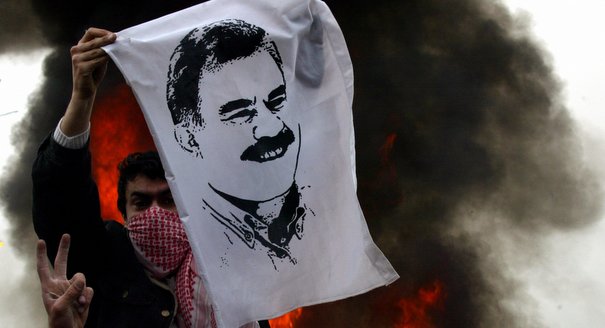
But it is Turkey’s Kurds, the third rail of national politics there, that must be accommodated if democracy is to prosper. When it comes to Kurds, the AKP has pronounced much and done little.
Ankara still represses, still imprisons and prosecutes willy nilly. It refuses to lower a parliamentary party’s electoral threshold to less than 10 percent – designed specifically to keep Kurds out of Parliament.
Turkey national elections are now scheduled for June. The AKP will likely win a majority for a third time — an impressive achievement. A new constitution has been promised, removing the current military-imposed one.
Erdogan has previously complained that assimilation—meaning of Turks who migrated to Europe—is a crime against humanity. But the assimilation of Kurds, who have lived in their own lands for a millennium, is regarded as perfectly normal.
Erdogan has a rare, but difficult, task of revising the constitution — and taking a huge step toward greater democracy. This change could free the Kurds from restraints on them since the inception of the republic. Turkey cannot claim democracy’s mantle when 20 percent of its people are denied their political rights.
Doing these things is not easy politically in a highly nationalist Turkey. So Erdogan’s caution is understandable.
But if Turkey is to assert democratic leadership in the Middle East, it will have to do much better when Iran’s people again challenge the regime; and should Syrians eventually rise up against one of the most authoritarian and mafia-styled regimes in the region.
Barkey served as a member of the U.S. State Department Policy Planning Staff, working primarily on issues related to the Middle East, the Eastern Mediterranean, and intelligence from 1998 to 2000.
Carnegie does not take institutional positions on public policy issues; the views represented herein are those of the author(s) and do not necessarily reflect the views of Carnegie, its staff, or its trustees.
More Work from Carnegie Endowment for International Peace
Sergei Kiriyenko used Russia’s parliamentary vote to further hone his strategy of corporate mobilization that is designed to maximize votes for United Russia.
The European far right might fail to steer EU policy in the direction Russia wants, but they will create enough chaos inside Europe to benefit the Kremlin.