• Research
  • Emissary
  • About
  • Experts
Carnegie Global logoCarnegie lettermark logo
DemocracyIran
  • Donate
{
  "authors": [
    "Marina Ottaway"
  ],
  "type": "legacyinthemedia",
  "centerAffiliationAll": "dc",
  "centers": [
    "Carnegie Endowment for International Peace",
    "Malcolm H. Kerr Carnegie Middle East Center"
  ],
  "collections": [
    "Arab Awakening"
  ],
  "englishNewsletterAll": "menaTransitions",
  "nonEnglishNewsletterAll": "",
  "primaryCenter": "Carnegie Endowment for International Peace",
  "programAffiliation": "MEP",
  "programs": [
    "Middle East"
  ],
  "projects": [],
  "regions": [
    "Middle East",
    "North Africa",
    "Egypt",
    "Gulf",
    "Levant",
    "Maghreb"
  ],
  "topics": [
    "Political Reform",
    "Foreign Policy"
  ]
}
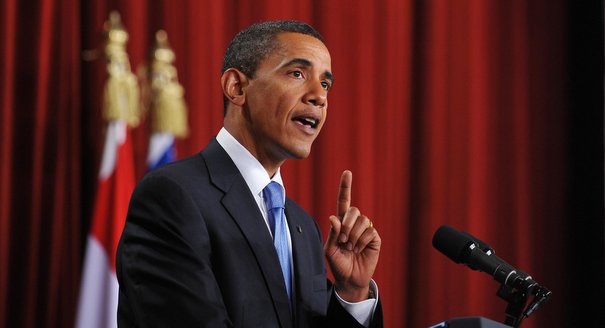
Source: Getty

In The Media

Did Obama Lay Out a Cohesive Middle East Policy?

President Obama’s speech in response to the Arab Spring did not establish a clear foreign policy for the region, but rather outlined a vision of a democratic and prosperous Middle East.

Link Copied
By Marina Ottaway
Published on May 19, 2011
Program mobile hero image

Program

Middle East

The Middle East Program in Washington combines in-depth regional knowledge with incisive comparative analysis to provide deeply informed recommendations. With expertise in the Gulf, North Africa, Iran, and Israel/Palestine, we examine crosscutting themes of political, economic, and social change in both English and Arabic.

Learn More

Source: Politico

Did Obama Lay Out a Cohesive Middle East Policy?President Obama’s speech will disappoint audiences in the Middle East. It does not outline a policy, but a vision — that of a democratic and prosperous Middle East — which of course is not new. In the region, this will be seen as another rhetorical statement rather than as a policy.

The amount of economic assistance he offered to countries that have started a transition, Egypt in particular, will undoubtedly disappoint. It will also probably be ridiculed as totally insufficient: up to $ 1 billion in debt relief to Egypt, helpful in the long run but not in the short run. And $2 billion in investment guarantees through the Overseas Private Investment Corporation is unlikely to encourage U.S. companies to invest in an unstable country.
 
Nor did he set out a new policy for the Israeli-Palestinian problem. He repeated well-known U.S. positions, which Arabs will criticize as being pro-Israel, even as Israeli Prime Minister Benjamin Netanyahu reacted strongly to Obama’s statements that the borders of a Palestinian state should be those of 1967, with negotiated modification.
 
The speech was not a winner.

About the Author

Marina Ottaway

Former Senior Associate, Middle East Program

Before joining the Endowment, Ottaway carried out research in Africa and in the Middle East for many years and taught at the University of Addis Ababa, the University of Zambia, the American University in Cairo, and the University of the Witwatersrand in South Africa.

    Recent Work

  • Article
    Reactions to the Syrian National Initiative

      Marina Ottaway, Omar Hossino

  • Article
    Slow Return to Normal Politics in Egypt

      Marina Ottaway

Marina Ottaway
Former Senior Associate, Middle East Program
Marina Ottaway
Political ReformForeign PolicyMiddle EastNorth AfricaEgyptGulfLevantMaghreb

Carnegie does not take institutional positions on public policy issues; the views represented herein are those of the author(s) and do not necessarily reflect the views of Carnegie, its staff, or its trustees.
More Work from Carnegie Endowment for International Peace

  • Lee and Lula walking
    Commentary
    Emissary
    Why Korea’s President Skipped Washington for Silicon Valley and Brasília

    Lee’s tour shows how Seoul is reorganizing its diplomacy away from Pyongyang and toward industrial networks and the geography of the compute economy.

      Darcie Draudt-Véjares

  • People standing on rocks in the ocean near the shore, with soldiers in the foreground
    Commentary
    Emissary
    The Migration Wave That Embarrassed Morocco and Rattled Europe

    Most migrants may have left Ceuta, but the effects may linger.

      • Alejandro Rodriguez
      • Sarah Yerkes

      Alejandro Martin Rodriguez, Sarah Yerkes

  • Supporters wave VOX and Spanish flags at the start of Patriots for Europe rally at Marriott Auditorium Hotel on February 08, 2025 in Madrid, Spain
    Paper
    How Populist Middle Powers Are—and Are Not—Reshaping Global Politics

    There is a transnational far-right populist movement that links middle powers in a global movement that extends well beyond Trump.

      • Christopher Chivvis

      Christopher S. Chivvis, Rohan Mukherjee, Milan Vaishnav

  • Commentary
    Carnegie Politika
    Russia Is Exporting Its Fuel Crisis to Central Asia

    When faced with fuel shortages in the past, Central Asian governments could always count on additional supplies from Moscow. That safety net no longer exists.

      Galiya Ibragimova

  • Shadowed figure lighting grocery store shelves
    Commentary
    Emissary
    Five Years After His Power Grab, Tunisia’s President Has Only Achieved Failure

    Saied’s main accomplishment has been to destroy a decade’s worth of democratic progress.

      • Sarah Yerkes

      Sarah Yerkes

Get more news and analysis from
Carnegie Endowment for International Peace
Carnegie global logo, stacked
1779 Massachusetts Avenue NWWashington, DC, 20036-2103Phone: 202 483 7600
  • Research
  • Emissary
  • About
  • Experts
  • Donate
  • Programs
  • Events
  • Blogs
  • Podcasts
  • Contact
  • Annual Reports
  • Careers
  • Privacy
  • For Media
  • Government Resources
Get more news and analysis from
Carnegie Endowment for International Peace
© 2026 Carnegie Endowment for International Peace. All rights reserved.