

Commentary
For every ruble allocated to social policy, health, and education in 2027, double that amount is earmarked for the army, the police, and the security services.
Alexandra Prokopenko
{
  "authors": [
    "Uri Dadush",
    "William Shaw"
  ],
  "type": "legacyinthemedia",
  "centerAffiliationAll": "",
  "centers": [
    "Carnegie Endowment for International Peace",
    "Carnegie China"
  ],
  "collections": [],
  "englishNewsletterAll": "",
  "nonEnglishNewsletterAll": "",
  "primaryCenter": "Carnegie Endowment for International Peace",
  "programAffiliation": "",
  "programs": [],
  "projects": [],
  "regions": [
    "North America",
    "United States",
    "South America",
    "South Asia",
    "India",
    "East Asia",
    "China"
  ],
  "topics": [
    "Economy"
  ]
}
Source: Getty
In the coming decades, the unprecedented emergence of the world’s poor countries as the largest global economies will both extend the frontier of prosperity and create massive tensions and unpredictable risks.
Source: Foreign Policy

Already, four (China, India, Russia and Brazil) of the seven largest economies are developing countries. Thirty years of 10 percent annual growth has transformed China from a poor, agrarian economy to an industrial giant and the world's second-largest economy. In Juggernaut: How Emerging Markets Are Reshaping Globalization, we predict that, in the next generation, Japan and Germany will fall further behind and the United States will be the only advanced country to rank among the world's seven largest economies.
Paradoxically, the new powerhouses will remain relatively poor. By 2035, China's GDP will surpass that of the United States, but China's per capita income will still be only half that of the United States. India's economy, the world's third-largest by 2035, will be three times larger than Japan's, but its per capita income will be only a quarter of Japan's.
The emergence of relatively poor countries as the largest global economies is unprecedented. We can only guess how this uniquely 21st-century phenomenon will affect international relations. What we know for sure is that representatives of poor people will hold great sway in international forums and they will be eager for the kinds and quality of goods and services the West takes for granted.
But we also know from recent history that, despite their economic ascent, China, India, Brazil, Indonesia, and Russia are still more prone to political, economic, and financial instability than the advanced countries. And while the United States was at the center of the last financial crisis, developing countries are even more lacking in regulatory structures, social safety nets, and -- in most instances -- the ability to ramp up fiscal deficits required to soften the impact of a crisis.
For this reason, the next great global crisis is just as likely to originate in the developing world as it is in New York or London. These huge economies are integrating into international financial markets, but that doesn't mean they have the institutions or wherewithal to handle a downturn.
These countries have a different perspective on labor regulations and the sacrifices necessary to limit environmental damage. While environmental and labor standards in developing countries remain well below those followed in the West, it is important to remember that the standards of advanced countries remained primitive well after they were much wealthier than today's developing countries. That is not, of course, a reason to repeat the errors of the past, but it does help provide context for the current controversy.
Nowhere is the perception gap and potential for disagreement greater than on climate change. Advanced countries contributed most of the carbon emissions now in the atmosphere, driving today's global warming, but developing countries now account for most new emissions. This disconnect between the past and future causes of climate change has led each side of the economic divide to lob recriminations at the other during negotiations meant to address this problem.
Advanced countries' historical responsibility and greater wealth make it logical that they should accept the bulk of the sacrifices required to limit climate change, but progress will be impossible without the participation of the largest developing-country emitters. An agreement that curbs emissions in advanced countries now, while limiting the future growth of emissions in developing countries, would be the way out of a global disaster.
Today's international institutions, which still largely reflect the power relationships at the end of World War II, also represent a significant challenge in adapting to this shifting geopolitical climate. The international community has taken a step in the right direction by establishing the G-20 and changing voting rights in the IMF, but that has only been a start. Although there are historical precedents for new players peacefully coming to the fore on the international stage, they have been the exception rather than the rule. The United States and its allies will have to find a way to accommodate the increasing military power and political influence of the emerging powers, and this means increasing their voice in existing institutions -- or running the risk that the emerging powers create their own, adding to discord.
Whatever path future reforms take, they will be the product of hard-fought compromise, not universal consensus. The failures of the Doha round of trade negotiations and the Copenhagen climate-change discussions, as well as the emergence of the U.N. General Assembly as the world's most expensive debating club, have amply demonstrated the futility of attempts to please everybody. Instead, a critical mass of players will have to drive the international agreement on each specific issue -- then work to co-opt the rest.
The governments of the United States and China must answer to their citizens, but they also share a planet and one integrated global economy. In the own interest of their citizens, politicians in these giant countries will need to consider the implications of their decisions for the world as a whole -- in other words, foster a global conscience that is conspicuously lacking today. The rise of developing countries extends the frontier of prosperity but also creates massive tensions. These risks should be acknowledged soon, or we will begin to address them only after another unpredictable crisis.

Former Senior Associate, International Economics Program
Dadush was a senior associate at the Carnegie Endowment for International Peace. He focuses on trends in the global economy and is currently tracking developments in the eurozone crisis.
Former Visiting Scholar, International Economics Program
Shaw was a visiting scholar in Carnegie’s International Economics Program. He is the co-author of Juggernaut: How Emerging Markets Are Reshaping Globalization.
Carnegie does not take institutional positions on public policy issues; the views represented herein are those of the author(s) and do not necessarily reflect the views of Carnegie, its staff, or its trustees.

For every ruble allocated to social policy, health, and education in 2027, double that amount is earmarked for the army, the police, and the security services.

Alexandra Prokopenko
The acknowledgment has sparked fears of a new arms race with China and Russia.

Chris O’Meara
Smaller powers cannot go it alone, but Canadian history shows that integration with the United States will not always be benign.
Paul Samson

The European Commissioner for Trade is headed to China. But after President Xi’s bridge-building visit to Washington, can a more isolated EU overcome Beijing’s stranglehold on critical raw materials? Who will blink first?

Rym Momtaz, ed.
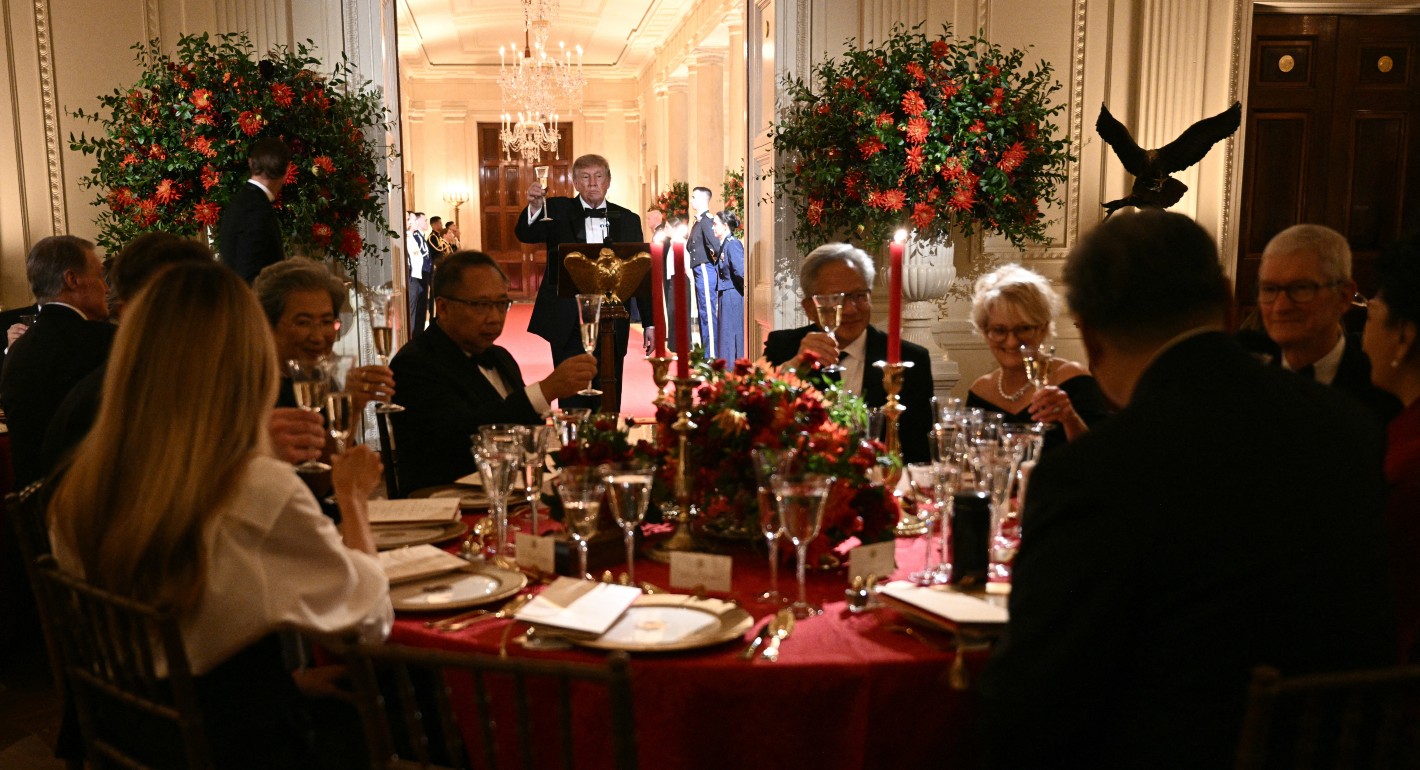
The summit may be remembered as a fatal blunder, when Washington, Beijing, and the AI industry collectively chose ceremony over action.
Jeffrey Prescott