

Commentary
Judy Dempsey
{
  "authors": [
    "Judy Dempsey"
  ],
  "type": "legacyinthemedia",
  "centerAffiliationAll": "",
  "centers": [
    "Carnegie Endowment for International Peace",
    "Carnegie Europe"
  ],
  "collections": [],
  "englishNewsletterAll": "",
  "nonEnglishNewsletterAll": "",
  "primaryCenter": "Carnegie Europe",
  "programAffiliation": "",
  "programs": [],
  "projects": [],
  "regions": [
    "Europe",
    "Southern, Eastern, and Western Africa"
  ],
  "topics": [
    "Foreign Policy"
  ]
}
Source: Getty
The European Union is considering pursuing Somali pirates onshore, although some countries have expressed concern of casualties both among their own soldiers and among Somalia’s civilian population.
Source: New York Times

Yet that is what is going to happen in the coming weeks when the German Parliament will be asked to support what could turn out to be one of the European Union’s most dangerous missions.
The mission involves pursuing Somali pirates onshore, the first time the Union has considered such an option. So far, the E.U. mandate off the Horn of Africa, known as Operation Atalanta, has limited the pursuit of pirates to the sea.
The E.U. foreign policy chief, Catherine Ashton, set out her goal to foreign ministers when they met in Brussels in late March. The changes to the Atalanta mandate, Mrs. Ashton said, would allow it “to take more robust action on the Somali coast.”
Gernot Erler, deputy parliamentary leader of the opposition Social Democrats and a specialist in foreign policy, is skeptical. “This is such a radical change to the mandate. Where will it all end? It could lead to mission creep,” he said.Austria and Spain, which along with Germany considered blocking the move, have similar reservations. But they, too, agreed to pass the issue to the military planners.
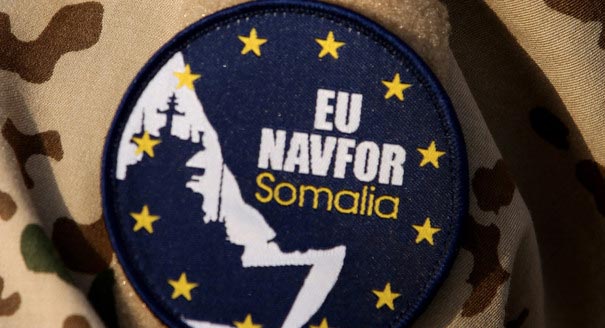
Militarily, the Union first became involved in Somalia in late 2008, when it established the European Union Naval Force Somalia. Since then, the operation has been protecting ships belonging to the U.N. World Food Program, which brings food aid to the tens of thousands displaced persons in Somalia.
Along with NATO’s Operation Ocean Shield and the Combined Task Force, the E.U. force has been deterring and preventing piracy and robbery off the coast of Somalia, protecting one of the world’s most important shipping routes.
Results have been mixed. According to a new report published last month by the One Earth Future Foundation, a nongovernmental organization specializing in global governance, Somali pirates continue to be a serious threat. By the foundation’s estimates, attacks in 2011 cost the shipping industry between $5.3 billion and $5.5 billion for security or re-routing.
The average ransom increased to around $5 million in 2011 from $4 million in 2010.
“While 2011 saw a lower success rate for Somali pirates, the increased price of ransoms meant that pirates received greater revenue for fewer hijackings,” wrote Anna Bowden, the main author of the One Earth Future Foundation report. The number of hostages of seafarers also increased, to 1,118 last year from 1,090 in 2010. Twenty-four were killed.
The European Union, however, is not naïve enough to believe that fighting the pirates is a panacea. Along with the United States, it has been pouring money into the Transitional Federal Government of Somalia to try to rebuild the failed state.
After 16 years of civil war, Somalia is plagued with famine, instability and such weak government and institutions that it has turned into a haven for Al Qaeda supporters. E.U. diplomats say the country needs a long-term strategy to bring stability, create jobs and end sectarianism. In the meantime, they say they also have to deal with short-term issues, and that means combating piracy.
France, Britain and the Netherlands have long been in favor of pursuing pirates on land so as to deny them their easy retreat.
But Germany, Spain and Austria were not willing to agree to a robust extension of the mandate, being afraid of casualties both among their own soldiers and among Somalia’s civilian population.
The result is, as always in Brussels, a compromise: European soldiers may go in, but only by helicopter — no troops on the ground. They may target pirate boats, equipment and gasoline reserves along the shoreline and the internal waterways, but they cannot shoot at people. They are allowed to use machine guns, but no rockets.
Despite these restrictions, military experts think this new approach will hurt the pirates. But risks to civilians remain, they warn. “It could have a coercive effect: The navy is taking the fight into the pirates’ own backyard,” said Lee Willett, senior research fellow in maritime studies at the Royal United Services Institute in London. He added that using force ashore increases the risk of affecting innocent civilians.
The pirates, depending on where they are based, are embedded among the local population. Analysts say they have contributed a share of the ransom money to poor communities, but they have also brought prostitution, alcoholism and other problems.
Under threat from helicopters, the pirates could be tempted to use villagers as human shields for their boats. Or they could simply take their boats off the shore and transport them farther inland. And then what? How far would the European Union be prepared to give chase? What if the pirates paid civilians to guard the boats on the beaches? How far does the beach stretch, in military terms, anyway?
E.U. diplomats will give no details. “We cannot tell you because we do not want the pirates to know,” one diplomat said, requesting anonymity because of the sensitivity of the issue. “Such details are secret.”
But this is an answer that the skeptical German lawmakers will not accept. They have seen what has happened in Afghanistan, where many civilians have died in NATO bombings.
Deputies from Chancellor Angela Merkel’s coalition have made it clear that they demand an answer to the question of the beach, either in terms of a clear definition in the E.U. operations plan or in the shape of a national reservation, or caveat, to stop German troops from going farther inland.
Ms. Merkel, recognizing how divisive this issue is, is playing for time. Analysts said she would prefer no debate at all about the width of the beach until mid-May, when crucial regional elections in North Rhine-Westphalia are over.
This article was originally published in the New York Times.

Nonresident Senior Fellow, Carnegie Europe
Judy Dempsey is a nonresident senior fellow at Carnegie Europe
Recent Work
Judy Dempsey
Judy Dempsey
Carnegie does not take institutional positions on public policy issues; the views represented herein are those of the author(s) and do not necessarily reflect the views of Carnegie, its staff, or its trustees.

Despite a new textbook, an influx of Russian teachers and managers, and an end to the teaching of Ukrainian, the Kremlin is unlikely to have “reprogrammed” locals.

Konstantin Skorkin

The acknowledgment has sparked fears of a new arms race with China and Russia.

Chris O’Meara

Smaller powers cannot go it alone, but Canadian history shows that integration with the United States will not always be benign.
Paul Samson

The European Commissioner for Trade is headed to China. But after President Xi’s bridge-building visit to Washington, can a more isolated EU overcome Beijing’s stranglehold on critical raw materials? Who will blink first?

Rym Momtaz, ed.

The summit may be remembered as a fatal blunder, when Washington, Beijing, and the AI industry collectively chose ceremony over action.

Jeffrey Prescott