

Paper
Matthew Rojansky
{
  "authors": [
    "Matthew Rojansky"
  ],
  "type": "legacyinthemedia",
  "centerAffiliationAll": "dc",
  "centers": [
    "Carnegie Endowment for International Peace",
    "Carnegie Russia Eurasia Center"
  ],
  "collections": [],
  "englishNewsletterAll": "ctw",
  "nonEnglishNewsletterAll": "",
  "primaryCenter": "Carnegie Endowment for International Peace",
  "programAffiliation": "russia",
  "programs": [
    "Russia and Eurasia"
  ],
  "projects": [],
  "regions": [
    "North America",
    "United States",
    "Caucasus",
    "Russia"
  ],
  "topics": [
    "Political Reform",
    "Foreign Policy"
  ]
}
Source: Getty
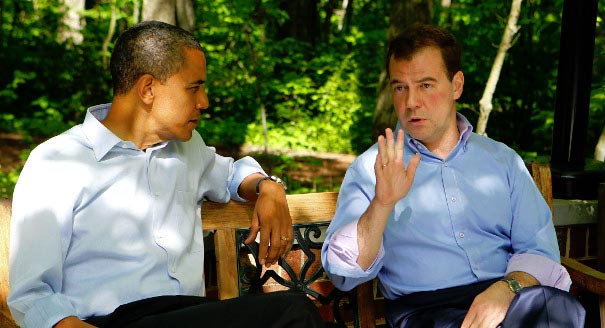
The Obama administration's policy on Russia is proving to be fairly insignificant in the ongoing U.S. presidential campaigns.
Source: Valdai Discussion Club

The Russian factor is in reality quite insignificant. There's very little of what you could call "ethnic voting" on Russian lines. If anything, it's mildly anti-Russian, because there's Polish, Ukrainian, to some extent some post-Soviet Jewish votes -- the number may be in the single digit millions, absolute maximum, probably not even that big. In terms of foreign policy, that's generally not an influential factor for American elections. Anything that takes place outside the borders of the United States, unless it represents competition for American jobs, which is not the case with Russia -- Russians are not competing for American jobs, they're buying American products -- it's not an important factor.
The only way in which this might be a significant factor is in what you could call the "moral narrative" of the elections. The moral narrative, in the case of Mitt Romney, is very much that he is a strong and serious businessman, and he's a tough leader, and that President Obama is weak, he's been irresponsible, he's somehow been naive when it comes to America's enemies. And that is why, I think, Mitt Romney has included Russia in the list of America's enemies, or "strategic foes" as he calls them, so that he can depict Russia as part of a problem that President Obama is failing to address. So to that extent it may have some influence in the elections, but I think overall, the influence will be very minimal.
Now there are two factors that could make a big difference. The first is who is appointed to senior government positions in the new administration. There are of course those who are simply ideologically, deeply opposed to cooperation with Russia, or for that matter, with any other state that they deem to be part of a set of bad actors. If such individuals are appointed to senior government positions, that could make a difference, simply because they can be involved in policy-making even without the involvement of the president.
The second big factor is Congress. Remember that 2012 is not only a presidential election year, it's also a congressional election year. And I think it's quite likely that Republicans will consolidate and strengthen their hold in both the House, and then perhaps win the majority in the Senate. If that happens, and you have President Obama continuing, then the government will be divided. And there is a guarantee that nothing will get done. If you have a Republican president and a Republican Congress, then there's a possibility that Russia will be something that is sacrificed as part of broader political deals between the White House and Congress. In other words, Congress has an agenda -- in some cases, and anti-Russian agenda -- and it will win on that agenda, and the White House will win on something else, like, for example, jobs or military spending.
He will feel that he has more ability to be flexible. If Obama wins, he will have a new account of political capital to spend; but I don't know that a compromise on missile defense either requires much political capital to be spent, nor would it be his first priority. And I think once you start to get further down the list, then you start not to see so much of a difference between term one Obama and term two Obama.
It depends on what you compare it to. If you compare the American factor to the economic factor, of course the economy is much more significant. If you compare the American factor to the factor of other foreigners -- for example, Northern Caucasus or Central Asia, the internal abroad -- those things are much more important than the American factor. Comparing it to the Russian factor in the American election, it is much more significant. And the reason for that is simply that America is simply much bigger than Russia is. So when Russians look at the outside world, they see America as quite a big player in the outside world. Americans don't see the same thing.
Yet the other factor is that I think somebody in the Kremlin and somebody in the [Russian] White House made a conscious decision that anti-Americanism will be part of a political campaign. Whether that was the beginning of the Duma election, or only the beginning of the presidential election, I don't know. But it played a role all the way through. It is beginning to fade away again now. But it has been very, very noticeable, and Americans have noticed it.
It's a good question. As an academic, I have learned that there's a way in which my job is similar to politics. If nobody is interested in hearing what I have to say, then nobody will pay attention to me. I have observed that criticism gets attention and keeps people’s interest, and for that reason, many experts are tempted to exclusively and harshly criticize government policy, as a way of getting more attention. It’s not terribly different for presidential and other political candidates. To get attention from voters, the media, and the general public, they have to be critical of government policy. They have an advantage when they are not in power (or when they are challenging the incumbent) because the people who are inside the government will only speak out in favor of the government’s own policies, and do not have the luxury of being critical.
That's a very good point. The difference with China is that even relatively ignorant American politicians have been forced to understand, by business and other interests, that criticism of China will have unacceptable consequences. Russia, no matter how many threats it makes, about Kaliningrad, missiles, whatever, is unable to persuade average American politicians -- not foreign policy experts, average politicians -- that the consequences of criticizing Russia will be not only undesirable, but unacceptable. There's just no such conviction. And there's a big reason for that, too, which is that when Russians make threats, they sound like Soviets. And the United States lived with Soviet threats for half a century. And we know that we can live with it for another half a century if we have to.
This interview originally appeared in the Valdai Discussion Club.
Former Deputy Director, Russia and Eurasia Program
Rojansky, formerly executive director of the Partnership for a Secure America, is an expert on U.S. and Russian national security and nuclear-weapon policies.
Recent Work
Matthew Rojansky
Matthew Rojansky
Carnegie does not take institutional positions on public policy issues; the views represented herein are those of the author(s) and do not necessarily reflect the views of Carnegie, its staff, or its trustees.

Before the next wave of EU enlargement takes place, the union needs to grapple with thorny questions of how power is distributed among its members.


Emil Sondaj Hansen, Ditte Brasso Sørensen

The real test may come after the leaders leave the room.



Sheena Chestnut Greitens, Oriana Skylar Mastro, Yukon Huang, …

The Horn of Africa countries are among those facing a new security calculus.


Andrew Leber, Lesley Anne Warner

The European far right might fail to steer EU policy in the direction Russia wants, but they will create enough chaos inside Europe to benefit the Kremlin.

Dimitar Bechev

The new U.S.–Denmark–Greenland agreement will help Washington exert political, economic, and financial dominance under the guise of security. Yet, it acknowledged Copenhagen’s and Nuuk’s sovereignty on the island.

Marc Pierini