• Research
  • Emissary
  • About
  • Experts
Carnegie Global logoCarnegie lettermark logo
DemocracyIran
  • Donate
{
  "authors": [
    "Nathan J. Brown"
  ],
  "type": "legacyinthemedia",
  "centerAffiliationAll": "dc",
  "centers": [
    "Carnegie Endowment for International Peace"
  ],
  "collections": [
    "Arab Awakening"
  ],
  "englishNewsletterAll": "menaTransitions",
  "nonEnglishNewsletterAll": "",
  "primaryCenter": "Carnegie Endowment for International Peace",
  "programAffiliation": "MEP",
  "programs": [
    "Middle East"
  ],
  "projects": [],
  "regions": [
    "North Africa",
    "Egypt"
  ],
  "topics": [
    "Political Reform",
    "Democracy"
  ]
}
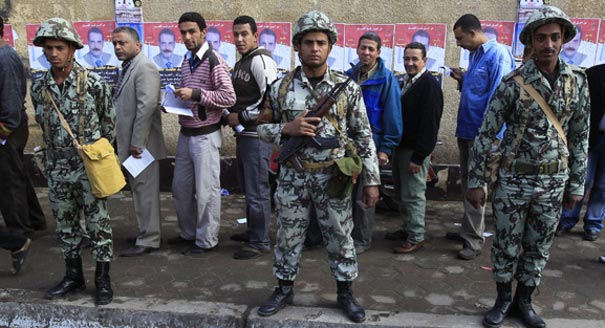
Source: Getty

In The Media

An Instant Analysis of Egypt's New Constitution

The recently revised Constitutional Declaration, written by the military, outlines the powers of the Egyptian presidency in a way that gives ultimate authority to the Supreme Council of the Armed Forces.

Link Copied
By Nathan J. Brown
Published on Jun 18, 2012
Program mobile hero image

Program

Middle East

The Middle East Program in Washington combines in-depth regional knowledge with incisive comparative analysis to provide deeply informed recommendations. With expertise in the Gulf, North Africa, Iran, and Israel/Palestine, we examine crosscutting themes of political, economic, and social change in both English and Arabic.

Learn More

Source: Arabist

The supplementary constitutional declaration (arabic) really does complete the coup in many obvious ways–basically returning martial law (in its more original sense rather than the “state of emergency” that just expired), making the military unaccountable, and grabbing back oversight of the political system for the military just weeks before the scheduled end of military rule. Most of this is clear on the surface and does not need much analysis.

Two more detailed notes I would add that may otherwise be missed:

  1. The new article 53 refers to the SCAF in its current formation. What people had forgotten about the SCAF was that it was a body that existed before February 2011, established by statute that placed the president of the republic at its head. Without this declaration, President Shafiq or Morsi would have headed the SCAF upon taking office (unless there was some change in the legislation on the SCAF’s formation I was unware of over the past year) In freezing the SCAF’s current membership in place and giving it such sweeping powers, the provisions really do constitutionalize a military coup.
     
  2. Giving the constitutional court a binding veto over any constitutional provision with only the vaguest guidance on the standards to use is simply a constitutional obscenity. With all my respect for some of the Court’s justices, this is simply a bizarre role for the Court. It is a parody of the South African transition, in which the Court was given the task of reviewing the draft constitution in light of a group of principles negotiated by political forces at the start of the process. The South African Court did find some violations and asked for changes. In that case, however, the Court was a new structure, it was a far more diverse body, the standards were clear, and those standards had consensus agreement.
One other brief legal and historical note: there is a brewing struggle over whether or not the parliament is dissolved. The SCAF’s argument–apparently supported by some Court justices in some comments if I recall correctly–is that the publication of the judgment in the Official Gazette has made the decision part of the legal order.

The Brotherhood’s argument is that the 1987 and 1990 dissolution came only after a popular referendum approved them, and that based on that precedent, a referendum is required now. I do not find that argument convincing because the previous referenda were based on a provision in the 1971 constitution permitting the president to dissolve parliament if that dissolution was approved in a referendum. When the 1987 and 1990 decisions came, the Court apparently advised the president that it was up to him as the executive authority to dissolve the parliament but that his authority to do so could be exercised only with the approval of a referendum (Lord only knows what would happen if the referendum had been rejected, but such things did not happen in those days).

Tariq al-Bishri’s argument is that the constitutional declaration does not give the SCAF any authority to dissolve the parliament and that therefore the correct way to enforce an SCC judgment (since the SCC only rules on the law) is to go to the administrative courts. This argument seems to be legally stronger but politically totally without legs.

There is a weird precedent here–in 1925 after the king dissolved the parliament immediately after it sat, the parliamentary majority, led by the Wafd argued (probably correctly) that the dissolution was unconstitutional. So they met in a hotel after the Parliament was sealed off. I don’t expect that precedent to govern the outcome now, but we might see Sa’d al-Katatni positioning himself as Sa’d Zaghlul.

So in the end, I think that Egypt will follow Hobbes’s maxim “in matter of government, when nothing else is turned up, clubs are trumps.” Those clubs, according to al-Ahram, have already been deployed. “Security” personnel have taken over the parliament and discovered–brace yourselves–that FJP deputies were doing things like preparing a budget different from that of the Ganzuri government.. And they were even talking about what positions people should have after the presidential elections. What clearer evidence could there be of a nefarious attempt to have elected officials govern the country?

This article was originally published in the Arabist.

About the Author

Nathan J. Brown

Nonresident Senior Fellow, Middle East Program

Nathan J. Brown, a professor of political science and international affairs at George Washington University, is a distinguished scholar and author of nine books on Arab politics and governance, as well as editor of five books.

    Recent Work

  • Commentary
    Rubble is Israel’s Doctrine, Not a Case of Improvisation

      Nathan J. Brown

  • Commentary
    Trump’s Plan for Gaza Is Not Irrelevant. It’s Worse.

      Nathan J. Brown

Nathan J. Brown
Nonresident Senior Fellow, Middle East Program
Nathan J. Brown
Political ReformDemocracyNorth AfricaEgypt

Carnegie does not take institutional positions on public policy issues; the views represented herein are those of the author(s) and do not necessarily reflect the views of Carnegie, its staff, or its trustees.

More Work from Carnegie Endowment for International Peace

  • Fertile river valley in Morocco
    Article
    Parallel Climate Reckonings: Colonial Water Legacies and Indigenous Adaptation, from Morocco to the American West

    If Indigenous land and water dispossession is ignored, climate adaptation strategies risk reproducing inequalities and worsening acute climate vulnerability.

      Frederic Wehrey, Charles H. Johnson

  • Pashinyan shaking hands
    Commentary
    Emissary
    At Stake in Armenia’s Election: Peace and Russian Influence

    Regardless of the outcome, there’s another path to ensuring that progress doesn’t stall.
      Zaur Shiriyev

  • Photo of garment workers sewing jeans in Kenya.
    Article
    The Strategic Stakes of AGOA Reform and Renewal

    Strengthening U.S.-Africa trade and advancing U.S. interests aren’t conflicting goals.

      • Tyler Beckelman
      • Kholofelo Kugler

      Tyler Beckelman, Kholofelo Kugler

  • Europe flags citizens demonstration
    Commentary
    Strategic Europe
    EU Enlargement Forgets Europeans

    Preparing candidate countries for EU membership is no longer enough. As the enlargement process becomes a reality, the union must also prepare its own societies.

      Iliriana Gjoni

  • Commentary
    Strategic Europe
    Taking the Pulse: Was it Right to Boycott Eurovision?

    Five countries staged the biggest political boycott in Eurovision history over Israel’s participation. With the FIFA World Cup and other sporting or cultural touchstones on the horizon, are boycotts effective?

      • Rym Momtaz

      Rym Momtaz, ed.

Get more news and analysis from
Carnegie Endowment for International Peace
Carnegie global logo, stacked
1779 Massachusetts Avenue NWWashington, DC, 20036-2103Phone: 202 483 7600
  • Research
  • Emissary
  • About
  • Experts
  • Donate
  • Programs
  • Events
  • Blogs
  • Podcasts
  • Contact
  • Annual Reports
  • Careers
  • Privacy
  • For Media
  • Government Resources
Get more news and analysis from
Carnegie Endowment for International Peace
© 2026 Carnegie Endowment for International Peace. All rights reserved.