

Article
C. Raja Mohan, Darshana M. Baruah
{
  "authors": [
    "C. Raja Mohan"
  ],
  "type": "legacyinthemedia",
  "centerAffiliationAll": "dc",
  "centers": [
    "Carnegie Endowment for International Peace",
    "Carnegie India"
  ],
  "collections": [],
  "englishNewsletterAll": "ctw",
  "nonEnglishNewsletterAll": "",
  "primaryCenter": "Carnegie India",
  "programAffiliation": "SAP",
  "programs": [
    "South Asia"
  ],
  "projects": [],
  "regions": [
    "North America",
    "United States",
    "South Asia",
    "Afghanistan"
  ],
  "topics": [
    "Security",
    "Military",
    "Foreign Policy"
  ]
}
Source: Getty
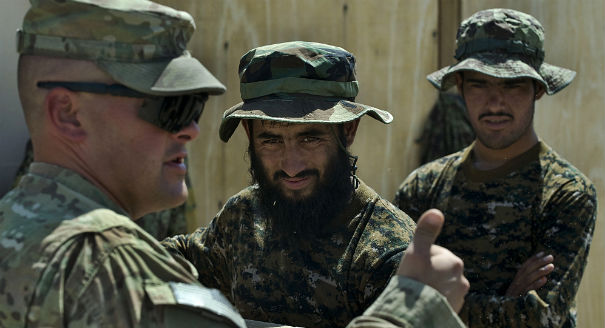
As Presidents Obama and Karzai meet to discuss the American withdrawal from Afghanistan, they will face major disagreements both between and within their two countries.
Source: Indian Express

As political support for Western occupation of Afghanistan rapidly evaporates and the financial crisis squeezes defense spending everywhere in the West, the credibility of the declared American strategy has come under a shadow.
There are deep differences in Washington on the structuring of the transition — the withdrawal of U.S. forces and the assumption of security responsibilities by the Afghan national forces in the coming months. Consider for example, the question on how large the residual American military presence in Afghanistan after 2014 should be. The United States currently has about 66,000 troops in Afghanistan.
Obama has already decided that by the end of 2014, American forces will end their combat role in Afghanistan and focus on a different mission: to train and assist the Afghan armed forces as they take charge of the country’s security. Besides assisting the Afghan armed forces, the residual force will also be involved in counter-terror duties focused on attacking the bases of al-Qaeda and its affiliates in the Afghan neighborhood.
Within this framework, the U.S. military leadership wants to keep as many forces in place as long as possible. Put another way, the generals want to leave the maximum number of troops available for the coming fighting season this year.
The political leadership is not so enthusiastic. The liberals in the Obama administration and in the Democratic Party want a steady withdrawal through 2013 and a quick handover of all security responsibilities to the Afghans. The U.S. military’s interest in having a residual force of 20,000 to 30,000 was widely reported a few months ago. The president and the civilian advisors have apparently ruled out such a large force and are now reportedly considering three options on the size of the residual force at 3,000, 6,000, or 9,000.
If the United States is divided, Washington and Kabul are at odds with each other on a number of issues. The most important differences relate to the conditions under which the U.S. forces will stay in Afghanistan after the occupation comes to an end.
Washington and Kabul are negotiating the “status of forces agreement” (SOFA) that will identify the legal terms under which U.S. forces will operate, and the nature of American control over its military bases in Afghanistan. The United States wants its forces to be subject to American rather than Afghan law. But Karzai, under growing pressure to demonstrate his independence from the U.S., is naturally emphasizing the question of Afghan sovereignty.
The question of immunity for American troops led to the breakdown of the negotiations between Washington and Baghdad on the presence of a residual American force in Iraq after 2010. But unlike the Iraqi government, Karzai needs the presence of the U.S. troops to ensure the stability of his regime. While he will drive a hard bargain, Karzai will have to find some compromise with Washington.
Meanwhile, the Taliban, which is being wooed intensely by the United States with the help of the Pakistani army, has declared the presence of even a single foreign soldier in Afghanistan after 2014 is unacceptable.
Karzai has demands of his own on Washington. He wants the U.S. to commit to a substantive arms supplies and the modernization of Afghan armed forces. Of particular interest to Karzai is the upgrading of the Afghan air force.
The Pakistani army, however, is likely to oppose any American moves in that direction. Rawalpindi must be expected to fully leverage its emerging role in the Afghan peace process to prevent Washington from making any significant offers on future arms transfers to Kabul.
Former Nonresident Senior Fellow, Carnegie India
A leading analyst of India’s foreign policy, Mohan is also an expert on South Asian security, great-power relations in Asia, and arms control.
Recent Work

C. Raja Mohan, Darshana M. Baruah


Alexander Gabuev, Paul Haenle, C. Raja Mohan, …
Carnegie does not take institutional positions on public policy issues; the views represented herein are those of the author(s) and do not necessarily reflect the views of Carnegie, its staff, or its trustees.
Japan’s revision of its three strategic documents reflects an intention to keep the United States engaged in the region while Japan fills any vacuums of U.S. power to preserve the Indo-Pacific order.
Ryo Sahashi
Over the past decade, China has moved from marginal player to major producer of all things batteries. The United States, Europe, and others are aiming to balance the market.

Milo McBride
The DFC should focus on advanced, low-carbon energy sources, prioritizing areas where the United States has comparative advantages.
Noah Gordon, Liana Schmitter-Emerson
Media coverage suggests Kyiv’s fortunes have changed. That shift may be important, but it only goes so far.



Dara Massicot, Aaron David Miller, Andrew S. Weiss
Lee’s tour shows how Seoul is reorganizing its diplomacy away from Pyongyang and toward industrial networks and the geography of the compute economy.

Darcie Draudt-Véjares