

Research
- +10
Rosa Balfour, Frances Z. Brown, Yasmine Farouk, …
{
  "authors": [
    "Moisés Naím"
  ],
  "type": "legacyinthemedia",
  "centerAffiliationAll": "",
  "centers": [
    "Carnegie Endowment for International Peace"
  ],
  "collections": [],
  "englishNewsletterAll": "",
  "nonEnglishNewsletterAll": "",
  "primaryCenter": "Carnegie Endowment for International Peace",
  "programAffiliation": "",
  "programs": [],
  "projects": [],
  "regions": [
    "North America",
    "South America"
  ],
  "topics": [
    "Political Reform",
    "Democracy",
    "Economy",
    "Trade"
  ]
}
Source: Getty
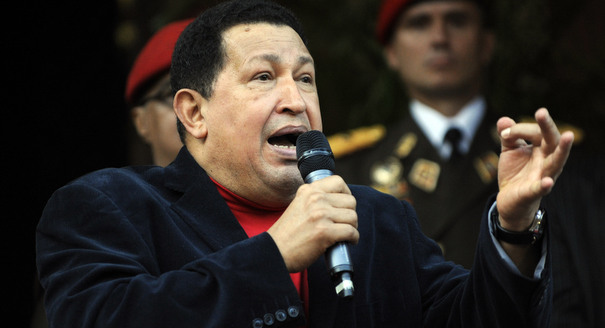
Venezuela is preparing for a potential power struggle amid intense secrecy over the president's health.
Source: PBS NewsHour
JUDY WOODRUFF: We turn now to Venezuela, where President Hugo Chavez was supposed to be inaugurated for a new term today, but was instead out of the country. Ray Suarez has more on the reason for and controversy surrounding his absence and the future of his political movement.
RAY SUAREZ: Thousands of supporters descended on the presidential palace in the Venezuelan capital, Caracas, today, chanting and waving flags in a show of support for their ailing, absent president. Venezuela is a country of 29 million people, an oil exporter subsidizing energy-hungry poor countries like Cuba and Haiti. And it sends 800,000 barrels of oil a day to the U.S., its number one customer. President Hugo Chavez has led the nation for 14 years. His third term expires today. He won reelection in October and was supposed to be sworn in again today for another six years, as the constitution requires. But Chavez suffers from aggressive, reoccurring cancer, hasn't been seen in public in a month, and was too sick to return to Venezuela from medical treatment in Cuba.
MOISES NAIM, Carnegie Endowment for International Peace: The illness of the president has been treated as a state secret from the beginning. He has been treated in Cuba under a veil of secrecy.
RAY SUAREZ: Moises Naim is a former Venezuelan cabinet minister, now a columnist and a visiting scholar at the Carnegie Endowment for International Peace in Washington. He says keeping Chavez alive in Havana strengthens the president's number two, Nicolas Maduro.
MOISES NAIM: This is essentially a power play. Behind that secrecy, there is nothing but an attempt to ensure the continuity of the regime, regardless of President Chavez's presence.
RAY SUAREZ: The U.S. State Department, after sparring with Chavez's Venezuela for more than a decade, was restrained in its response today to the government and court's decision to extend the inaugural deadline.
VICTORIA NULAND, State Department Spokeswoman: Obviously, the inauguration didn't go forward today, as planned. We have been saying all the way through that it's up for -- up to Venezuelans to decide on the next step.
RAY SUAREZ: And Nuland expressed a desire to reset the relationship, saying the U.S. is open, but it's up to Venezuelans.
VICTORIA NULAND: Our sense is that, at the moment, they're very much preoccupied with internal affairs. So we're standing by.
RAY SUAREZ: The former soldier and coup leader turned elected president antagonized Washington, it seemed, whenever he could, forging friendships with Iran's Mahmoud Ahmadinejad, Syria's embattled Bashar al-Assad, and he formed an especially close bond with Cuban Presidents Fidel and Raul Castro. While relishing his role rallying the Latin American left against U.S.-led free trade and anti-terrorism efforts, Chavez had an opponent he couldn't beat in cancer. He bore his sufferings in public, talking about his treatment, showing the effects of radiation and chemotherapy. Then, after medical treatment in Cuba, he would pronounce himself cleared of cancer and ready to return to the country's business.
PRESIDENT HUGO CHAVEZ, Venezuela (through translator): Free. I am totally free.
RAY SUAREZ: During last year's campaign, he didn't disclose specifics about the nature, location, or severity of the cancers.
PRESIDENT HUGO CHAVEZ, Venezuela (through translator): I'm leaving, but the high political authority, although I will not hand it over, I will delegate it and it is in good hands. Here is Nicolas Maduro and all of the political cabinet of the republic.
RAY SUAREZ: After he left the government in the hands of his hand-picked number two, Chavez's treatment and condition remained shrouded in secrecy.
ERNESTO VILLEGAS, Venezuelan Minister of Communication and Information (through translator): The president is carrying out his medical treatment. It is a very strict treatment.
RAY SUAREZ: That lack of information has led to confusion and anger.
ALFONSO MARQUINEZ, Opposition Lawmaker (through translator): In the morning, they tell us the president is in a serious condition, but then in the afternoon, they say he is exercising. That has created a wave of rumors, a wave of uncertainty and economic and political instability across the nation.
DIEGO PADRON, Venezuelan Conference of Bishops (through translator): The population is confused. And a big part of it is also annoyed because, despite more than 25 announcements about the health of the president, until now, we have not had one single Venezuelan medical report.
RAY SUAREZ: The man who tried to unseat Chavez in the last election, opposition leader Henrique Capriles, says a high-court decision to postpone the inauguration solves nothing.
HENRIQUE CAPRILES RADONSKI, Former Venezuelan Presidential Candidate (through translator): Make no mistake, none of these directors of the government received a presidential mandate on October 7. There is only one leader of the party that is in front of us, who is the president of the republic, who was elected on the 7th of October. Don't confuse one thing with the other. Not the vice president of the republic nor any of these directors received a mandate, nor fit in the shoes of the leader they say they are defending.
RAY SUAREZ: Cynthia Arnson, director of the Latin America Program at the Woodrow Wilson Center for International Scholars, says Capriles, who came closer than anyone to unseating the president, will likely lead those who want to end the Chavez era.
CYNTHIA ARNSON, Director, Latin America Program, Woodrow Wilson Center for International Scholars: He will remain, I think, the person who the opposition will put up to run against Maduro. But I think he's coming from behind, and it's also going to be a very difficult, a very short period of time in which to organize another national election.
RAY SUAREZ: But Chavez remains popular and loved by half the population. One supporter says: "I love you. We need you."
A priest adds this prayer, for the cancer to be defeated and for new word from Chavez.
Maduro's been running the country and giving detail-free updates on Chavez's health.
NICOLAS MADURO, Vice President of Venezuela (through translator): President Chavez is conscious of all the circumstances he's living through, which are complex circumstances. He's conscious of the battle he is fighting and he has a spirit of battle, as always.
RAY SUAREZ: Here's where the power struggle gets interesting. Now that the Supreme Court has extended the Chavez term indefinitely, Vice President Maduro's position is secure. But the vice president is appointed, not elected. He has a rival in the head of the national assembly who would become Venezuela's interim leader for 30 days if Chavez dies. The National Assembly president, Diosdado Cabello, has strong ties with the army, an important power base in Venezuela. We asked Arnson whether you can have the president's movement, Chavismo, without Chavez?
CYNTHIA ARNSON: The movement will definitely survive, but it will be very different. There will be different factional conflicts. There will be -- there's really no one who claims the heart and soul of the ardent Chavez following in the same way that Hugo Chavez has been able to do over these years.
RAY SUAREZ: Naim says, in one way, it doesn't matter who's in power, Maduro, Cabello, even Chavez himself. Whoever is president this year will face the severe economic consequences of the last decade of mismanagement.
MOISES NAIM: Even if President Chavez comes back for some reason, he will have to make decisions that he has avoided for 14 ears. A devaluation of the currency will be necessary. Cutting the spending of the public sector will be also necessary. Cutting imports is going to be very important, and dealing with inflation, dealing with all sorts of distortions that have accumulated in the economy and that are going to be very hard to sustain in the near future.
RAY SUAREZ: Even with high oil prices, running a society on imported goods, generous price subsidies, and cronyism is more expensive than Hugo Chavez could afford.
JUDY WOODRUFF: Online, we have a profile of Chavez's number two, Vice President Nicolas Maduro, a former bus driver and union leader who is a loyal supporter of the ailing president.

Distinguished Fellow
Moisés Naím is a distinguished fellow at the Carnegie Endowment for International Peace, a best-selling author, and an internationally syndicated columnist.
Recent Work



Rosa Balfour, Frances Z. Brown, Yasmine Farouk, …
Moisés Naím
Carnegie does not take institutional positions on public policy issues; the views represented herein are those of the author(s) and do not necessarily reflect the views of Carnegie, its staff, or its trustees.

With its public finances in shambles, the far right polling at 35 percent ahead of the 2027 presidential election, and a growing protest movement, is France’s crisis a threat to the EU’s geopolitical awakening?

Rym Momtaz, ed.

Putin’s conservative staffing policies and search for ever greater control have cemented parliament’s transformation into a bureaucratic appendage of the executive branch.

Andrey Pertsev

Without a ceasefire with Ukraine on attacking each other’s energy infrastructure—to which the Kremlin is unlikely to agree—the diesel agreement between Putin and Trump is largely for show, rather than representing a genuine increase in the volumes of Russian diesel on the global market.

Sergey Vakulenko

Russian strikes are weakening the economy sustaining Ukraine’s war effort. Closing the growing funding gap will require more European support and politically contentious reforms in Kyiv.

Balázs Jarábik

Ex-president Gurbanguly Berdimuhamedov remains interested in politics, but his son Serdar, Turkmenistan’s current president, is becoming increasingly independent and willing to break with his father’s legacy. If their covert rivalry goes too far, both risk losing power.

Galiya Ibragimova