

Article
C. Raja Mohan, Darshana M. Baruah
{
  "authors": [
    "C. Raja Mohan"
  ],
  "type": "legacyinthemedia",
  "centerAffiliationAll": "dc",
  "centers": [
    "Carnegie Endowment for International Peace",
    "Carnegie India"
  ],
  "collections": [],
  "englishNewsletterAll": "ctw",
  "nonEnglishNewsletterAll": "",
  "primaryCenter": "Carnegie India",
  "programAffiliation": "SAP",
  "programs": [
    "South Asia"
  ],
  "projects": [],
  "regions": [
    "South Asia",
    "India",
    "Western Europe",
    "France"
  ],
  "topics": [
    "Security"
  ]
}
Source: Getty
With their shared strategic interests and increasing defense ties, France and India are poised to become close partners in the security of the Indian Ocean region.
Source: Indian Express
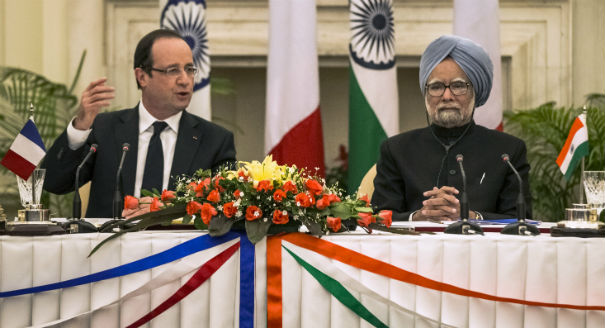
There will be much to celebrate when the president of France, Francois Hollande, arrives in Delhi on Valentine's Day to review the state of bilateral relations with Prime Minister Manmohan Singh and chart out an ambitious future course.
Two decades of political romance with Paris has produced one of the most productive bilateral relationships for Delhi. By choosing India as one of the first major foreign destinations, Hollande is signalling his determination to deepen the partnership that was founded and built by his two predecessors, Nicolas Sarkozy and Jacques Chirac. Whether it was Delhi's integration into the global nuclear order or the recognition that its rise on the global stage is inevitable, it was Paris that first articulated big new ideas about India in the last two decades. This week, the two leaders have work to do finalizing the terms for many large transformative projects that are in the pipeline. Two of them have grabbed most of the headlines.
One is the plan to build six large nuclear reactors in Jaitapur, Maharashtra. Besides the reactors, France is committed to developing "full civil nuclear cooperation" with India. Delhi expects French cooperation in building commercial uranium enrichment facilities that would fuel the new Indian reactors as well supply other nuclear power stations in the region. More broadly, the civil nuclear collaboration between Delhi and Paris could help develop India as a joint base for providing nuclear services in Asia and beyond.The other is the deal to supply 126 Rafale medium multi-role combat aircraft (MMRCA) to the Indian Air Force. This is not just a one-time transaction to equip the IAF with modern fighters but facilitates a significant expansion of India's defense-industrial base. In the civilian nuclear arena as well as in defense, France promises to differentiate itself from other suppliers on the critical question of technology transfer. This makes the role of France a very special one in the development of India's strategic capabilities.
Prime Minister Singh and President Hollande are not expected to dot the many 'i's and cross the 't's of the two agreements. Their task is to recognize the special salience of the current moment in bilateral relations, demonstrate maximum flexibility in what each has to offer and push the two bureaucracies into clinching final agreements. Hollande needs early closure as part of his effort to revive the sclerotic economic growth in France, and the PM can't afford endless haggling, the default Indian negotiating style, on these two strategic projects.
As they wrap up the pressing nuclear and defense agenda from the past and look ahead, one important new area of cooperation presents itself — maritime security in the Indian Ocean. India's domestic discourse on the Indian Ocean has long been shaped by the US and more recently by China. The awareness of France as an Indian Ocean power and the appreciation of the benefits of a strong naval partnership with it remain rather limited.
Although India's naval engagement with the US has grown manifold in the last decade, there are many inhibitions that prevent the realization of its full potential. While the US is likely to remain a major Indian Ocean power for a long time to come, its priorities are shifting to the Pacific, where it must cope with the challenges to its long-standing naval primacy.
With America's rapidly declining dependence on imported oil from the Middle East, its unfolding pivot to Asia and the fiscal pressures to cut military expenditure, the importance of the Indian Ocean is likely to progressively decline in the coming years for Washington.
Meanwhile, Delhi must indeed prepare for the inevitable emergence of China as a full-fledged naval power in the Indian Ocean in the longer term. In the interim, as India seeks to consolidate its natural advantages in the Indian Ocean, France is a compelling naval partner.
The possession of territories in the Indian Ocean has long made France a resident power in India's extended maritime neighborhood. Its island territories—the Reunion and Mayotte islands—are located astride critical sea lines of communication in the Western Indian Ocean.
Besides military presence on these islands, France also has a base in its former colony Djibouti, which sits at the mouth of the Red Sea, oversees the traffic between the Mediterranean and the Indian Ocean.
More recently, France has also acquired a military base in Abu Dhabi, right inside the volatile Persian Gulf. Together, these military bases constitute a "French Quadrilateral" that covers important choke points in the Western Indian Ocean. The size of the French naval profile in the Indian Ocean is smaller than that of the US. But it is likely to be more enduring, thanks to the country's dependence on energy imports from the Middle East and its big political stakes in Africa.
France already contributes to bolstering Delhi's naval strength as a partner in the construction of its Scorpene submarines in India. The planned launch of the jointly developed SARAL satellite for ocean mapping later this month underlines the broad scope of current maritime cooperation between India and France.
As the geopolitical weight of the Indian Ocean grows, Delhi and Paris need to integrate different strands of current bilateral cooperation in the maritime domain. Given the deepening political comfort between Delhi and Paris, Manmohan Singh and Hollande must declare that deepening maritime collaboration is a shared strategic objective and order their defense establishments to begin operational military cooperation in the Indian Ocean.
This could include sharing of naval intelligence, providing access to each other's facilities in the Indian Ocean, helping smaller countries, especially critical island states, develop their maritime capacities, providing mutual logistical support, mounting joint scientific expeditions, developing submersible vehicles that can operate in the deep, and pursuing cooperative naval missions in the Indian Ocean.
This article was originally published in the Indian Express.
Former Nonresident Senior Fellow, Carnegie India
A leading analyst of India’s foreign policy, Mohan is also an expert on South Asian security, great-power relations in Asia, and arms control.
Recent Work

C. Raja Mohan, Darshana M. Baruah


Alexander Gabuev, Paul Haenle, C. Raja Mohan, …
Carnegie does not take institutional positions on public policy issues; the views represented herein are those of the author(s) and do not necessarily reflect the views of Carnegie, its staff, or its trustees.

Are Germany’s economic, industrial, and political struggles becoming a liability for the EU’s ability to rise to the geopolitical moment?

Rym Momtaz, ed.

China’s police training infrastructure construction projects provide benefits to recipient countries, promote China’s image as a major global security provider, and are likely to reinforce alignment between Beijing’s security priorities and those of countries in the Global South.


Cameron Waltz, Sheena Chestnut Greitens, Kim Nguyen, …
They face an uphill climb, but they could draw on a strategy that other diplomats have used in the past.


Shana Tabak, Alejandro Martin Rodriguez
Understanding the climatic pain points is necessary for policymakers hoping to minimize the war’s negative environmental consequences.


Alejandro Martin Rodriguez, Joy Arkeh, Sarah Yerkes

Radical-right parties are expected to do well in upcoming elections in four of the EU's biggest member states. If successful, they could prevent the union from addressing key challenges ahead.

Stefan Lehne