

Report
Iskander Rehman
{
  "authors": [
    "Iskander Rehman"
  ],
  "type": "legacyinthemedia",
  "centerAffiliationAll": "dc",
  "centers": [
    "Carnegie Endowment for International Peace",
    "Carnegie China"
  ],
  "collections": [
    "China’s Foreign Relations",
    "U.S. Nuclear Policy"
  ],
  "englishNewsletterAll": "ctw",
  "nonEnglishNewsletterAll": "",
  "primaryCenter": "Carnegie Endowment for International Peace",
  "programAffiliation": "NPP",
  "programs": [
    "Nuclear Policy"
  ],
  "projects": [],
  "regions": [
    "North America",
    "United States",
    "East Asia",
    "China"
  ],
  "topics": [
    "Nuclear Policy",
    "Security"
  ]
}
Source: Getty
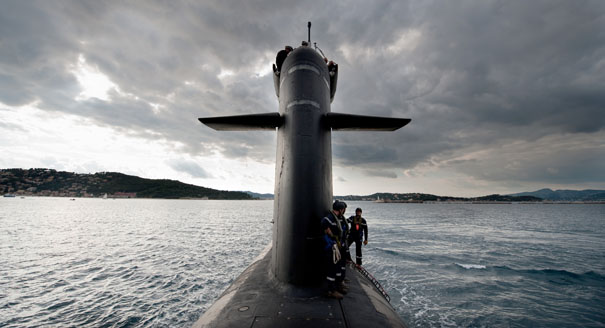
Despite Washington's efforts to construct stronger ties with China, relations between the two countries have been repeatedly buffeted by a series of tensions and misunderstandings.
Source: BBC Vietnam
Despite America’s best efforts to construct stronger ties with China, relations in-between both countries have been repeatedly buffeted by a series of tensions and misunderstandings. Many of these frictions appear to have resulted from a more assertive Chinese posture in the South China Sea. Almost every week, Asian headlines seem to be dominated by reports of jingoistic statements over disputed islets, or of a renewed bout of aggressive maneuvering by boats from one of Beijings numerous maritime agencies. When attempting to explain this upsurge in Chinese pugnacity, analysts have pointed to the rising power's selective interpretation of the law of the sea and growing unwillingness to compromise over what it calls its “blue national soil”, particularly when confronted with an increasingly intransigent domestic populace. Others have pointed to the more immediately tangible benefits to be derived from the presence of numerous offshore oil and gas deposits within contested waters. Strangely enough, however, one of the principal explanations for China’s increased prickliness towards foreign military presence within its maritime backyard has yet to be clearly articulated.
Indeed, not only is the South China Sea one of the world’s busiest trade thoroughfares, it also happens to be the roaming pen of China’s emerging ballistic missile submarine fleet, which is stationed at Sanya, on the tropical Island of Hainan. The United States, with its array of advanced anti-submarine warfare assets and hydrographic research vessels deployed throughout the region, gives Beijing the unwelcome impression that Uncle Sam can’t stop peering into its nuclear nursery. When Chinese naval strategists discuss their maritime environs, the sentiment they convey is one of perpetual embattlement. Pointing to the US’s extended network of allies in the Indo-Pacific region, and to their own relative isolation, Chinese strategists fear that Beijing’s growing navy could be ensnared within the first island chain-a region which they describe as stretching from Japan all the way to the Indonesian archipelago. Applying this maritime siege mentality to naval planning; they fret that the US Navy could locate and neutralize their fledgling undersea deterrent in the very first phases of conflict, before it even manages to slip through the chinks of first island chain.This concern helps explain China's growing intolerance to foreign military activities in the South China Sea. Tellingly, some of the most nerve-wracking standoffs involving US and Chinese forces have unfolded in close proximity to Hainan. The infamous Ep-3 crisis, during which a US spy plane entered into collision with a Chinese fighter jet, occurred while the plane’s crew was attempting to collect intelligence on naval infrastructure development. Similarly, the USNS Impeccable incident, during which a US hydrographic vessel was dangerously harassed by five Chinese ships, took place approximately seventy miles to the south of Hainan. During the confrontation, Chinese sailors reportedly attempted to unhook the Impeccable’s towed acoustic array sonars.
In public, China's protests over foreign military activities are couched in territorial terms. In private, however, Chinese policymakers readily acknowledge the centrality of the nuclear dimension. Thus in the course of a discussion with a former Chinese official, I was told that “even though territorial issues are of importance, our major concern is the sanctity of our future sea-based deterrent.” He then went on to describe, with a flicker of amusement, how fishermen off the coast of Hainan regularly snag US sonars in their nets, and are encouraged to sell them back to the local authorities in exchange for financial compensation. Of course, such cat and mouse games are nothing new-and are perfectly legal- provided they occur within international waters or airspace. During the Cold War, American and Soviet ships would frequently conduct forward intelligence gathering missions, sometimes in very close proximity to each others’ shores. At the time, American thinkers cautioned that such risky behavior could potentially lead to misinterpretation and nuclear disaster. Unlike the Soviets, however, who could confine the movements of their boomers to the frigid, lonely waters of the Barents and Okhotsk seas, the Chinese have chosen to erect their nuclear submarine base smack-bang in the middle of one of the world’s busiest maritime highways.
Needless to say, this location is hardly ideal. When it comes to picking strategic real-estate in their near seas, the Chinese have but a limited roster of options. After all, their maritime backyard is girded by a sturdy palisade of states which increasingly view China’s meteoric rise, and attendant truculence at sea, with a mixture of alarm and dismay. Like a dragon caught floundering in a bathtub, China’s naval ambitions are simply too broad and grandiose for its constricted maritime geography. This perceived lack of strategic depth provides a partial explanation to Beijing’s increased obduracy over territorial disputes in the South China Sea. In order to better protect its valuable subsurface assets, China aims to establish a ring of maritime watch towers or bastions around Hainan. Absolute control over the remote Spratly islands, in addition to the more proximate Paracels, would greatly facilitate this concentric defensive configuration.
Until not long ago, China’s strategic submarine force wasn’t really taken seriously. Their lone 0-92 Xia class boat was deemed too antiquated-and noisy-to be anything more than a symbol of Beijing’s desire for great power status. Some observers had ventured that China would be content to rely almost exclusively on its rapidly modernizing land-based missile system for its deterrent. Recent developments, however, suggest that this may be about to change. In its latest report to Congress, the US-China Economic and Security Review Commission stated that China could soon equip its new class of Jin submarines with the JL-2 ballistic missile, which has a range of approximately 4 600 miles. This would enable Beijing, the report adds, to establish a “near-continuous at-sea strategic deterrent”. In all likelihood this force will be berthed at Hainan. The second Obama Administration will therefore have the unenviable task of dealing with tensions in a region which is not only riddled with territorial divisions, but is also rapidly morphing into one of the world’s most sensitive nuclear hotspots.

Former Associate, Nuclear Policy Program
Rehman was an associate in the Nuclear Policy Program at the Carnegie Endowment and a Stanton Nuclear Security Fellow. His research focuses on security and crisis stability in Asia, specifically the geopolitical ramifications of naval nuclearization in the Indian Ocean.
Recent Work
Iskander Rehman
Carnegie does not take institutional positions on public policy issues; the views represented herein are those of the author(s) and do not necessarily reflect the views of Carnegie, its staff, or its trustees.

A summer of escalation in the Black Sea has hurt Ukraine economically and is exacerbating world food security. A truce is needed—as is a broader reframing of Europe’s Ukraine strategy.

Thomas de Waal

As the U.S. stumbles in its war with Iran, we are likely to see an acceleration of its disengagement from the region.

Michael Young

Why governance of rapidly evolving technology will be distributed and complex.


Stewart Patrick, Scott Singer

It should address the shortcomings of previous crisis communication efforts and adapt to the demands of frontier AI.

Lucy Luo

Washington’s decision to support some UN functions while letting others wither is pulling the organization apart at the seams.
Stewart Patrick, Theodore Zaritsky